
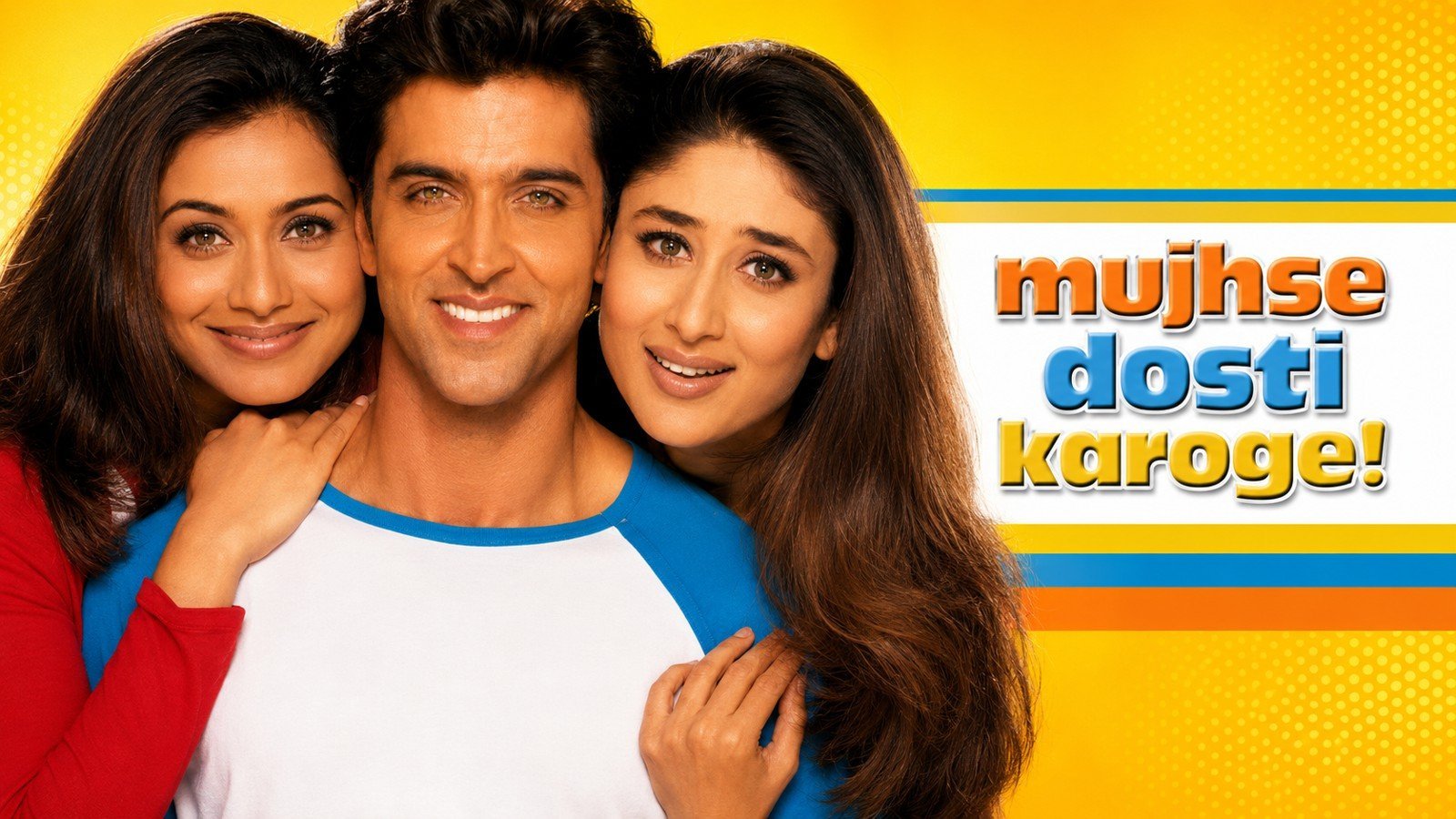
Mujhse Dosti Karoge (2002)
Cast: Hrithik Roshan, Rani Mukherjee, Kareena Kapoor
Director: Kunal Kohli
Music Director: Rahul Sharma
Synopsis: Brilliant cast, locations and lavish production values but no decent script
Reviewed by: Faiz Khan
Great cast, great music, great locations... shame about the film. That, in a nutshell, sums it all up.
I continue to be amazed at how little faith some filmmakers have in their audiences. We are informed at the outset that Raj (a ten-year-old who grows up to become Hrithik Roshan) and his family are leaving for London to cash in on the "dot.com" boom. We are then shown fifteen years passing with Raj and his childhood friend exchanging endless emails.
Give me a break.
Fifteen years before this film was made, most homes didn't even own a personal computer, let alone have internet access or email. Surely Mr Kunal Kohli could have devised a more believable excuse for their separation? But I suppose plain old-fashioned letter writing wasn't fashionable enough for the MTV generation. Everything has to be internet-based, regardless of whether it makes any sense.
So Raj leaves for London, leaving behind his two childhood friends, Tina and Pooja. Pooja is the plain Jane; Tina is the glamorous one with attitude. Even at the tender age of ten, Raj has eyes only for Miss Attitude and immediately starts corresponding with her. Tina, however, couldn't be less interested, so the quietly devoted Pooja begins replying to Raj's emails while pretending to be Tina.
Fifteen years pass. During that time, the friends neither meet nor even speak to each other except through emails. Yet Raj, despite living in London and presumably meeting countless women, remains hopelessly devoted to this unseen "Tina." Eventually his family returns to India for a short visit, throwing poor Pooja into a panic because she has been masquerading as Tina all these years. The real Tina (Kareena Kapoor) reluctantly agrees to continue the deception, pretending she is the one who wrote all those heartfelt messages.
The obvious question is whether Raj will recognise the soul behind the words.
He doesn't.
Instead, he heads straight for the glamorous Tina, barely noticing Pooja. Nursing a broken heart, Pooja quietly steps aside while Raj falls head over heels for the beautiful but rather shallow Tina. Something, however, doesn't quite feel right. Pooja understands him perfectly, remembers every little detail about him—including his weakness for gobi ke parathe—and becomes his closest confidante. Yet the penny stubbornly refuses to drop.
Eventually Tina discovers that she too has fallen in love with Raj, and their families happily agree to the marriage.
Raj returns to London, where Pooja unexpectedly visits him carrying homemade gobi ke parathe for her "friend." During a day spent wandering around London, they find themselves inside a church, where Raj suddenly has an epiphany worthy of divine intervention. He realises it was Pooja—not Tina—who had written all those letters, and instantly concludes that he has loved Pooja all along.
Make any sense to you?
I suppose the intended message is that you fall in love with a person's heart rather than their appearance. The trouble is that Raj has spent the entire film proving exactly the opposite, instantly falling for—and remaining infatuated with—the rather airheaded Tina.
The pair return to India intending to reveal everything, only to discover that Tina's father has died. Suddenly orphaned, she has nobody left, prompting Raj's parents to insist that the wedding must go ahead. Ever the sacrificial lamb, Pooja decides it is too late to confess the truth, and the inevitable love triangle trudges towards its predictable conclusion.
This is Kunal Kohli's directorial debut, and unfortunately he makes a complete hash of what was actually quite a promising premise. Writing the story, screenplay and directing the film himself, he squanders almost every opportunity the material offers. There are flashes of what might have been, but they are buried beneath clumsy storytelling and uninspired direction.
The film constantly reminds you of Kuch Kuch Hota Hai, except you've already seen all of this done before—and done infinitely better.
Having said that, it remains superior to the average Bollywood romance. Coming from the Yash Chopra stable, however, expectations are understandably much higher.
The greatest disappointment is the complete absence of genuine romance. Instead of allowing relationships to develop naturally through intimate scenes, Kohli simply inserts another song whenever emotions need expressing. Songs may entertain, but they are no substitute for real chemistry.
There are occasional glimpses of what the film could have been. Raj dancing with Pooja in her bedroom to the strains of Raj Kapoor's "Pyaar Hua Ikrar Hua" is charming and genuinely affectionate. But where a similarly intimate farewell later in the film could have been quietly heartbreaking, Kohli instead gives us Raj turning up with homemade gobi ke parathe.
It is enough to make you cringe.
What the film desperately needed were moments of genuine intimacy—something akin to Aamir Khan and Pooja Bhatt's unforgettable garage dance in Dil Hai Ke Manta Nahin, or Shah Rukh Khan and Kajol's beautifully understated reunion in Kuch Kuch Hota Hai. Those scenes created romance. Here, there is precious little.
Nor does Kohli create any real dramatic conflict. Raj's dilemma never carries emotional weight, and Pooja's silent suffering becomes repetitive rather than moving. Even the lengthy antakshari sequence feels like another excuse to insert a song where genuine drama should have taken centre stage.
Hrithik Roshan is badly let down by the writing. Scenes requiring sensitivity are pitched far too loudly, and Raj never develops into a believable character. One almost longs to see Hrithik play someone flawed for a change instead of yet another impossibly decent, impossibly perfect hero. He needs characters with shades of grey rather than endlessly playing Mr Goody Two-Shoes. His role here is not unlike Na Tum Jaano Na Hum, except that film possessed a warmth and sensitivity completely missing here. He dances magnificently—as always—but surely it's time directors started giving both him and the audience something more substantial.
Rani Mukerji fares little better, burdened with some astonishingly corny dialogue that sounds as though it has escaped from a 1960s melodrama. Every sentence carries a double meaning until the device becomes painfully tiresome. Pooja herself is another variation of the eternally self-sacrificing heroine—the Betty to Tina's Veronica, forever losing out with remarkable grace but showing precious little fight. It all becomes unbearably saintly. Even so, it is refreshing to see Rani playing a substantial leading role instead of being pushed into the background.
Kareena Kapoor seems simply to have wandered over from the sets of Kabhi Khushi Kabhie Gham, changing only her character's name from Pooja to Tina. What felt fresh and exuberant there feels forced and repetitive here. The role offers her little to work with, and one wonders whether the Yash Chopra banner alone persuaded her to accept it.
The film's greatest strength is undoubtedly Rahul Sharma's excellent soundtrack. Anand Bakshi's lyrics are consistently good, and Sharma delivers a melodic, breezy score that recalls the tunefulness of an earlier era. The music remains memorable long after much of the film has faded from memory.
On the whole, Mujhse Dosti Karoge! is a major disappointment—a film that continually promises more than it ever delivers. It is attractive to look at, pleasant while it lasts, but ultimately little more than empty fluff, watched once and forgotten almost immediately.
I'm sorry to say it, but this looks set to complete Hrithik Roshan's unwanted hat-trick of disappointments.
Oh dear.

0 Comments
Leave a Comment