
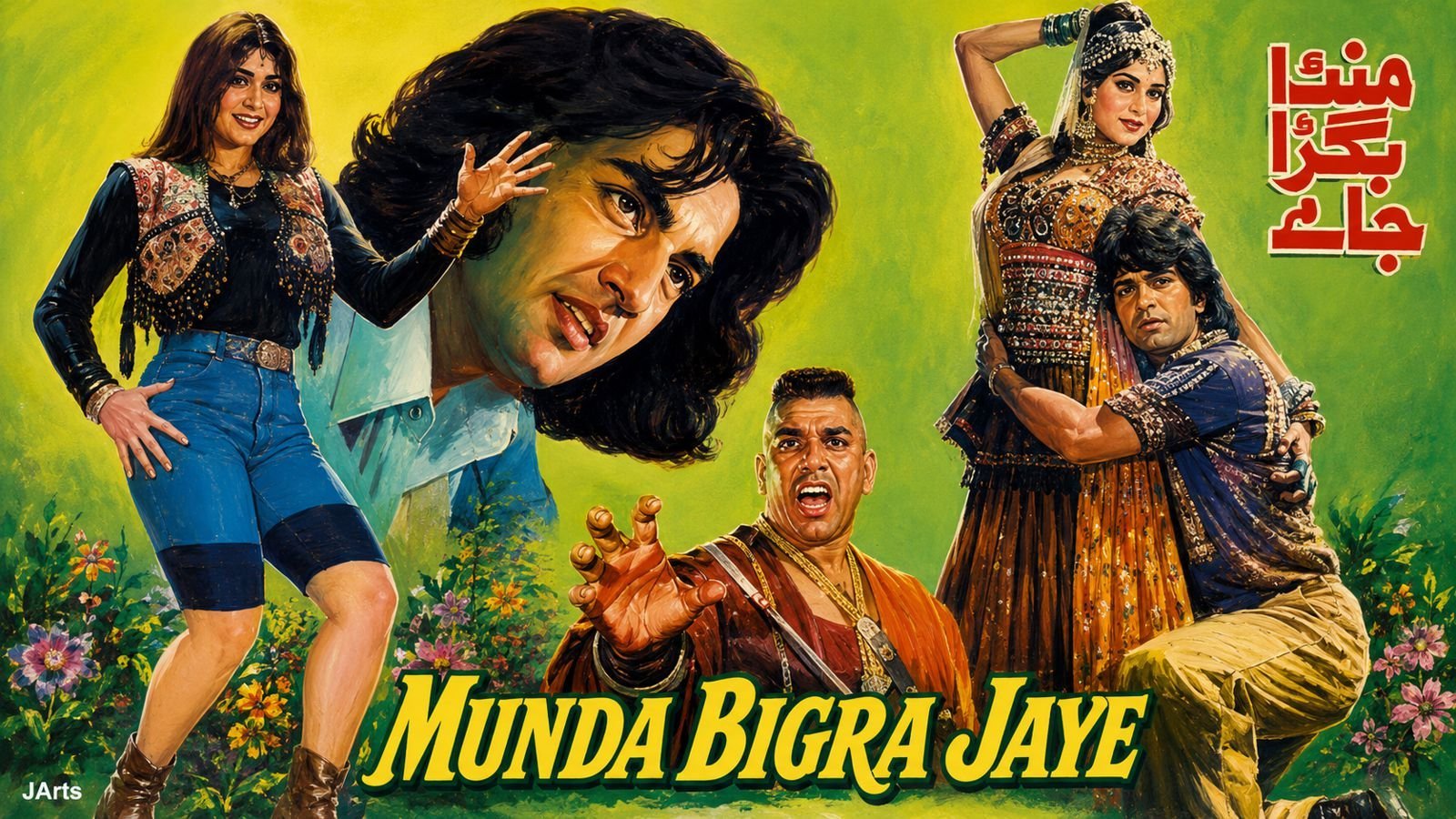
Munda Bigra Jaye (1995)
Cast: Babar Ali, Reema, Jan Rembo, Sahiba, Shafqat Cheema, Ismail Tara, Zeba Shehnaz
Director: Shamim Ara
Music: M. Ashraf
Synopsis: a "frothy and bubbly" slapstick farce featuring breakout TV star Jan Rembo transitioning to the big screen with massive success.
Reviewed by: Omar Khan
Shamim Ara's career went through many twists and turns, with low moments followed by some significant successes, and then tragically, ill health struck brutally, from which she never recovered. Munda Bigra Jaye was a commercial triumph for her as a director. She diligently put together a string of commercial hits, placing herself at the top of the ladder for Urdu movie directors in the 1990s. The era was a struggle for Pakistani cinema, specifically for Urdu movies.
Piracy had wooed away large swathes of the cinema-going public, and the newest Bollywood films were available on pirated VCDs and cable TV. At about this time, the satellite dish appeared in Pakistan, and more Indian content beamed directly to average homes, cutting into cinema's potential audience. Osama Bin Laden, The Iraq War, growing extremism, anti-West sentiment, and a growing number of Pakistanis caught up in a cultural maelstrom. 9/11 was around the corner, and a new sort of Jihadi culture seeped into and changed the fabric of Pakistani life.
Shady organisations with footprints pointing to training camps linked to the country resulted in increased isolation from the international community. The majority of Western Airlines abandoned the Pakistani route altogether.
The country lurched in the direction of ultra-conservatism, further exacerbated by the economic divide between the English-medium elite and the economically bereft. The marginalised, disillusioned masses aligned increasingly with the Saudi brand of Islam with which to identify.
Diplomats posted to Pakistan with their families and schools run by Westerners found that as attacks on churches and symbols of "the West", such as cinemas, increased, they started leaving their families behind. Soon, Pakistan became a diplomatic post for the single man without a family. Sports teams stopped touring, nascent Film festivals died, and a rise of militancy and extremism sounded the death knell of cinema. Indeed, the religious extremists torched cinemas across the land, and 30 years on, things have not recovered and perhaps never will.
So, Munda Bigra Jaye arrives amidst considerable shifts in the nation's social fabric and finds an audience desperate for some timely escapism, that this film manages to provide. It's a comedy caper aimed at the lowest common denominator and keeps the gags coming at a quickfire rate, and the pace manages to keep from flagging.
Production values are of the Pound shop variety, and the film's aesthetic is loud, bold and flashy in the Govinda and Karishma Kapoor style of the early 90s. Jan Rembo comes across as an impoverished reincarnation of the ghost of Munawar Zareef with hardly an ounce of the original's charisma, uniqueness, nerve, and talent. A pale and very low-brow reincarnation. It is easy to identify the scores of dialogues and scenes that would have had local audiences doubled up in uncontrollable laughter. However, accessing that level of humour isn't for everyone, just as Hollywood's Dumb and Dumber wasn't everyone's cup of tea.
Munda Bigra Jaye
Reema is trim, tall and smart as a good desi girl should be, bringing energy and vigour to her role as a con artist. Babar Ali's hairstyle should be in a museum and is a reminder of just how hideous the styles of the 90s were, and Shahrukh Khan has to bear some of the blame for that. When Babar Ali steps into those synchronised dances, though, it's pretty frightening. The chemistry between the stars pops and fizzes, which certainly helps things along, and Shafqat Cheema displays his undoubted screen presence.
It is not difficult to see why this film was a success. It was pure escapism and, in troubled times, perhaps came as medicine to some extent to soothe the frayed situation. The songs are not the kind you might enjoy listening to away from the movie but complement proceedings well on screen, and there is a nod to the "Choli Ke Peechay" song along the way that's bordering on theft. It's all escapist piffle done with verve and energy but on a wavelength that will not work for everyone. The level of humour is occasionally thoughtlessly offensive, though it may not be deliberately so. It's so crass and juvenile that taking offence gives the film more importance than it deserves. The film clicked with the masses and raked in the money.
According to Mushtaq Gazdar’s excellent book on Pakistani cinema, it raked on more cash than Aina and Maula Jatt, propelling it to the top of the Box office champions list. You can be pretty sure that the collections have not been adjusted for inflation, though. Aina and Maula Jatt would have been far more widely screened than Munda Bigra Jayega could have hoped, as the cinema screen count had been reduced drastically from the late 1970s until 1995. A ticket buyer in 1977 would have had to pay a fraction of what a ticket would cost by the 1990s. Despite that, the film drew crowds that had been dwindling and bought some respite for Urdu films for a short-lived period before slipping back into collapse mode, which it remains till the present time.
Babar Ali, Reema, Jan Rembo and Sahiba became staple cast members of every second or third production for five years.
Still, lightning never struck quite as ferociously as it did with Munda Bigra Jaye: a surreal experience, and little point in divulging the storyline or plot details. The film doesn't require engaging the brain beyond a surface level, which is probably crucial to the film's enormous appeal and success—the plot twists and turns, tapping into tried and tested formulas.
There is a back story that unfolds as the beloved Munda turns out to be not what he thought he was, and in the murky past, babies were shifted about and lost in the mix, yet it all comes together and they all lived happily ever after and so on.
Bollywood’s Mr India has a considerable influence on the music and the dance numbers, as well as Shafqat Cheema’s “Surya” character, who appears to be a distant poor cousin of the Mogambo character played by Amrish Puri. There is also a heavy dose of “national integration” with Rembo. The scriptwriters try their hardest to get a tax rebate from the government for the sterling effort they make to suggest all Pakistanis belong to one nation, even if they somehow forgot to mention the Urdu Speaking community of Karachi who were not indigenous Sindhis at all but settlers who emigrated from India. Maybe they don’t count as part of the “Pakistani Nation”.
A lot of heavy-handed patriotism is injected into proceedings, which must have been very popular with officialdom.
Munda Bigra Jaye reminds me of a bright fluorescent orange Jalebi in the deep fryer, glowing like neon. You take a crunchy bite or two, which overwhelms you with a sugar rush, but a short while later, that rush turns nasty. The best thing is to switch the brain off or then batter the brain cells with some substance abuse. The film should have a warning: "This Film Kills Brain Cells and is injurious to health", much like a jalebi or some hideous Gutka! Yet it remains fascinating due to the shifting, turbulent times in which it emerged.


0 Comments
Leave a Comment