
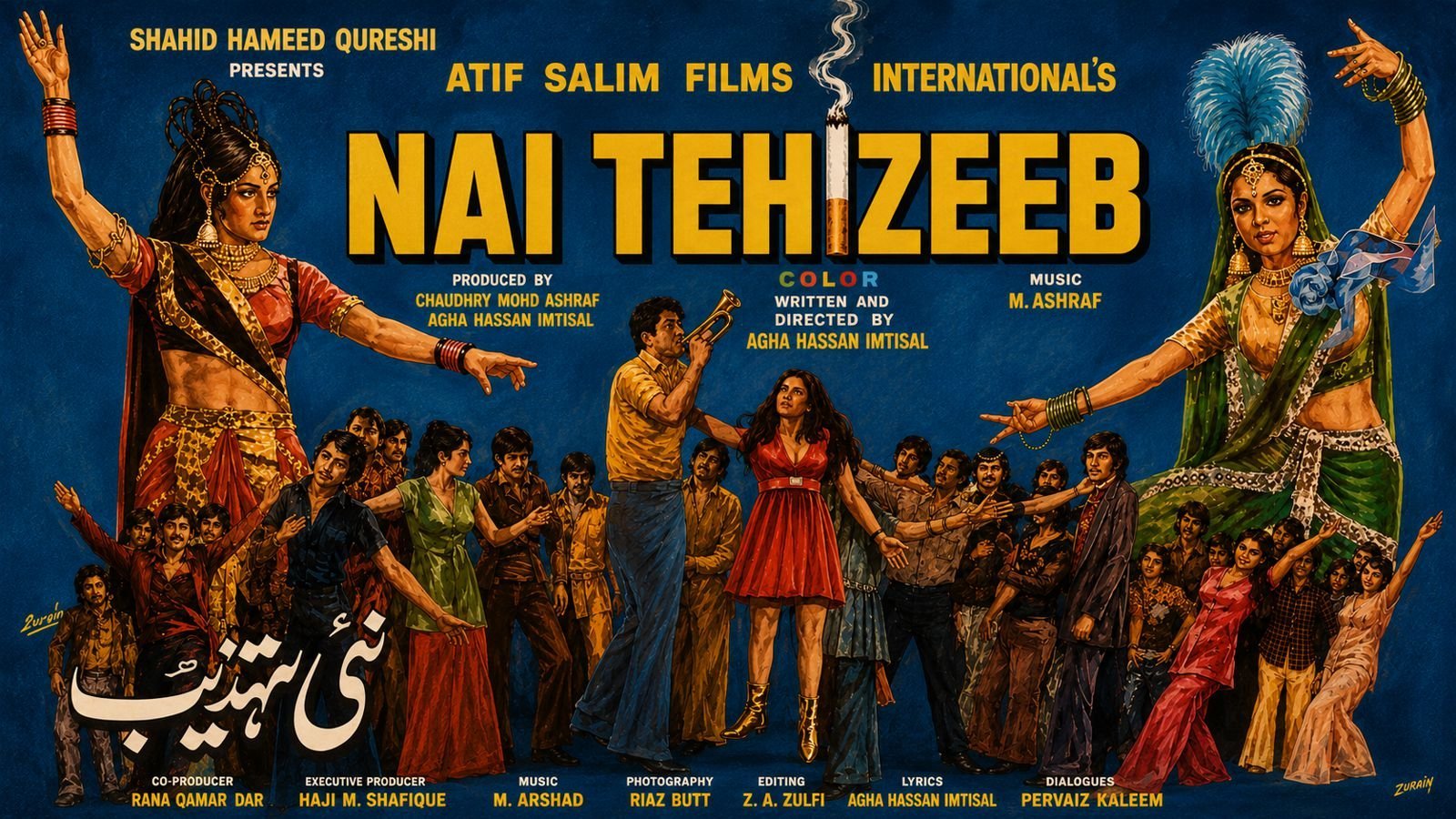
Nai Tehzeeb (1979)
Cast: Rani, Shahid, Babra Sharif, Usman Pirzada, Nanha, Bahar, Afzaal Ahmad, Nayyar Sultana, Asifa, Seema, Changezi, Imdad Hussain, Saqi, Albela, Meena Shori, Sheikh Iqbal, Saba, Roshan, Fozia Durrani, Ibrahim Nafees
Director: Agha Hassan Imtesal
Music: M. Ashraf
Reviewed by: Omar Khan
Nai Tehzeeb opens with a scene that would have audiences in 2022 rushing to their keyboards and phones in horror and disgust. In Sister Honey mode, Bahar Begum is glamming herself up for a night out with BFF Seema. Another layer of lipstick? She muses, pouting sexily in front of her mirror. What’s this, no lipstick? Bahar now bristles in rage as she yells for children, Nyla and Saima, to own up to messing up her make-up. Nyla is the first to arrive, slapped mercilessly and shaken furiously for ruining the make-up again. The home has little resistance against the tyrannical Bahar now that her husband has been laid low with a crippling injury sustained during his service. Seema arrives to take her friend out for a double date, where the girls let the boys have a taste if the price is right. This way, they earn extra pocket money to look good and feel great about themselves.
In a dreadful misfortune, Nyla and Saima’s parents are killed in a head-on motor car collision, leaving the kids at the mercy of the evil Bahar, aided and abetted by the witchy Seema.
It’s barely half an hour into the movie, and it’s already proudly wearing its year on its sleeve – 1979. The Cold War was still in full swing; the Afghan-Soviet conflict was flaring up, and an uprising in Iran that nobody had anticipated. In Pakistan, General Zia ul Haq consolidated his grip, and the tone of the New Pakistan was echoed resoundingly in the script and style of the film Nai Tehzeeb.
Right from the title sequence, the Zia influence is loud and clear. There is a credit for “Islamic Suggestions,” which is fascinating, and never has this particular credit been seen before or since this specific film. In the opening scene, we understand that women who like makeup and pull men are a scourge and an evil of society that needs cleansing.
The film advocates that Afzal Ahmed, Bahar’s husband, has the moral right to murder his wife for dishonouring him and being a nasty cow.
The wounded soldier does indeed try to thwart Bahar’s evil designs, but her partner in crime, Seema, saves the day, and together, they manage to ward off Afzal and scare him away for the time being. Seema and Bahar plan to use the girls to make millions, and thus Nyla and Saima are hastily enrolled into Seema’s Kotha, where she runs a thriving Escort Service, and her home doubles as a finishing school for Fine Ladies.
Bahar, who has joined Seema as head of the Escort Service, keeps her nieces in a dungeon and allows them out for training and clients alone, yet she doesn’t realize that the girls are turning on their clients, beating the daylights out of them. When Bahar finally catches on, she decides to have them “auctioned” on the market for the highest bidders. It’s time to cash in before the girls grow old, and Rani appears quite stately as a teenager in 1979.
Nai Tehzeeb
The ‘girls’, played by Rani and Babra, flee the clutches of the Escort Service and land up with Afzal and plot the demise of Bahar and Seema, who have some wealthy and influential friends to lean on.
Shahid and his sister appear on the scene, and as they return home one night, they find their saintly elder sister in a rage. Nayyar Sultana, dressed in black with every inch of her body covered, rails at her errant, wanton, and immoral siblings and tells Shahid to look at the fire where his porn stash was smouldering to ashes. Nayyar Sultana mournfully scoffs at her sister’s fashion sense and recoils in horror at the nearly sleeveless arms on display, informing them of the impending doom. She decides to have Shahid married off instantly.
Saima (Rani) is the bride-to-be, and Raju (Afzal), is thrilled he has received a proposal from such a well-respected family. Bahar has a counter plan, and she spins a web of deceit to bring her exhusband Raju down once and for all.
Bahar has poor Raju implicated and raided by the police for running a den of vice, just when his daughter is about to tie the knot in a well-attended and sober ceremony. Nayyar, who has come for her bride, is horrified as the police drag away Raju, accusing him of being a pimp, and they also decide to arrest both the sisters, Saima and Nyla, as accomplices.
The sisters manage to flee and escape into the night, where they bump into a doddering, bearded and highly respectable-looking yetilike man spouting all sorts about how the dark streets are unsafe for vulnerable girls. He suggests they get into his car so he can take them to a safe house known for its kindness and open doors to impoverished young women.
At this point, the audience is willing the elderly man to be Hanif in disguise to dupe the girls, gulped as in Snakes & Ladders when they inches from safety. The girls come crashing down back to square one, having been bitten in the ass by the Queen Snake Bahar. And so it transpires.
Hanif performs his duties doing the dirty, bringing the girls back to Seema Aunty’s Finishing School cum Kotha for Uptown Girls.
It doesn’t take them more than two minutes to escape again. Babra is snagged by Bahar yet again while Rani gets away, and fate brings her to the home of a crusading Nayyar Sultana, who senses that she has found a valuable ally in Rani.
Meanwhile, Shahid and his sister Shazia, rebel against Nayyar, claiming their humiliation resulted from her “sharafat” and oldfashioned values. They vow to turn the house into a shrine to celebrate the Nai Tehzeeb by throwing a massive dance party and inviting all their friends, including girlfriends, in his address book. The guy in every dance scene of the ‘70s is present, lighting up the dance floor with abandon as though he was grooving with the hip set at Stringfellows.
Halfway through the movie, the threads are sufficiently entangled for the rest of the film to start some song and dance scenarios and eventually payback for the dreadful Bahar and Seema. The moral of the tale bears the stamp of Zia Ul Haq’s draconian era of incredible double standards.
The film winds its way to its conclusion with many familiar plot twists and turns in typical masala style. Coincidence and fate shape the script. M. Idrees's Islamic Suggestions serving as the moral compass and guiding light, along with a double honour killing being the light at the end of the tunnel.
The Nai Tehzeeb, AKA Western “culture,” brings cancer to our doorstep. When Farrah Fawcett, Gary Glitter and Suzi Quatro posters adorn your living room, the end is near. Nayyar Sultana cannot stop worrying about the evil Nai Tehzeeb, but others seem oblivious to its dangers.
Nai Tehzeeb Will Shazia and Shahid come around and see sense, and will Shazia stop referring to her boyfriend as Lollypop, or will she be punished for her errant ways? Will Rani be able to redeem Shahid before it’s too late? Will Babra escape the clutches of Bahar and Seema’s Escort Agency and finally find some love, and will Afzal proceed to carry out an honour killing with the Zia ul Haq Censor Board nodding their approval? The film falls under the “social” category, which means it is a film that attempts to correct the evils of society or at least draw attention to them. As a film, it’s messy, convoluted, and uneven, but manages to hold attention primarily due to the thick and juicy layers of preachy morality as the main ingredient. Sadly, the film failed to catch on and departed cinemas within a few weeks and has faded away from memory, trying hard to remain relevant by attempting to be somehow connected to Rani and Shahid’s classic Tehzeeb from earlier in the ‘70s. The film’s strongest aspects are the classy performance turned in by Bahar and a solid one by Seema as her accomplice. Afzal does well as the wounded veteran, and Nayyar adds fire and drama. Rani, Babra and Shahid are adequate in their roles. Nai Tehzeeb is another excellent example of how popular Pakistani cinema always fascinates, encapsulating a society’s attitudes of a specific time in history.


0 Comments
Leave a Comment