
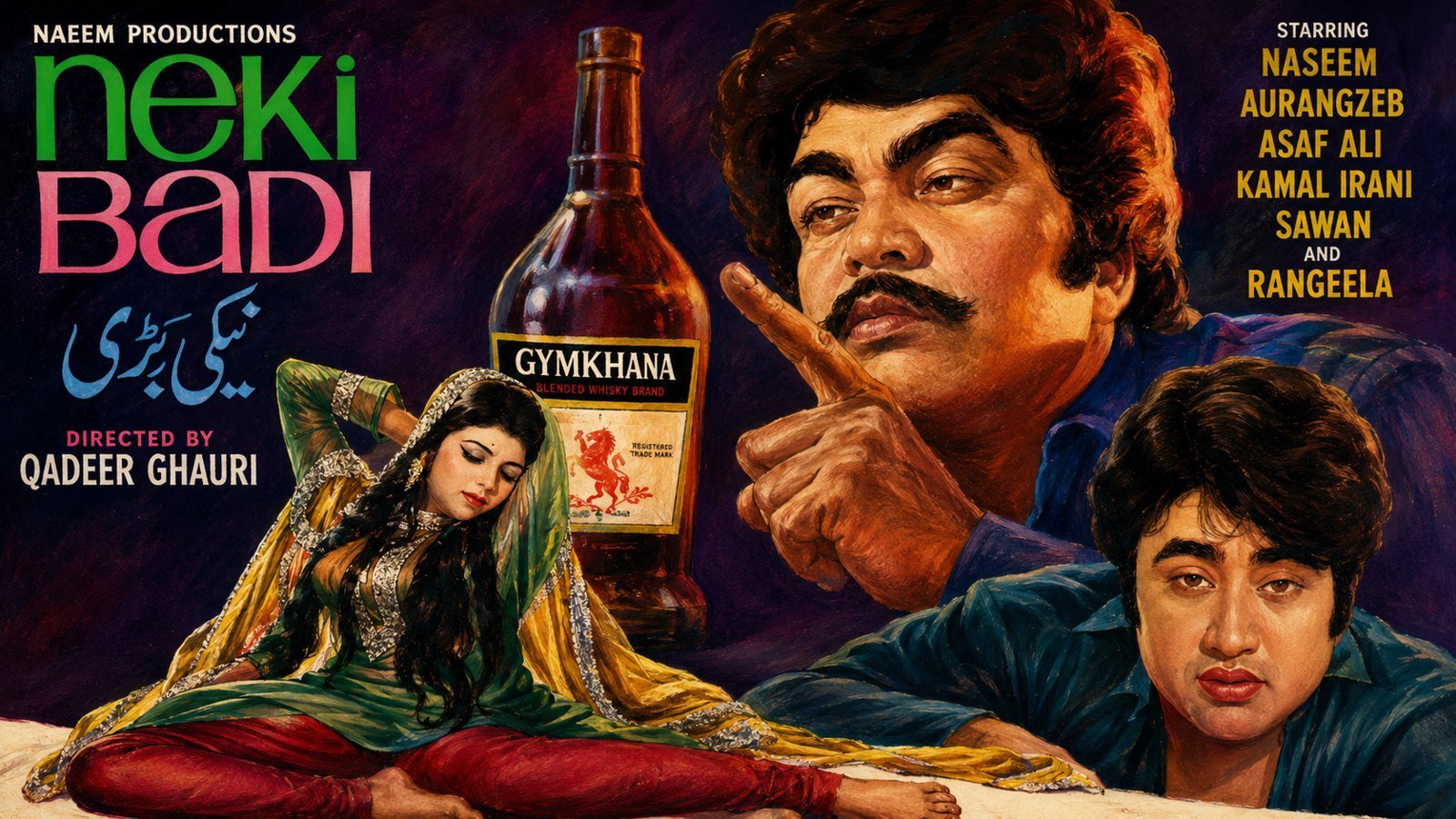
Neki Badi (1975)
Cast: Nisho, Shahid, Sabiha, Talish, Adeeb, Khalid Saleem Mota
Director: Qadeer Ghauri
Synopsis: Psychotic, serial criminal blazes a terror trail while his family suffers the consequences in this classic battle between good and evil.
Reviewed by: Omar Khan
Lollywood’s seasoned villain Adeeb plays Jabroo, a notoriously coldhearted, remorseless criminal who is short, nasty and brutish; rather like life itself, he spends his life thieving, killing, raping, looting and forging to get his kicks. Within minutes of the movie’s opening shots, Jabroo has broken into a peaceful home, looted himself a bunch of jewels, and stabs the watchman to death in his escape.
All in a day’s work for Jabroo, a married man with two young kids for whom he has only contempt. For Jabroo, family is a parasitic burden he is expected to tolerate like a nasty rash. He would happily sell off his wife and kids to fuel a game of cards at the gambling den, followed by some VAT 69 and a shimmy or two with the local tart at the whorehouse. As you can see, he is an evil shit, totally off the rails and on a collision course with the law, for which he also has utter contempt.
The police finally come knocking on Jabroo’s door in the middle of the night, searching for the lost goods (least bothered, it seems, about the murdered watchman). They find nothing, but just as they drag Jabroo to the police station, his young son hands over the stolen necklace, not realizing that rather than save his father, he has just incriminated him. A seething Jabroo is trooped off to jail, but is there a jail in the land that can hold such evil at bay? Most unlikely.
As it happens, Jabroo completes his robbery sentence (the poor murdered watchman wasn’t worth a sentence), allowing the rest of the family some respite from his torrent of evil, if only for a while.
Mrs. Jabroo is the perfect Pakistani wife: subservient, obedient, docile, beautiful, earnest, long-suffering, and of course, the picture of motherhood. She has to struggle against the odds to make ends meet, and a loan that her family has taken out has to be repaid and is an endless burden on her. Still, she strives on, and she raises Jabroo’s children single-handedly. They are fortunately not a bit like their ghastly father, and thus the title “Neki Badi,” which translates to “Good & Evil,” is perfectly apt for a film as basic as this.
The dutiful wife gets embroiled in the nasty clutches of a loan shark as she has to pay for her husband’s court case, among other things. The debts start to mount as she struggles to bring her kids up, and Talish, the loan shark, tightens the noose around her neck, knowing that her creep of a husband is locked up for the moment.
Meanwhile, the young son grows up to become the handsome and winsome Shahid, an upright young man who stands up for justice and the oppressed whenever the occasion calls for it. As he begins to earn a living and tries to support his mother and sister, he sends back a cash remittance, not knowing that his dastardly father has already had the remittances intercepted and thus, the debt mounts further. As is the norm in Lollywood movies, fate brings two potential enemies together as Shahid falls for the village belle Nisho, who also happens to be Talish’s daughter. Despite the obstacles between their families, the loan situation and the sleazy loan sharks treatment of Mrs Jabroo, they fall in love.
Before you know it, Jabroo is released from jail, ready to make up for lost time, and it takes him just a few minutes to pick up on his old habits. He steals from his wife to go live it up with the local tart Ishrat Chaudhary, gambles, fornicates, steals, robs, and murders; old habits die hard, and the prison reform system has made him even more
Neki Badi blood-thirsty and deranged than previously. Jabroo sabotages his daughter’s marriage as he stoops to all lows to get his hands on some loot.
Eventually, he ends up on a collision course with his very own son, but when that happens, Sabiha Khanum (Lollywood stalward and legend) does her awesome wife thing and sides with her criminal husband because that is what a good wife must do. And so the conclusion arrives amidst this entanglement of good and evil, greed and generosity and indeed “Neki Badi.” It’s all rather simplistic and crude, like a poorly written fairy tale for the kids in detention class.
The film is also noticeable for having (even for 1975) a very dated theme and production values for a mainstream Urdu movie release. Urdu movies had discarded mainly Black & White films by the end of the late 1960’s. There was no audience for a movie as rough and crudely executed as this one. Though Punjabi movies retained a rough and ready earthiness and were still accepted by audiences in black and white, increasingly, colour was the thing.
Neki Badi is a film of the aesthetic and execution of a “Punjabi” era movie. It is crude and rough, has little polish, and contains overthe-top violence and insanity typically associated with the genre. In those days, it was considered a “status” thing to produce an Urdu movie instead of a Punjabi film, which could be one reason why a film like “Neki Badi” was ever created. It stood no chance at the Box Office and has faded to a total obscurity over time.
Performance-wise, Adeeb hogs the show as Jabroo while the rest merely go through the motions as a script as bland as this would probably require. Neki Badi is far from being the most excruciating film we have watched. That honour is reserved for Pashto movies, yet it is memorable only for its utter ordinariness and little else. It is a movie that has been forgotten by time, perhaps deservedly so, yet it does have Talish, who is always value for money. There is a glimpse of the saucy Ishrat Chaudhary from early in her career, and she is always a welcome sight. There is also a reasonably tuneful song in the voice of Mehdi Hassan, who had the knack of turning even the mundane into something ethereal.


0 Comments
Leave a Comment