
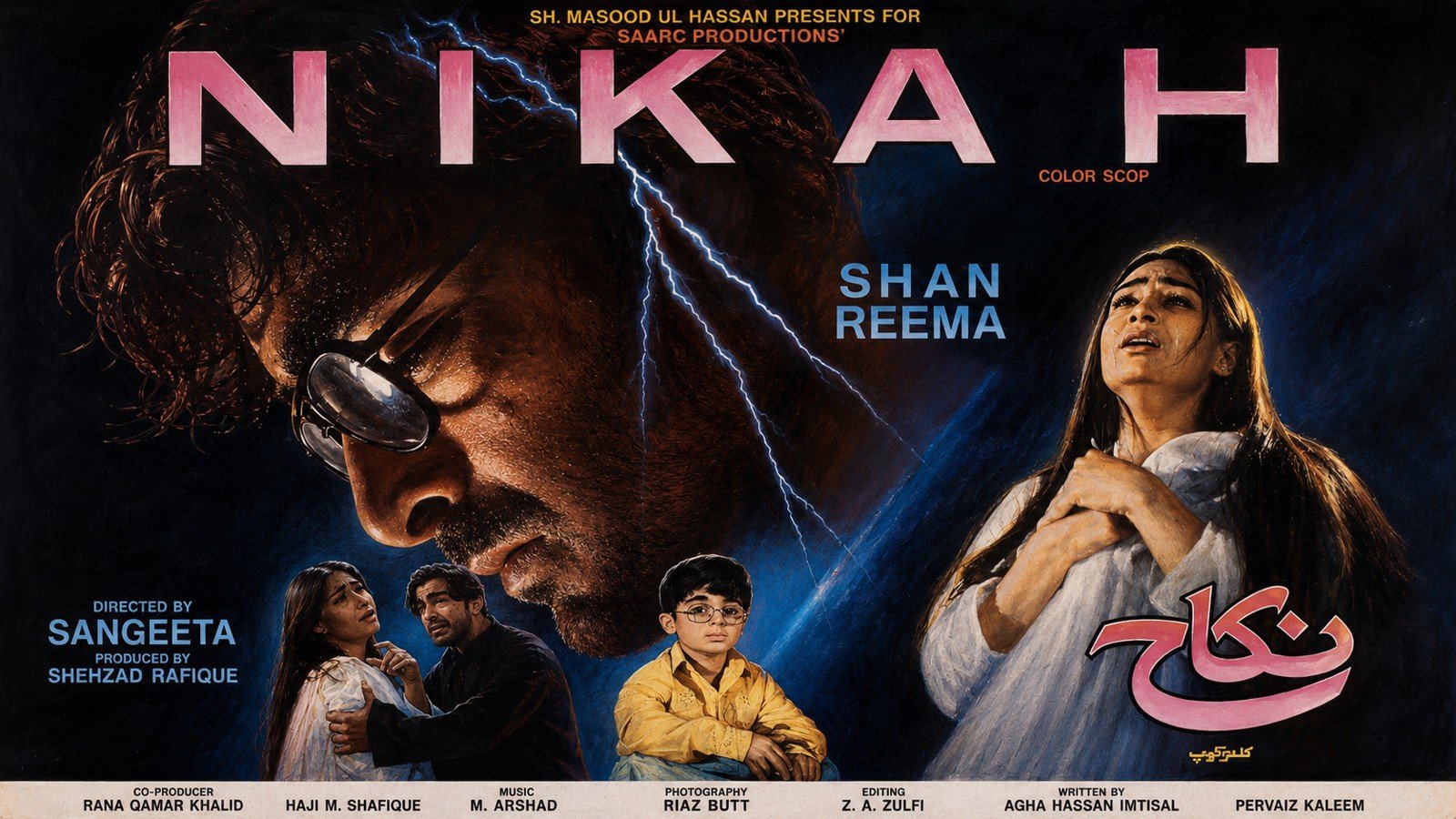
Nikah (1998)
Cast: Reema, Shaan, Nirma, Laila, Mishi Khan, Irfan Khoosat
Director: Sangeeta
Synopsis: Sangeeta uses a stale formula but comes up with a winning tear-jerker!
Reviewed by: Omar Khan
Nikah was a significant success in the summer of ’98, scoring a hit for Sangeeta, who had hit the jackpot with Khilona a few years before. The film’s success cemented Reema’s position at the top of the ladder (though Saima’s Chooriyan was going to change that in the months to come), and helped Shaan rehabilitate after a dreadful run in the mid- ‘90s when he dropped out of the scene altogether.
Nikah was a significant step in the right direction for Shaan and catapulted Madame Sangeeta to the highest bracket for directors. Nikah‘s story is a well-worn, tried, and tested Lollywood formula, where the modestly earning but fiercely proud and upright man (in this case, Shaan), marries a girl who feels stifled by his poverty, leading to a tragic breakdown. In Nikah, we have the honest, decent, if not very wealthy, government servant (magistrate) taking a fancy to Reema at a friend’s wedding. The two fall madly in love in a couple of songs, and soon it’s time for marriage plans. When Shaan tries to approach Reema’s family for their daughter’s hand, he is stunned to find that his future motherin-law rejects him outright, citing his modest income and religious conservatism, which she views as backwardness as reason enough. A feisty
Reema stands by her man and marries him despite her mother tolling the bells of doom.
At first, things appear blissful, but soon, cracks appear as Reema starts to feel like she is missing out on some of the finer things in life, and that her freedom is being compromised in her home with a mullah mother-in-law. One evening, Reema gets it in the neck for playing on the rooftop with her son in the monsoon rain— because, according to her mother-in-law, she was displaying herself for the entire community to gawk at. Then, Reema has her mind poisoned by her Bua against her mother-in-law, and slowly but surely, the marriage comes under extreme strain. When all appears lost, a glimmer of hope appears in the young son who might miraculously manage to bring the parents together again—but at what price?
Madame Sangeeta has pulled off an effective tear-jerker with Nikah, which not only did roaring business but earned her some terrific press and established her as an “A” league director for what it’s worth. Reema turns in a winning performance, and generally, the acting is relatively strong; however, Shaan is so earnest, stylized, and deliberate that he is less natural for it. His acting is mannered, and though he certainly makes an effort, and a laudable one at that, the problem is that his effort shows through in his acting. The evil, scheming woman who plays the role of Reema’s mother plays her role superbly, while the tarty Laila is thankfully marginalized to a bit role and one song. Nirma, too, makes an appearance in a brief part and in no way suggests that she is leading lady material for the future. There are a few trademark cheap, vulgar dialogues along the way, the usual double entendre and suggestive use of words, but nothing serious in the vulgarity stakes. Even the songs are tolerable, and one mega-hit pop song (GT Road te braikan) was shot with laughable results in Madame Sangeeta’s patented MTV style.
Nikah However, this is one of those rare movies for which families braved the ghastly local cinemas, and even the middle classes were lured away from their VCRs and air-conditioned comfort. Nikah is far from a classic and a carbon copy of many similar films before it (Sheeshay ka Ghar and Aina, to mention a couple). Yet, it qualifies as a feather in Madame Sangeeta’s amazingly well-endowed hat.



0 Comments
Leave a Comment