
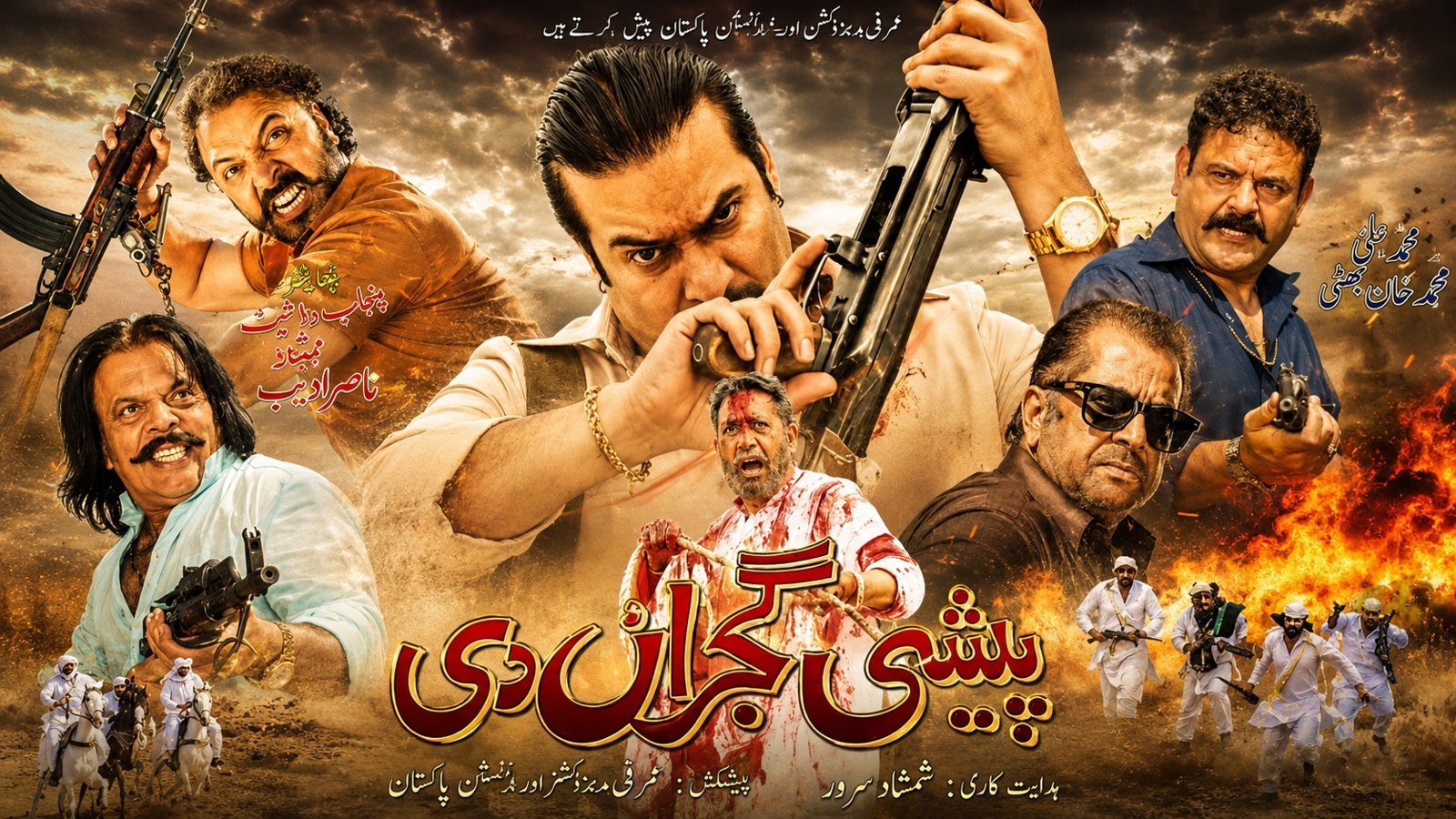
Peshi Gujjaran Di (2018)
Cast: Shafqat Cheema, Moammar Rana, Shahid, Mahi Khan, Honey Shehzadi, Soha Ali, Jiya Butt, Haider Sultan
Director: Masood Butt
Nutshell: Vendetta, clan wars, comic book violence, busty babes, twisted moral posturing…same old Punjabi formula.
Reviewed by Omar Khan
Punjabi movies over the last decade or so have stagnated to the point that alarm bells have been ringing, with former superstars such as Shaan pleading with the government for support. There has been considerable resentment that the centre of gravity of filmmaking in Pakistan has shifted to Karachi, leaving Lahore neglected. Recently, the Chief Minister of Punjab announced a large fund for filmmakers in the hope of encouraging Lahore to return to its former glory.
Shaan has starred in a couple of productions which haven't exactly set the world on fire, either commercially or artistically. A large sum from the fund has also been allocated to Madam Sangeeta for her new ventures, including a film titled Makho, starring Moammar Rana, Saima, and other actors from the 1990s.
Sangeeta herself is closing in on 80, bless her, and it seems quite incredible that money from this fund has not gone to newer filmmakers rather than those who have been part of the stagnation they are now trying to recover from. Makho might turn out to be a great movie. Still, all the rushes shown on social media, and practically everything about the venture, reeks of cinema that is utterly stale: rotten, congealed wine presented in a new bottle by the same dinosaurs who have been part of the decline they are supposedly trying to reverse.
I have been an ardent admirer of Sangeeta since her acting days, and I have enjoyed some of the films she directed. Still, by the time 2000 rolled around, she had acquired a reputation for churning out mindless dross in record time and under budget, with each film practically indistinguishable from the previous one. It is not entirely her fault, as she is a director employed by producers to follow a track that has already been beaten to death, over and over again.
Punjabi films of the 1990s, aside from a few exceptions—Choorian and Nikki Jaee Haan come to mind—generally followed a formula that had already been done to death since the era of Sultan Rahi.
Meanwhile, the Internet, social media and access to Indian films on Netflix and YouTube have had a huge impact on the kinds of films people want to see. Yet in Lahore they have continued churning out the same Chaudhary-versus-Gujjar garbage ad nauseam. Nobody is interested in watching these movies anymore. They have turned into self-parody and are totally redundant.
Peshi Gujjaran Di arrived in the middle of 2018, well before Covid struck, so its chances were certainly not destroyed by that devastation. Within minutes of the film's start, it becomes evident that this is yet another film in which clan wars are at the forefront.
The Gujjars are represented by Shafqat Cheema and his three middle-aged sons, while their adversaries are the current kingpins of crime. This mob apparently runs things from Karachi to Kabul. As it happens, Cheema's university-going son is in love with Haji Mastan's daughter, the head honcho of the criminal syndicate.
Not only does Mastan control practically all of Pakistan, but he also has law enforcement and some of the country's most powerful ministers in his pocket. Cheema promises to approach Mastan to arrange his son's marriage to Mastan's daughter, but is double-crossed. Both young lovers are brutally murdered, igniting a massive war between the two parties.
The law is seriously compromised and bends to Mastan's gang's every whim. The main police officer advises Cheema to approach a supremely powerful minister who controls all the strings of power. Both parties approach the minister, played by veteran star Shahid, fully slathered in Kala Kola in a failed attempt to hide his age. Still, he looks decent enough and initially sides with his slimy criminal friends.
Later, his conscience is shaken when one of the judges delivers a powerful lecture on the sorry state of affairs in the nation. Then comes a moment of heavy symbolism that changes the course of events. A portrait of the Quaid-e-Azam begins to topple from its perch. It is saved from crashing to the ground by the judge, who continues his soliloquy to the picture with such passion that it has a profound effect on Shahid, whose dormant morals are shaken to the core.
All of a sudden, he is transformed from a renowned corrupt minister into an upstanding member of the nation, standing up for justice rather than against it.
Meanwhile, there are numerous street battles between the warring factions, and in one of them Cheema and his family are gunned down and pronounced dead. Mastan is victorious and celebrates, only to discover, much to his dismay, that the dead have apparently returned from their graves. Another battle erupts, and most of the gangsters' men are decimated.
Even the girlfriends join the fighting, having completed their earlier duties of bosom-heaving and gyrating through assorted dance numbers. More bloodbaths follow, along with increasingly ludicrous scenes of violence.
Shahid's family are attacked and gunned down by Mastan's lot. The climax eventually arrives after a few more sultry, sexy numbers are thrown in for the girls to display their talents in clothes meticulously designed to highlight every curve.
There is one particularly brilliant scene straight out of a Russ Meyer movie when Moammar Rana's girlfriend rushes out to meet him. The cameraman's focus is solely on an enormous bust bouncing along in slow motion as she runs into her sweetheart's arms. The relentless ogling of the woman's bosom is embarrassing to watch, yet entirely typical of the sexism that has long been a hallmark of Punjabi cinema in Pakistan.
These films are made for an almost completely male audience, and the slo-mo bouncing breasts are there to titillate and excite while still technically adhering to the rules of skin coverage.
So the film settles into a pattern of street battles with loads of fake blood, fake bullets and dead bodies that can quite clearly be seen breathing heavily...
It's par for the course.
Artistic standards are pitifully low, and women are featured largely to be ogled at as sex objects for the ticket-buying punters. The ladies in this film appear to have been imported from Punjab's bawdy theatre scene, and they are well-versed in exciting their target audience. They look like Bratz dolls, with everything exaggerated: blue, grey or green contact lenses and enough foundation to make them whiter than white.
The film is ludicrous and reflects a culture and society that appears twisted and contradictory beyond belief. There is plenty of posturing and moralising about good faith and the virtue of following the Holy Prophet, yet what is actually depicted on screen is beyond farce.
It is fascinating how the nation's institutions are depicted. In this regard, there hasn't been much change over decades. The Police are depicted as corrupt to the point of being complicit with crime. The judiciary, for once, is depicted by an individual who is the film's de facto hero. He is morally upstanding, and his concern and devotion to the law and his country are admirable. Politicians are depicted as obscenely wealthy and all-powerful, with morals that are compliant to any situation. In this film, Shahid's morals are awakened by the judge's lectures. One institution is always championed in Pakistani film, TV, school textbooks and pop culture, but in this film there is little scope for any mention of that particular entity.
In any case, had there been any form of criticism, however minute, the film would never have seen the light of day. Treading carefully and keeping your views to yourself on certain things is essential for survival here in Pakistan. The Faith and the forces are untouchable, and daring to question them in any way often results in deadly consequences. The blasphemy law, a cloaked version of a modern-day lynch mob, is there to crush any semblance of dissent. As in the Dark Ages, it is misused by the powerful as a tool to seize the land, property, and wealth of those who are powerless to defend themselves.
The film becomes a depressing indictment of our filmmaking, our audiences, the way we represent ourselves and the morals on display: the embarrassing sexism, the vulgarity, the loudness, the orgy of violence, the intolerance, the hatred.
A film like this, and so many others just like it, presents Pakistan and the Pakistani experience in the most dreadful light.
Among the actors, Shafqat Cheema has genuine screen presence and is the only one who appears to have even a rudimentary grasp of acting. Shahid is simply going through the motions, while Moammar Rana is on autopilot, doing whatever he must to cash his paycheque.
If Peshi Gujjaran Di represents the direction and future of Punjabi cinema, then there isn't even a glimmer of hope. On the other hand, if films like this can still draw audiences and elicit cheers, perhaps it is time for some serious introspection about who we are.
In one particularly amusing/disturbing scene, a minion of Mustan is gunned down for daring to be two minutes late in delivering a message to his master. "Your crime was that you took 9 minutes rather than the normal 7 that it takes", and for that he is sprayed with bullets.
Peshi Gujjaran Di represents Punjabi cinema beyond its death throes. Surely things cannot get any worse than this.
I had to keep the door locked so that nobody would walk in and discover that I had actually taken two and a half hours out of my life to watch something as hideous as this.
Punjabi films are a sad reflection of what we have become. It is a frightening and depressing reflection, but sadly also very revealing.

0 Comments
Leave a Comment