
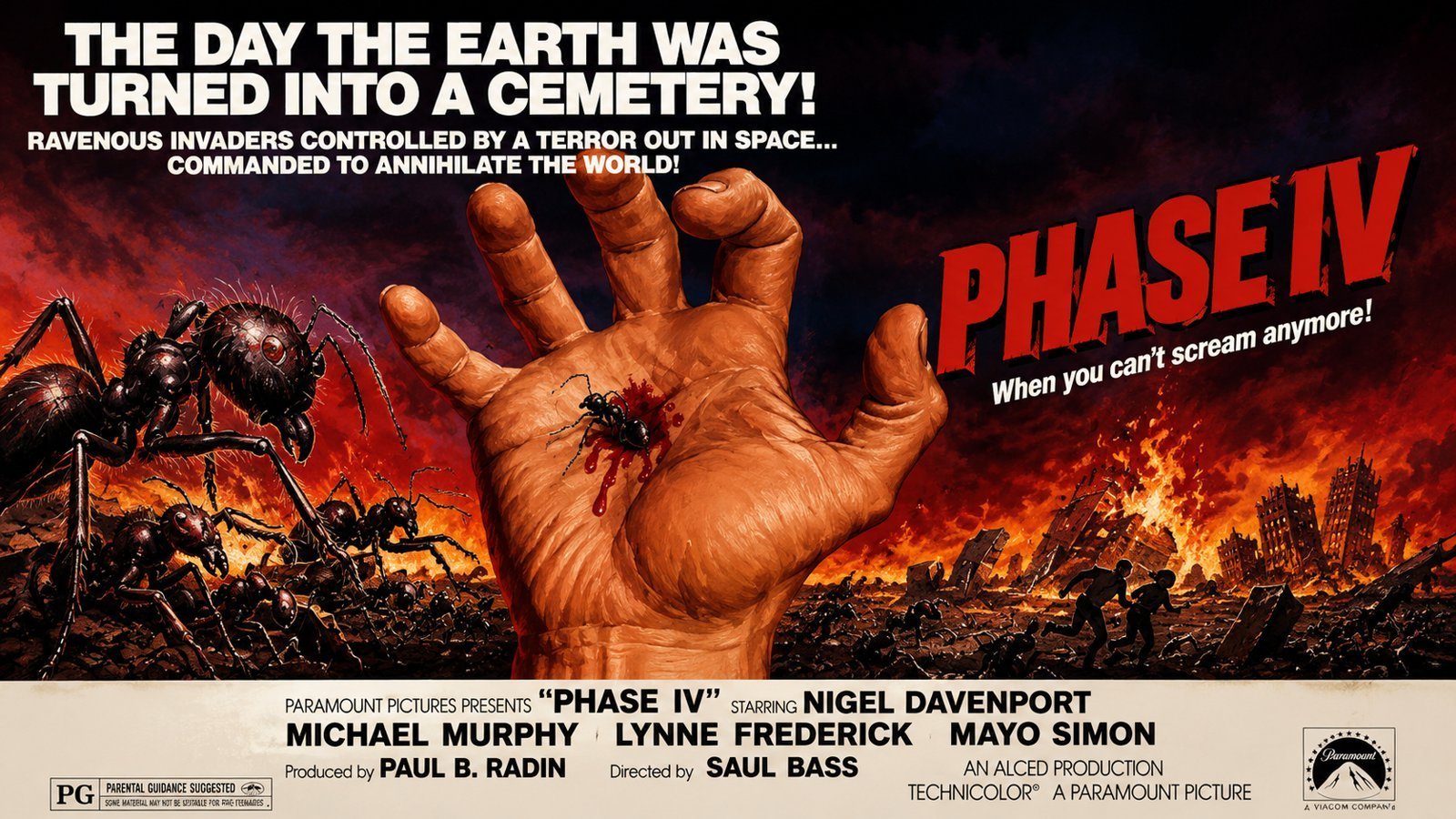
Phase IV (1974)
Cast: Michael Murphy, Nigel Davenport, Lynn Frederick
Director: Saul Bass
Nutshell: A duo of scientists try to unravel mysterious happenings in the Nevada Desert
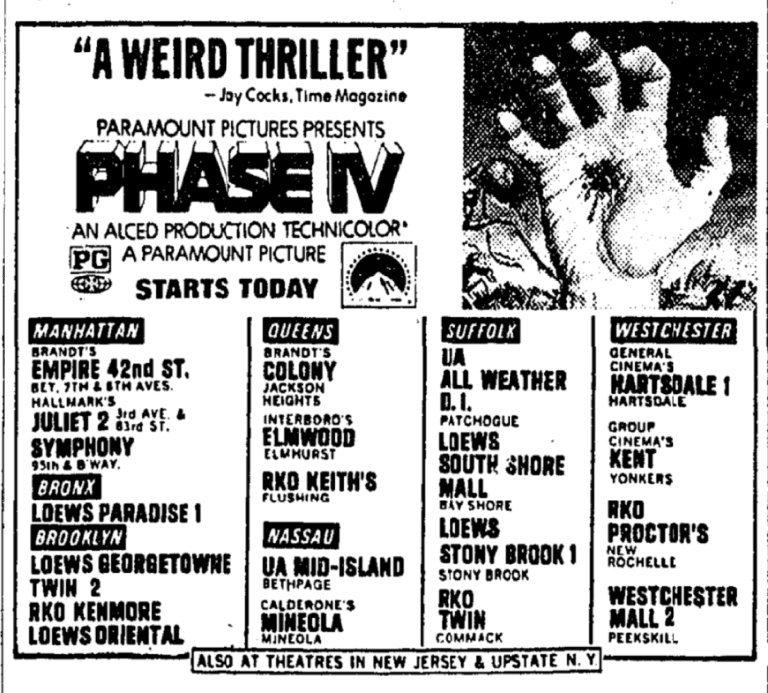 A film directed by the legendary poster and title-sequence designer Saul Bass was always going to be a fascinating prospect. Given his extraordinary visual flair, displayed so memorably through his collaborations with Hitchcock and others, the thought of Bass directing a feature film was genuinely exciting. Here he was given the opportunity to helm a project that probably never looked like a commercial proposition to begin with—an unusual science-fiction tale involving ants behaving in increasingly strange ways in the middle of the desert.
The film opens promisingly enough with some striking macro photography of ants scurrying across the landscape while a sombre narration informs us that their behaviour is unprecedented, unnatural and potentially catastrophic. It is an arresting beginning and immediately suggests that something extraordinary may be unfolding.
A pair of scientists establish themselves in the desert with an array of impressive-looking computer equipment in an attempt to monitor the phenomenon and assess the potential danger. They soon discover strange pillar-like structures and become increasingly fascinated—and disturbed—by the remarkable patterns emerging among the ant colonies. Instead of behaving independently, the ants appear to be acting in complete unison, almost as though they have developed a collective intelligence.
Before long, the scientists' worst fears appear to be coming true. The ants begin attacking isolated individuals, and those unfortunate enough to remain in the desert soon find themselves overwhelmed and killed. As the colonies gather momentum, every attempt to halt their advance seems destined to fail. The research station becomes a besieged fortress while the surrounding desert slowly turns into a battlefield. Humanity's future appears to hang in the balance as these tiny insects, united in purpose, threaten civilisation in ways never before imagined.
It all sounds wonderfully bizarre and intriguing on paper, but the reality is a crushing disappointment. The film never manages to generate the suspense or sense of escalating menace that such a premise cries out for. Instead, it simply meanders from one minor crisis to another without ever persuading the audience that the ants pose any genuine threat. The extraordinary macro photography is admittedly fascinating at first, but there are only so many close-ups of ants marching around before the novelty begins to wear thin. Eventually, the footage becomes repetitive, and with no real dramatic momentum to support it, interest steadily drains away.
The fundamental problem is that the film never creates urgency. There is no mounting terror, no growing sense of helplessness and very little atmosphere. You keep waiting for the moment when everything clicks into place, and the nightmare truly begins, but it never arrives. What initially appeared to be an inspired science-fiction concept simply refuses to ignite.
The film was a commercial failure on its original release but, over the years, has accumulated something of a cult following. There are even those who regard it as a neglected masterpiece, endlessly analysing its symbolism and hidden meanings.
I'm afraid I simply don't see it.
There are certainly isolated moments that remind you of Saul Bass's extraordinary visual imagination, but they are too few and too widely scattered to sustain the film. The dialogue is ponderous, the pacing glacial, and the endless ant photography, impressive though it undoubtedly is from a technical standpoint, cannot compensate for the absence of tension or excitement.
The recent 4K Blu-ray looks absolutely magnificent and probably presents the film better than it has ever been seen before. Unfortunately, pristine image quality cannot rescue a film that simply fails to engage. As entertainment it falls flat; as science fiction it lacks imagination; and as a suspense film it barely raises a pulse and as a horror film, its doesn't even register.
Saul Bass will deservedly remain one of the greatest visual designers the cinema has ever known. His contribution to film history is beyond dispute. Sadly, his lone venture into feature-film direction proves to be a fascinating curiosity rather than a successful film. Some devoted Bass admirers will undoubtedly continue searching for profound metaphors and hidden meanings to justify its reputation.
For everyone else, it's likely to feel exactly as it did to me—a fascinating idea that becomes increasingly dull with every passing minute.

0 Comments
Leave a Comment