
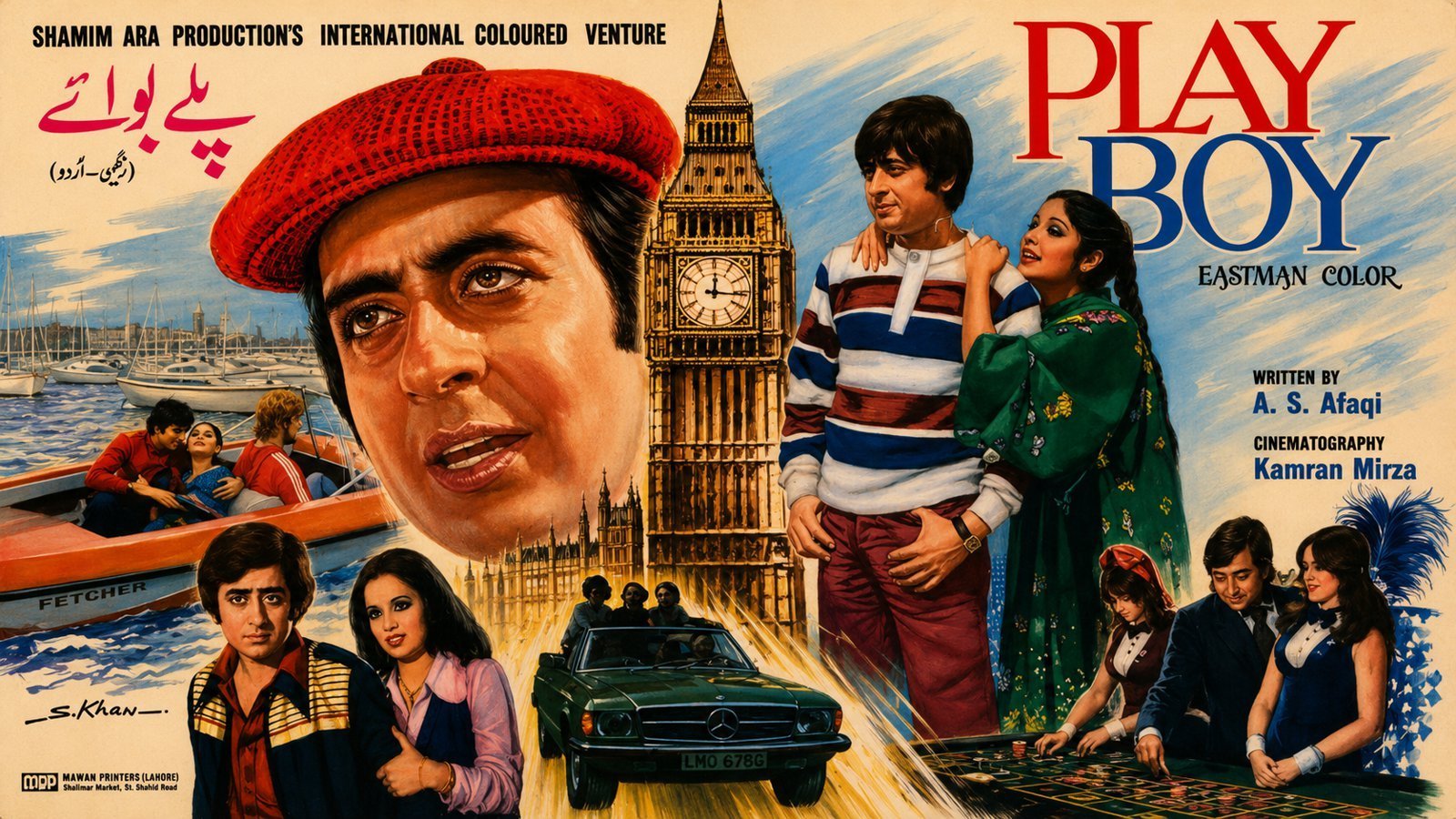
Playboy (1978)
Cast: Nadeem, Babra Sharif, Talish, Asif Reza Mir, Nadia
Director: Shamim Ara
Synopsis: Immigrants realise that there’s no place like home in this warped fantasy rumoured to be Donald Trump’s favourite movie.
Reviewed by: Omar Khan
Shamim Ara’s nationalistic farce is full of the worst kind of propaganda and deception. It elevates her to the ranks of being Pakistan’s version of Leni Riefenstahl without an iota of the latter’s talent and vision.
The film should be screened outside all western Embassies in Pakistan, where tens of thousands of exodus seekers line up daily, hoping for a cherished Visa. Once these supposedly misguided multitudes would watch Playboy, they would realise their folly, chuck away their air tickets and realise that, as Dorothy so eloquently put it in The Wizard of Oz, “There’s no place like home.”
The plot is stale wine in a new bottle and wine that has already passed its sell-by date and is rotten to the drop. Nonetheless, the message that Playboy preaches is that all foreign lands are saturated with evil and decadence and that heaven on earth is a nation called Pakistan—a perfectly canny ploy with both eyes on box office returns.
According to Playboy, all Pakistanis who leave their homeland to try to earn a living abroad will end up as miserable alcoholics floundering on the streets, homeless and needy in a living Hell or worse, still married to one of the heathen gora race. We are shown that
Pakistani women born in Britain and adopting a Western lifestyle can only look forward to a life of drugs, alcohol, gang rapes and, ultimately, premature and violent death.
Playboy depicts everything Western as decadent and evil and everything to do with Pakistan as heaven-sent. The film is an extreme of self-deception and wishful thinking. Ms. Ara would do somewhat better to address the issue of why most sane Pakistanis want to abandon their heavenly country for a foreign land. Why is it that the vast majority of Pakistanis still struggle for an opportunity to live in the West when according to Ms. Ara, the land of paradise is right here at home?
Indeed, one viewing of Playboy would reverse the exodus. Those thousands of Pakistanis living in the sense of “false happiness” for so long would do their best to abandon their adopted countries and return to the hallowed turf. Also, most Westerners would probably leave their homes to seek a life in Pakistan with its flourishing economy, impeccable law and order, zero corruption and nepotism, education system, religious intolerance and human rights record.
The film shows Talish as a man who made the fatal mistake of leaving Pakistan for a better life. What a fool; he should have known better. Anyway, he is snagged by some conniving witch of an English woman who deceives him into marriage and produces a daughter she doesn’t allow to be brought up by Maulvis in the prescribed manner. The gori wife dies, leaving a daughter with “the poison” of her mother’s English blood in her veins, an irreversible condition that can only spell doom. This confused daughter can only survive if she is packed off immediately to Pakistan to be saved by our “morally
Playboy superior” and “pure” society. Pure what? You might well ask yourself? Pure virtue and goodness, of course.
Talish’s daughter, brilliantly played by Nadia, hangs out with “dirty Hippies” who are considered evil as sin as they propound theories of freedom, liberty, and love rather than social order, strata and rigid control. The poor girl is doomed for having an independent spirit and the ability to think for herself.
Babra Sharif, the epitome of a “good” Eastern girl, is packed off to London to reform Nadeem, who is apparently in severe danger of being blinded by the bright lights of the West. She has to reform him before it’s too late (you see, they got married over the phone long distance, so he is her proxy husband!).
While men are allowed to behave like absolute morons (witness the crowd at any T20 match staged in the sub-continent), women are condemned if they are seen having any fun. In fact, in Playboy, we are treated to a sub-Farrelly brothers’ scene when Nanna’s thunderous farts resound in the background (for which he won a thoroughly welldeserved Nigar Award as Best Comedian) as he has an upset tummy. If only a woman would be shown farting with abandon loudly on screen, how liberating it would be! Babra is undoubtedly not the farting type. She is all virtue; a servant, cooking, cleaning, and serving tea and coffee all day long, the perfect “good girl”. In contrast, in morally correct societies, the Westernised girl is having a “jolly good time” with her friends.
The film boasts a stunning array of quotable lines. Daughter referring to the father: “Yes, he’s rich but backwards, England main reh kar bhi so narrow-minded, really, I’m ashamed of him!”
and to the father’s: “Yeh tehzeeb hamari naheen hai beti, tumhe ganday hippeeon ke saath nahin milna chahiye.” There is the terrific retort: “This is my country; I belong here”!
As nature intended, the Westernised girl gets rewarded when gang-raped and murdered by her “dirty Hippy friends”. Just as the only way a “happy ending” is achievable is when our whole brood of Immigrant Pakis see the light and realise that they are indeed much better off in the Land of the Pure. They all immediately book seats on the next PIA and return from a hellish land of corruption and vice, and filth to a land of purity, where milk and honey flow instead of water and injustice is just a figment of the imagination.
Playboy is a ghastly piece of deception and pathetic wishful thinking of the worst kind. The film is regressive and a blatant falsity. Ms. Shamim Ara would do a much greater service to her people if she showed them exactly why people are queuing up night and day, with many risking drowning on refugee boats, to join the departure from the Land of the Pure. Yet it is considered a “classic” Lollywood creation—educational and informative.



0 Comments
Leave a Comment