
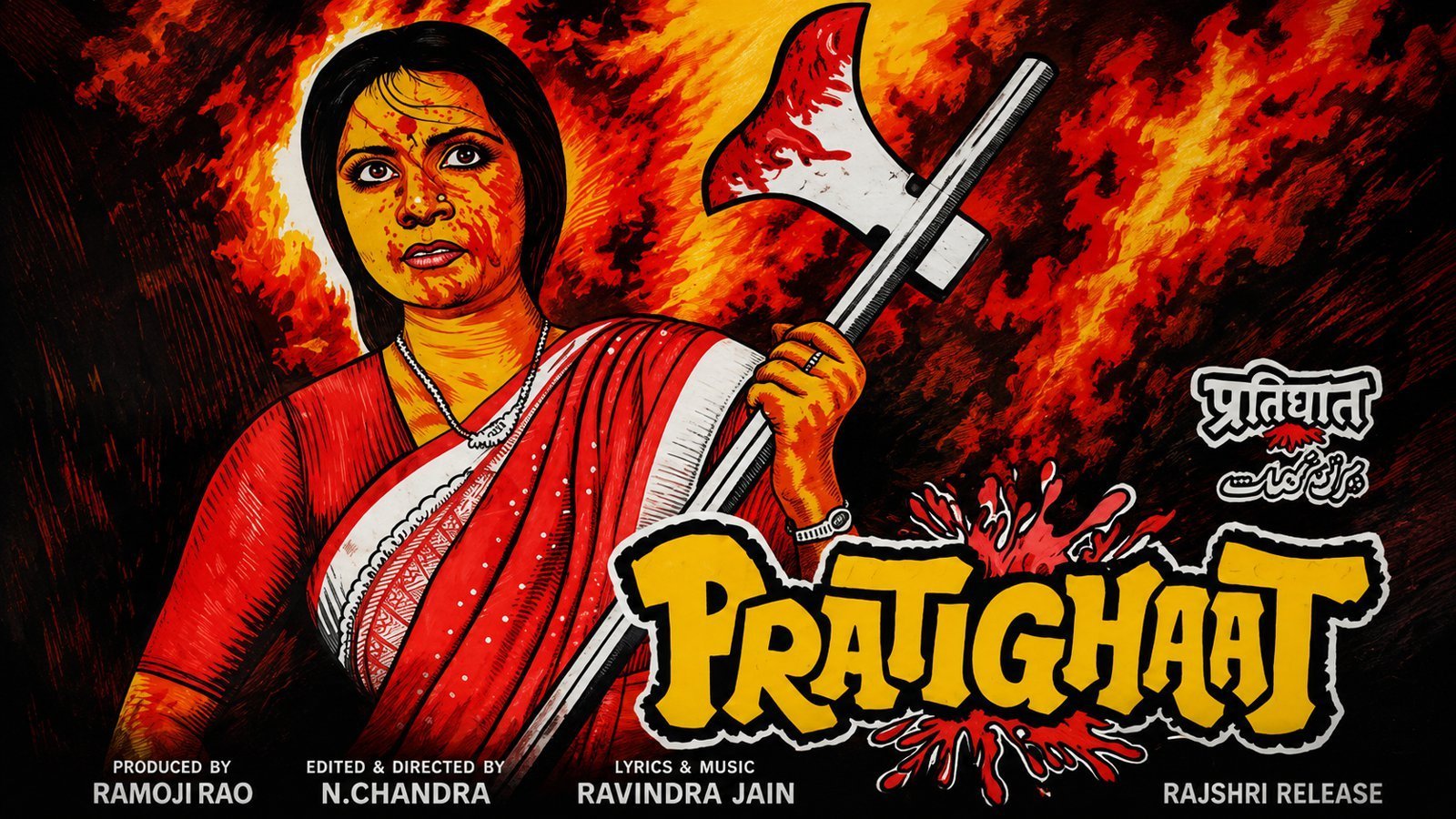
Pratighaat (1987)
Starring: Sujata Mehta, Nana Patekar, Rohini Hattangady, Charan Raj
Director: N. Chandra
Synopsis: Searing sociopolitical drama contains the most powerful woman's role in years.
Reviewed by: Omar Khan
Before N. Chandra hit the big time directing slick commercial ventures starring Bollywood's biggest names, he had already carved out a reputation making low-budget, earthy socio-political dramas. These were unmistakably commercial films, but they relied not on polish, glamour or star power, but on the sheer strength of their scripts and the performances they inspired.
Chandra was also instrumental in introducing Nana Patekar to mainstream Hindi cinema. His breakthrough came with the highly acclaimed Ankush, in which Nana delivered the first of many explosive performances that would soon become his trademark. Ankush struck a powerful chord with audiences and, despite its modest budget and lack of established stars, became a considerable success in the urban centres thanks largely to Chandra's assured direction and his remarkable ability to extract outstanding performances from his cast.
What distinguished Chandra at this stage of his career was his instinctive ability to portray simmering unrest. Both Ankush and Pratighaat are driven by an undercurrent of social tension that threatens to erupt at any moment. Pratighaat in particular burns with political fury. It is rough, unpolished filmmaking, but so passionately made and so emotionally charged that its imperfections become part of its appeal. There is scarcely an ounce of subtlety to be found, yet Chandra's conviction is so overwhelming that the film succeeds magnificently, sweeping the audience along with its anger and its call for resistance against corruption and injustice.
Despite the absence of major stars, Pratighaat went on to become one of the surprise successes of 1987.
The story unfolds in a town on the outskirts of a large South Indian city, where local student politicians and their gangs of hired thugs exercise absolute control. The situation bears more than a passing resemblance to parts of Pakistan, where criminal elements have often operated under the guise of student organisations, intimidating entire communities with impunity. The population has become conditioned to accept corruption, violence and injustice as facts of everyday life.
Into this environment arrives Sujata Mehta as a spirited young lecturer determined to challenge the established order.
Almost immediately she senses that something is deeply wrong. Lazy policemen ignore their responsibilities, petty corruption infects every level of society, and ordinary citizens have long since abandoned hope. Even her own husband reveals an unsettling moral weakness when she catches him attempting to bribe the young daughter of a local judge. As events spiral further out of control, she turns for help to the local police chief—an old friend—only to discover that the rot extends far deeper than she ever imagined.
The town is effectively ruled by Kali, a former student leader turned politician who dispenses his own version of justice from within his lavish residence. He has become the true law of the land, feared by everyone and challenged by no one.
Until one woman refuses to bow.
The premise itself may sound familiar, but Pratighaat possesses an urgency and intensity that elevate it well above the average commercial melodrama. Yes, it contains songs, exaggerated action scenes and all the familiar ingredients of mainstream Hindi cinema, yet beneath those conventions lies a remarkably gritty portrait of a society collapsing under the weight of political corruption. Chandra creates an atmosphere where violence feels inevitable and the tension steadily tightens until the entire film seems on the verge of exploding.
Nana Patekar is absolutely mesmerising in what is essentially an extended supporting role. Even with relatively little screen time, his extraordinary presence dominates every scene in which he appears. Few actors in Indian cinema have possessed such effortless authority before the camera.
Rohini performs admirably in a substantial role, while Sujata Mehta delivers perhaps the finest performance of her career. Although she later became increasingly mannered in subsequent films, here she brings conviction, strength and vulnerability to the central character.
Ultimately, however, the greatest credit belongs to N. Chandra himself. He fashions a film bursting with passion and urgency, transforming what could easily have been another routine commercial potboiler into something far more memorable. The final act, as violence, corruption and long-suppressed anger erupt simultaneously, is directed with tremendous force. Chandra captures the mounting hysteria of a society spiralling towards breakdown with remarkable assurance.
Beyond its entertainment value, Pratighaat remains an invaluable snapshot of the corruption, political violence and social decay that characterised much of life in the Indo-Pak subcontinent during the 1980s.
Sadly, its message feels no less relevant today than it did nearly four decades ago.

0 Comments
Leave a Comment