
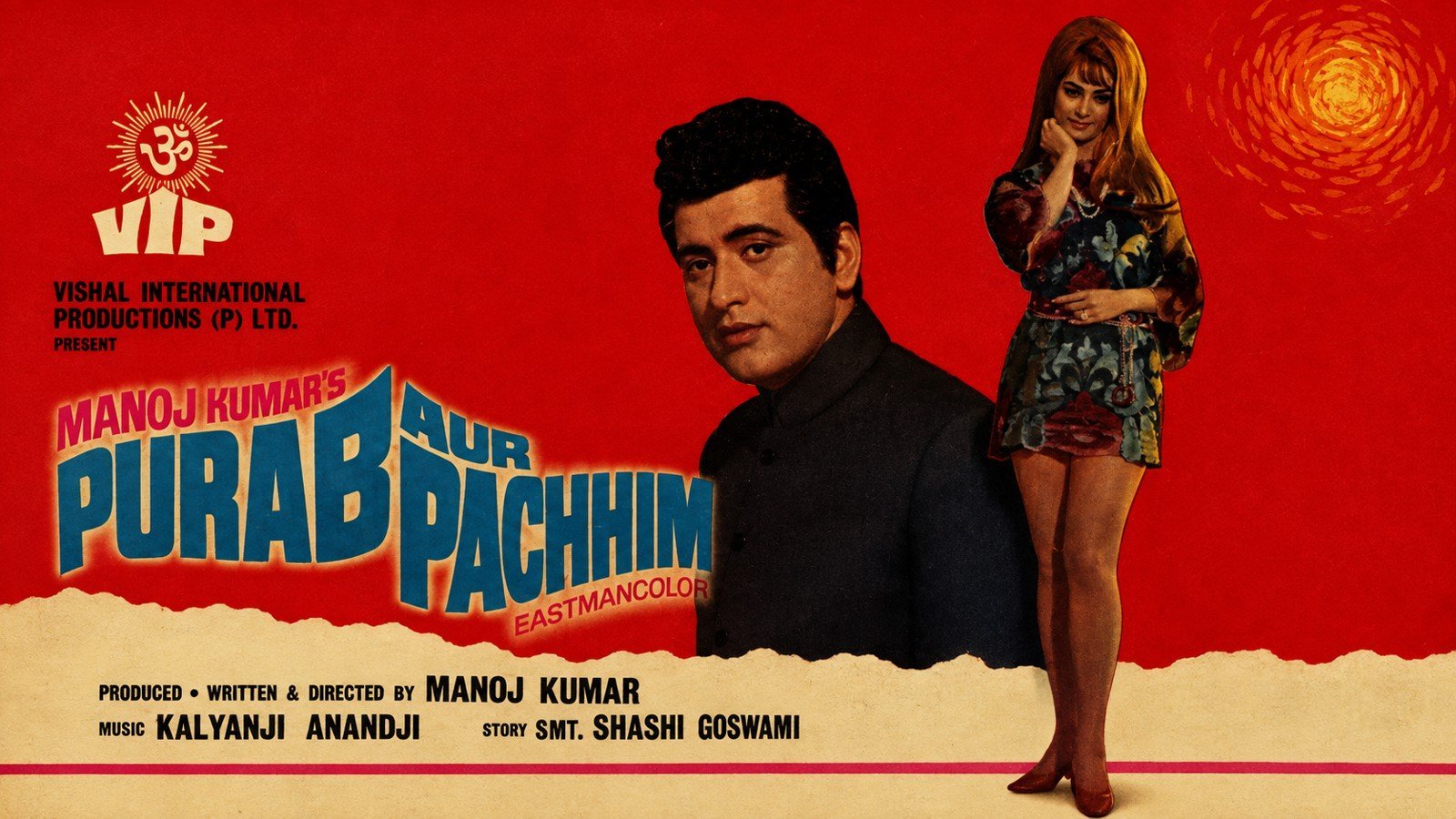
Purab aur Pacchim (1970)
Cast: Manoj Kumar, Saira Banu, Ashok Kumar, Pran, Prem Chopra, Vinod Khanna
Director: Manoj Kumar
Music Directors: Kalyanji Anandji
Synopsis: Manoj's Bharat travels to London to teach the wayward a lesson or two
Reviewed by: Omar Khan
Manoj Kumar, buoyed by the phenomenal success of Upkar (1967), assembled a lavish cast for his follow-up, once again casting himself as the idealistic Bharat – the embodiment of Mother India's perfect son.
The tangled web of a story begins in pre-Independence India with the freedom movement gathering momentum and the British Empire slowly retreating. Ashok Kumar plays the upright village priest whose family is deeply involved in the struggle for independence. His son, however, is Pran, who dreams not of freedom but of escaping the dirt and overcrowding of India for a better life abroad. Patriotism means little to him.
In an act of unforgivable betrayal, Pran informs on his own uncle, a prominent freedom fighter, delivering him into British hands where he is promptly riddled with bullets before the horrified family. Realising that Independence is now inevitable and fearing the inevitable lynch mob awaiting collaborators like himself, Pran flees India with his young son, abandoning his pregnant wife (Nirupa Roy), who steadfastly refuses to leave her homeland for what she considers a shallow existence overseas.
Pran lands in London, where he becomes a wealthy businessman through his uncanny success at the dog races, while his son grows into none other than Prem Chopra — a thoroughly debauched hippie of the worst possible persuasion.
Back in India, Nirupa Roy gives birth to a daughter, while Kamini Kaushal, widow of the martyred freedom fighter, gives birth to young Bharat. The pre-Independence scenes are filmed in black and white, and only when 15 August finally arrives, with the Union Jack lowered and the Indian tricolour raised, does the screen burst gloriously into Technicolor. Manoj Kumar never knowingly missed an opportunity for symbolism.
Years later, Bharat has grown under the wise guidance of Ashok Kumar into the perfect nationalist, overflowing with patriotic fervour, moral certainty and an expression of permanent self-satisfaction. He is quite possibly the most irritating know-all ever committed to Indian cinema, and to complete the package he delivers his patriotic sermons in the booming voice of Mahendra Kapoor.
One day Bharat is invited to England to study science, staying with another uncle (Madan Puri), who has settled there with his English wife and children. Well... supposedly English. Shammi, beneath a blonde wig while puffing theatrically on an elegant cigarette holder, hardly convinces anyone that she has just stepped out of Mayfair.
Bharat is appalled by everything he encounters in the West. Here are people capable of putting rockets into space while simultaneously wallowing in moral decay. Even worse are the children of Indian immigrants, who know nothing of their own heritage, spend their days smoking, drinking and experimenting with every conceivable vice, and seem trapped in an endless cycle of decadence and hedonism.
Gradually Bharat's relentless sermonising begins to wear everyone down. Even Madan Puri starts yearning for India again, dusting off old K.L. Saigal records and listening to them nostalgically all day, much to the annoyance of his very Indian-looking "English" wife.
Madan Puri's daughter Preeti is played by Saira Banu, sporting impossibly short miniskirts and flowing blonde hair. Manoj Kumar reportedly delayed production for over a year because Saira was suffering from colitis and he believed nobody else could play Preeti.
He was right.
This is one of the finest performances of her uneven career. She perfectly captures Preeti's westernised innocence without making her unlikeable. She chain-smokes, drinks, parties with hippies and has almost completely abandoned her cultural roots, while her brother is an even bigger disaster, changing his name every few days for reasons known only to himself.
Naturally Bharat proceeds to reform them all.
One by one these lost souls abandon their sinful western ways and rediscover the glorious virtues of India. The path to salvation, according to Manoj Kumar, leads directly back to Bharat Mata.
There are countless wonderfully entertaining scenes along the way.
Manoj Kumar's use of symbolism is magnificently unsubtle. The transition from black and white to colour at Independence is only the beginning. Later, a bursting champagne bottle is employed as a visual metaphor for ejaculation — all delivered with the subtlety of the proverbial sledgehammer.
Then come the patriotic songs.
Time and again Bharat bursts into Raghupati Raghav Raja Ram at the slightest provocation. On one memorable occasion his singing proves so inspirational that an entire gathering of Germans joins in, apparently on the verge of abandoning Christianity and embracing Hinduism there and then.
Even better is the unforgettable death scene in which one of the hippies whom Bharat has "saved" is fatally wounded. In his dying moments he begs Bharat — in French, no less — to perform his last rites by singing Raghupati Raghav, effectively embracing Hinduism with his final breath.
Only Manoj Kumar could stage something so magnificently earnest.
Another priceless sequence sees Pran extolling the achievements of Western civilisation while ridiculing India as backward. Bharat promptly silences him by reminding everyone that it was the ancient Indians who invented the zero, and therefore every subsequent scientific achievement in human history owes its existence to India.
Naturally this revelation arrives... in song.
Kalyanji-Anandji provide a magnificent score. The patriotic songs became enormous hits, but for me the real revelation lies elsewhere. Their wonderfully funky, late-60s dance numbers are sensational.
The standout arrives aboard a boat on the Thames where Preeti introduces Bharat to London's hippie crowd. There, among cousins who have transformed themselves from Mohan into "Man" and Omkar Prasad into "O.P.", everyone launches into the deliriously infectious Who's Got the Time to Think. It sounds suspiciously like Asha Bhosle masquerading as one of the hippies and remains one of the most gloriously unexpected Bollywood dance tracks of its era.
The crowning glory, however, is the climactic musical number where Twinkle Twinkle Little Star receives the full Punjabi nationalist treatment. During this utterly surreal reinvention of the nursery rhyme, Saira Banu's resistance finally crumbles and she emerges fully "desified", her western ways finally washed away.
It is impossible not to grin.
Purab Aur Pachhim has earned its place as a genuine Bollywood classic. More importantly, it established the template for countless later films exploring the clash between Eastern and Western values. Manoj Kumar effectively copyrighted the character of Bharat. Every subsequent "Bharat" was a different individual, but they all embodied the same idealised vision of India, and no other actor seriously attempted to inherit the mantle.
The patriotic Bharat persona continued through several more films, reaching its commercial zenith with Roti Kapda Aur Makaan before eventually losing its appeal. Even Manoj's son, Kunal Goswami, proved unable to keep the flag flying.
Today, Purab Aur Pachhim is fascinating not merely as entertainment but as an invaluable social document. Historians studying post-colonial India could learn almost as much about the aspirations, anxieties and self-image of the nation from Manoj Kumar's films as they could from many academic texts. Cinema often reveals what societies dream about, fear, or desperately wish to become.
The film also features a youthful Vinod Khanna in a small role, years before superstardom beckoned, followed by his remarkable departure from cinema to join Bhagwan Rajneesh's controversial commune in Oregon, and his equally remarkable return once that extraordinary chapter came to an end.
0 Comments
Leave a Comment