
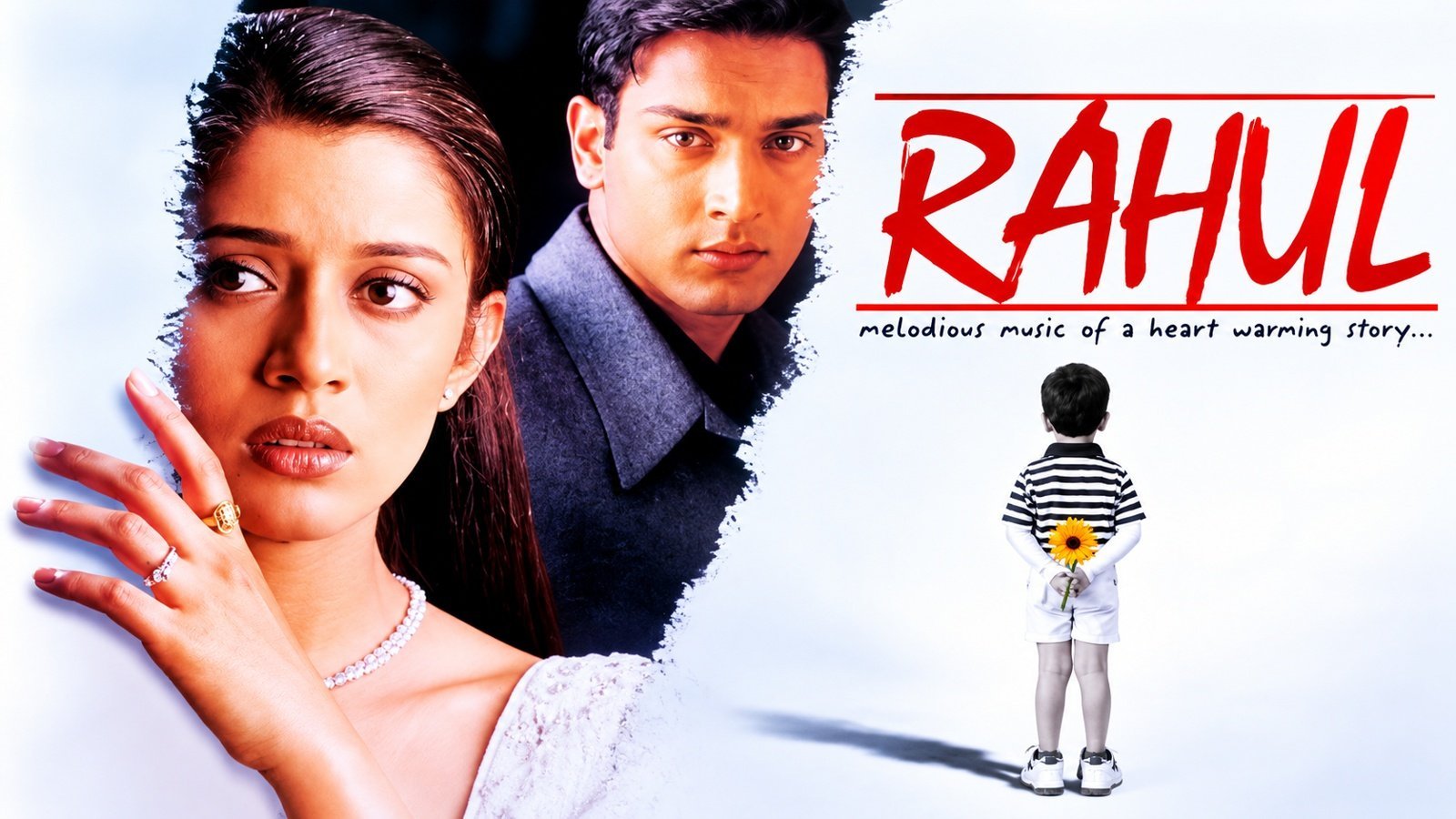
Rahul (2001)
Starring: Neha, Jatin Grewal, Yash Pathak, Rajeshwari Sachdev, Mahesh Thakur
Director: Prakash Jha
Music Director: Anu Malik
Synopsis: Bollywood takes the Kramer Vs. Kramer angle once again....yawn!!
Reviewed by: Faiz Khan
Rahul (2001)
A Subhash Ghai presentation immediately raises expectations of spectacle, but Rahul appears to promise something altogether different. Director Prakash Jha has generally been associated with intelligent, socially conscious cinema, and after films such as Hip Hip Hurray and Mrityudand, it seemed he was ideally placed to tackle a sensitive drama about divorce and the emotional devastation it inflicts upon a child.
Sadly, Rahul turns out to be another example of a worthwhile idea undermined by an implausible screenplay.
Rahul (Yash Pathak) lives alone with his father Akash (Jatin Grewal), a tourist bus guide who devotes his entire life to raising his son. Rahul has never understood why his mother Meera (Neha) abandoned them and has grown up believing she neither wanted nor loved him. Akash does little to challenge that belief, poisoning the boy's mind against the woman who left them behind.
Everything changes when Rahul discovers that his mother still longs to see him. Unable to reconcile the conflicting versions of the truth, the young boy secretly begins visiting her, hoping somehow to bring his broken family back together.
Seen through the eyes of a child, this should have been a moving and insightful study of separation, loyalty and emotional manipulation. Instead, Jha constructs his drama upon foundations so flimsy that the emotional impact is repeatedly compromised.
The entire separation hinges upon the most hackneyed of Hindi film conflicts: rich versus poor, interfering in-laws and wounded male pride. Worse still, the custody arrangements make almost no sense. We are expected to believe that a court would award a one-year-old child to a father with limited means, no family support and no one to help raise him, while denying custody to a financially secure mother. The premise simply collapses under the weight of its own improbability.
Ironically, the most compelling aspect of the film is also its most uncomfortable. Akash, despite being presented as the devoted parent, emotionally manipulates Rahul at every opportunity. His bitterness towards Meera becomes a form of abuse inflicted upon the child, forcing Rahul to choose between parents who should both be protecting him. Those moments carry genuine emotional force because they expose the damage adults inflict upon children when personal grievances take precedence over love.
Unfortunately, Jha surrounds these scenes with a gallery of stock Bollywood characters: the snooty in-laws, the sacrificing girlfriend, the wise grocery shopkeeper, the sermonising doctor and assorted clichés that dilute what should have been an intimate family drama. The climax, stretched far beyond necessity, resolves matters in an entirely unsatisfying fashion.
There are flashes of the sensitive filmmaker one expects from Prakash Jha, particularly whenever the narrative remains focused on Rahul himself. Those moments are touching, occasionally heartbreaking, and remind you of the far better film struggling to emerge beneath the melodrama.
Yash Pathak gives an impressive performance, capturing both the innocence and confusion of a child caught between two warring parents. He is easily the film's greatest asset. Jatin Grewal, however, struggles to give Akash the emotional complexity the role demands, while Neha delivers a sincere and effective performance as the mother.
Anu Malik's score is a mixed affair. "Ched Na", "Main Hoon Apni Piya Ki Jogan", "Wah Re Wah" and "Chalti Hai Purvai" are pleasant enough, while "Eh Kaash Aisa Na Hota" and "A Song to Sing" are considerably less successful. In fact, the latter is so interminable that I wandered off to buy popcorn during it. Even taking my time, the song was still playing when I returned.
Rahul had the potential to become an affecting drama about divorce viewed through the eyes of a child. Instead, Prakash Jha allows melodrama and an implausible screenplay to overwhelm an otherwise worthwhile premise. There are moments that genuinely move, largely thanks to Yash Pathak's performance, but they are too few to rescue a film that ultimately falls well below the standard one expects from its director.
Disappointing.

0 Comments
Leave a Comment