
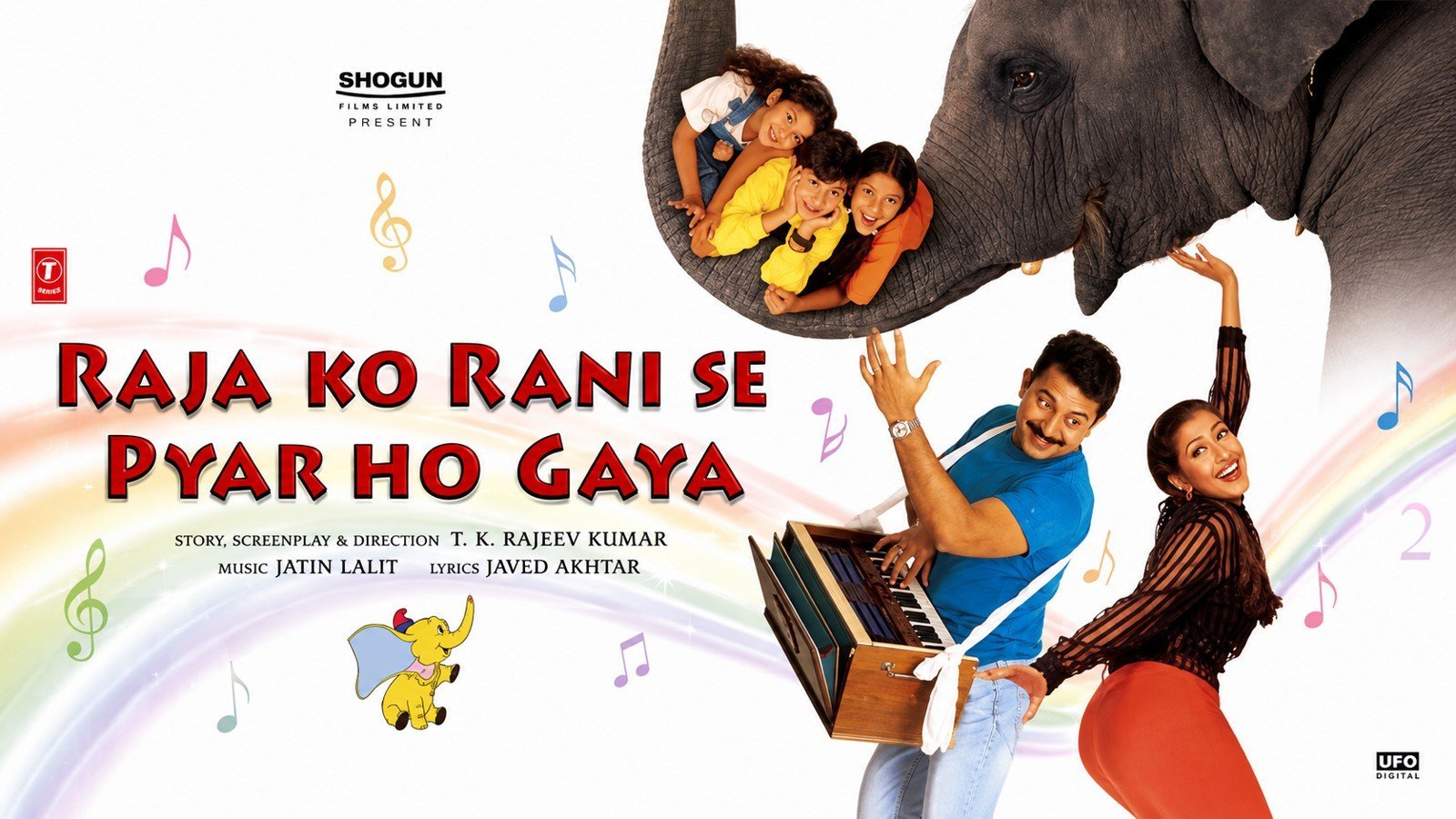
Raja Ko Rani se Pyar ho Gaya (2000)
Starring: Manisha Koirala, Arvind Swamy
Director: T.T Rajeev Kumar
Music Director: Jatin Lalit
Synopsis: high tedium is far from the fantasy/comedy that the producers intended
Reviewed by: Faiz Khan
Raja Ko Rani Se Pyar Ho Gaya (2000)
The title is borrowed from the memorable song in Akele Hum Akele Tum, and for a fleeting moment one hopes that this might be a gentle, old-fashioned romantic fairy tale. Those hopes are quickly dashed.
The film also arrived burdened with publicity surrounding the supposed controversy of Manisha Koirala pulling an elephant's tail—a scene that, rather amusingly, doesn't even appear in the finished film. With an elephant playing a central role, many assumed this would be another variation on Haathi Mere Saathi. It isn't, although one thing is certain: it never comes remotely close to recapturing the charm or success of that classic.
The story begins promisingly enough.
Mohit (Arvind Swamy) lives in a village where he has been raised on fairy tales narrated by his grandmother (Dina Pathak), stories inevitably involving handsome princes and beautiful princesses. During a village fair, city girl Manisha (Manisha Koirala) arrives, dancing exuberantly to "Dafli Wale". At the same time, Mohit is amusing local children by pretending to hold his breath underwater.
When Manisha is thrown from her horse into the lake, Mohit rescues her, catching his first glimpse of the "princess" of his dreams beneath the water's surface. Before he can even introduce himself, she disappears back to the city, leaving him hopelessly smitten. Naturally, a fantasy song follows, much of it photographed underwater.
Determined to find her again, Mohit travels to Mumbai under the pretence of searching for a missing Gajendra statue—one which, conveniently enough, he himself has hidden. Through a series of thoroughly implausible coincidences, Manisha eventually finds him instead. During their meeting she accidentally breaks the treasured statue, leaving Mohit heartbroken.
To make amends, she sends him a baby elephant named Appu.
From this point onwards the film changes direction completely.
What had begun as a mildly whimsical romance suddenly transforms into a children's comedy centred almost entirely around hiding an elephant inside a house. Appu proceeds to indulge in every imaginable comic antic, each one intended to provoke laughter but instead becoming increasingly repetitive and tedious. The attempts at slapstick rarely raise even a smile.
Just when the elephant-based comedy has exhausted itself, the screenplay veers off yet again with the arrival of stock villains, abandoning whatever fragile identity the film possessed and descending into entirely routine Bollywood formula.
The result is a film that never seems certain what it wants to be. Is it a romantic fantasy? A children's adventure? A family comedy? An action melodrama? It tries to be all of them and ultimately succeeds as none.
Arvind Swamy brings his customary warmth and understated charm to Mohit, and for a while that alone keeps the film afloat. Unfortunately, even he cannot rescue a screenplay so unsure of its own direction.
Manisha Koirala fares little better. Released alongside Champion, this represented another disappointing choice during a difficult phase of her career. To make matters worse, both she and Arvind Swamy are dubbed, with voices that sit awkwardly against their performances and further distance the audience from the characters.
The film's sole saving grace is Jatin-Lalit's music. After a comparatively quiet period, the duo return with a pleasing soundtrack. Songs such as "Jiske Liye", "Aao Suno" and "Dil Chura Ke Chal Di" remain far more memorable than anything in the narrative itself.
Ultimately, Raja Ko Rani Se Pyar Ho Gaya feels like a film made without a clear vision. Its fairy-tale opening offers a hint of promise before the screenplay loses confidence and lurches awkwardly from one genre to another. The result is an aimless, forgettable affair that never decides what audience it is trying to entertain.
I approached this film with very modest expectations.
Even those proved too optimistic.

0 Comments
Leave a Comment