
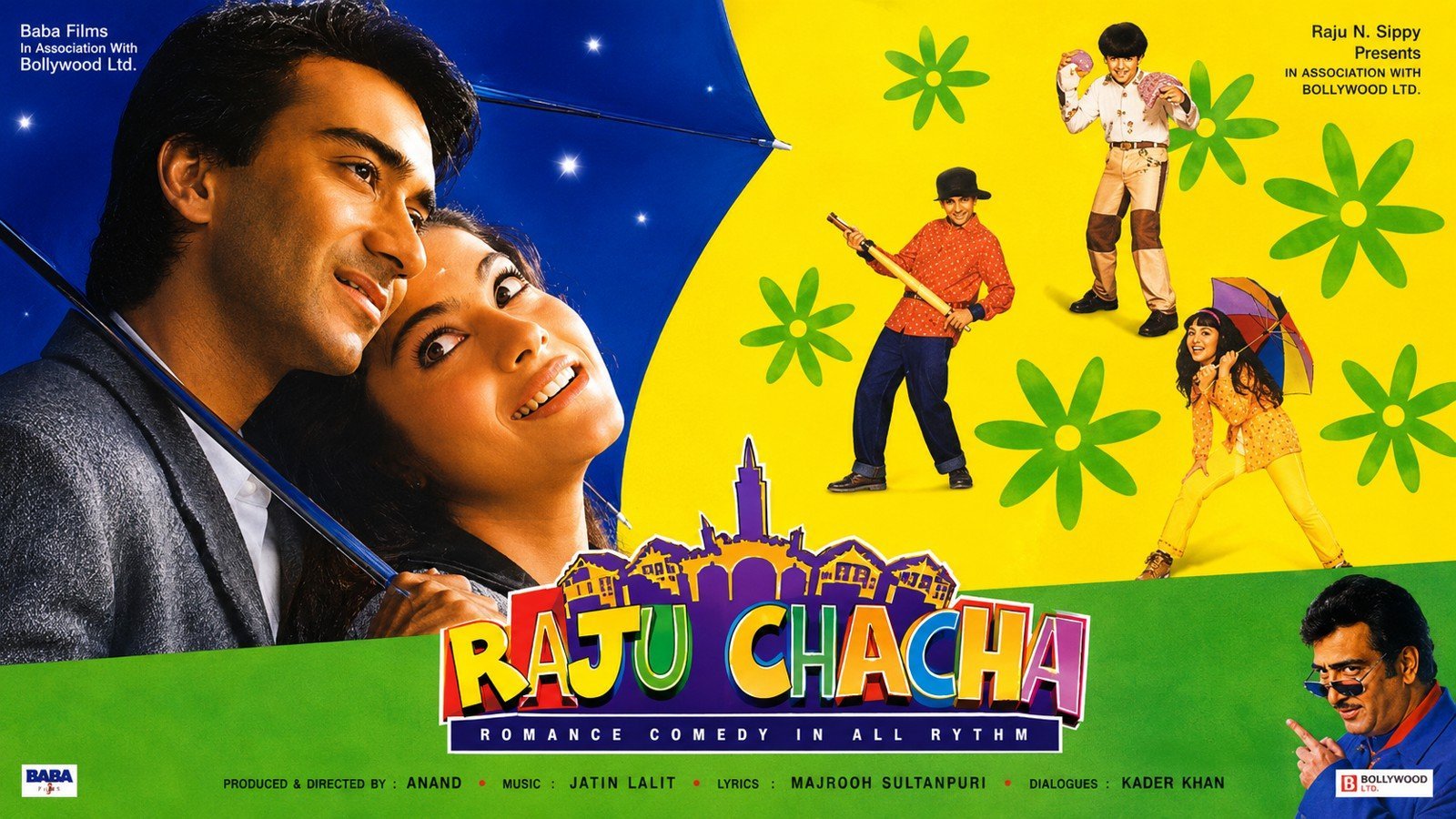
Raju Chacha (2000)
Starring: Kajol, Ajay Devgan, Rishi Kapoor
Director: Anil Devgun
Music Director: Jatin Lalit
Synopsis: Super lavish production fails to mask a failed Sound of Music clone
Reviewed by: Faiz Khan
Raju Chacha (2000)
Few Bollywood productions have arrived carrying expectations quite as enormous as Raju Chacha. Long before its release, headlines focused on its staggering budget, its lavish production values, comparisons with The Sound of Music, and claims that it would present a refreshing children's adventure told through the eyes of its young protagonists.
At the outset, I must confess to having enormous respect for Ajay Devgn. He has always struck me as one of Bollywood's more committed actors, someone willing to experiment rather than simply coast on his image. As producer, he clearly invested not only vast sums of money but also a great deal of personal passion into this project.
Sadly, while there is no shortage of money on the screen, there is precious little heart.
Rishi Kapoor plays a wealthy widower struggling to control his three impossibly unruly children. Every governess flees in despair until, as a last resort, he hires Anna (Kajol), a gentle young woman raised in an orphanage. The inevitable comparisons with The Sound of Music begin almost immediately, even extending to some rather curious Austrian-inspired costumes for Kajol.
Before Anna arrives, she encounters Shekhar (Ajay Devgn), a charming conman who immediately falls for her, although his affections are initially ignored. Once she reaches the household, the children unleash the expected barrage of tricks and practical jokes. These sequences, bolstered by expensive special effects, are clearly intended to be hilarious.
They aren't.
In fact, the young child who accompanied me to the screening found them more frightening than funny.
Eventually the children warm to Anna, while Shekhar slowly wins her heart. Just as happiness seems within reach, he is exposed as a thief, Anna rejects him, tragedy strikes the family, and the film lurches into an entirely different story involving greedy relatives, inheritance battles and comic-book villains.
The screenplay seems unable to decide what sort of film it wants to be.
It begins as a fairy tale, morphs into a family comedy, briefly becomes a romance, then transforms into a melodrama before finally ending as an action adventure. None of these genres is developed with any conviction. Plot threads are introduced only to disappear without consequence. One supposedly crucial fax exposing the villains' crimes is treated as though it will become central to the story, only to vanish completely from the narrative moments later.
What should have been a warm, magical children's film instead becomes an exhausting procession of clichés.
The villains are cardboard cut-outs lifted from dozens of older Hindi films, complete with endless scheming over family fortunes. The emotional misunderstandings become repetitive long before the interval, and the second half drifts into material that feels surprisingly unpleasant for what is supposedly family entertainment.
The scenes in which the children are slapped, bullied, humiliated and even forced to drink alcohol are particularly uncomfortable. There are countless ways to portray children suffering hardship without resorting to such ugly imagery. For a film clearly aimed at younger audiences, these moments feel badly misjudged.
Nor does the expensive production design compensate for the lack of imagination elsewhere.
The enormous mansion, reportedly costing around five crore rupees to construct, is undeniably impressive, but it feels like a monument to excess rather than storytelling. Every frame screams money, yet almost none of it generates genuine wonder.
One also detects more than a passing influence from films such as Home Alone, but imitation alone cannot recreate their charm or comic timing.
Ajay Devgn gives an earnest performance and remains one of the film's few likeable presences. Kajol has remarkably little to work with, and after the interval her character becomes almost an afterthought. One suspects that had this not been a home production, the role might have held considerably less appeal.
Rishi Kapoor is his dependable self, bringing warmth and professionalism as always.
The three child actors, however, never emerge as memorable personalities. Compare them with the unforgettable youngsters in films like Masoom, Hum Hain Rahi Pyar Ke or even Kuch Kuch Hota Hai. Those children possessed individuality and charm. Here they simply merge into one noisy collective, leaving almost no lasting impression.
The soundtrack proves another major disappointment. Apart from Shaan's pleasant solo, Jatin-Lalit deliver one of the weakest scores of their otherwise distinguished careers. The overuse of Amit Kumar's voice only compounds matters, while several songs feel like padding rather than genuine narrative moments.
Technically the film is handsome enough. The cinematography is polished, the production values are immense and no expense appears to have been spared. Unfortunately, lavish spending cannot disguise weak writing or uncertain direction.
I attended the screening with a five-year-old companion.
During the film's entire three-hour running time, he laughed exactly once.
That is an extraordinarily poor return on such an extravagant investment.
Despite all its money, spectacle and ambition, Raju Chacha remains a curiously joyless affair—a children's film that forgets to entertain children.
Save yourself the three hours.
Your children certainly won't thank you for it.

0 Comments
Leave a Comment