
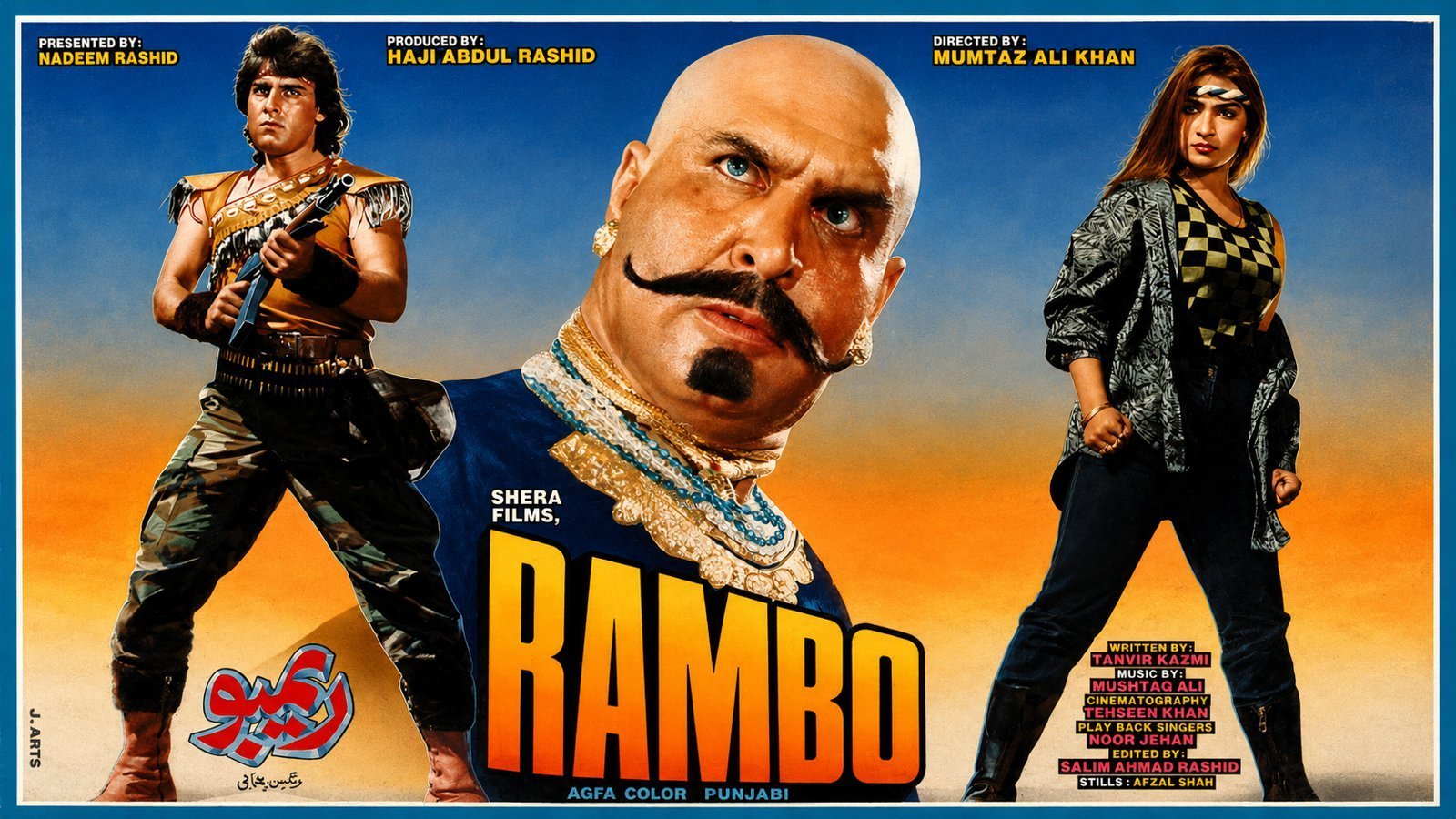
Rambo Aka Halaku (1991)
Cast: Ajab Gul in and as Rambo, Reema, Hamayun Qureshi, Munir Zareef, Suneeta, and Babrak.
Director: Mumtaz Ali Khan
Synopsis: A whiff of rebellion is in the air as a brutal, Psychotic Jagirdar’s excesses take matters to an unbearable extreme.
Reviewed by: Omar Khan
The 1991 Double language production is immediately set apart with its unique location around the Muzaffarabad area. Everything looks attractive and comparatively fresh compared to the usual “look” of an average Lollywood movie.
On-screen, the area’s people remain ruled over with an iron fist by a nasty Jagirdar who has Amrish Puri’s Mogambo as a role model. The madman relishes in “Keeping men in their place,” and he doesn’t tolerate any hint of dissent. Khan Baba (Humayun Qureshi) wears some fine threads and has an ‘80s New Wave Pop Star looks about him, occasionally very Studio 54 chic.
Reema and Babrak, Khan Baba’s two spoilt rotten kids, return from London, and the old man is excited. First, she has to watch out for her brother Babrak, who is a bit of a pervert and nearly makes a play for his sister. Reema is a rude, arrogant bitch and is ready to be “taught a lesson” along the way. Ultimately, she has to morph into Miss Perfect.
You can soon easily read the plot a mile off with Reema to be rescued, “saved”, and brought onto the right path along the way.
Meanwhile, a rebellion led by Rambo is brewing, which is the essence of the movie’s plot.
Disaster strikes Rambo’s home when Babrak makes a play for his sister one night when Rambo is away, and his sister sacrifices herself rather than ending up as Babrak’s conquest, dying just as Rambo finds her.
Humayun Qureshi has a prime role and looks acceptable, but his role is a pale shade of Mogambo with mannerisms that don’t work for him, and tiny ticks that look awkward and infantile. His role is a decent effort but a wasted opportunity, and Qureshi is less memorable than usual this time.
Ajab Gul, playing Rambo, now must rise to attempt to overthrow the evil Jagirdar system and bring a rebellion among the people against the injustices they must bear. Reema is feisty and has an odd dialogue delivery style. The film looks good because of the backdrop; otherwise, at 2 hours and 40 minutes, it’s way too long and predictable to maintain a half-decent grip on the viewer—way too many songs and not nearly enough dramatics and action. The fights are very flat and offer no thrill factor at all. Ajab Gul is anonymous as Rambo and often shouts, but does he convince? The script is feeble, and the action is tame at best. The film is predictable and offers no novel surprises or twists. It is inoffensive but way too long and slow. The villain’s “get up” is often spectacular, but the script again lets them down.
Ajab Gul comes across as loud and shrieky as Rambo. Qureshi is all look and not much style as the villain Halaku AKA Khan Baba.
Fatally, the songs are dreadfully frequent and manage to bloat the film’s time without increasing its intrigue, as they don’t add anything particular to the plot and aren’t lewd enough or notable in any way, just bland.
There are also elaborate dance numbers that are a little flat and routine. The film has a definite Pashto movie vibe, as did many films in the early ‘90s. By this time, Pirated content had destroyed the Urdu
Rambo Aka Halaku (Punjabi, Pashto, Urdu)
movie market, and cinema was pretty much a male-only thing in Pakistan. The double language films often catered to the Pashto audience and reflected the style, manner, craft and sensibilities of those particular movies. It can often work as a positive tactic, but it can be tedious viewing, especially with the habit of having a dozen songs in a film and an amount of “comic relief”.
Punjabi films of the ‘90s had moved three steps closer to the Pashto style of filming, as highlighted by the double language films. Even some Urdu productions were handled by Pashto filmmakers and contained an element that would suit their audiences. These were dark days for Pakistani films, but fortunately, the blandness of a double or triple language film, aiming to please three markets, left each market unsatisfied. The Punjabi, Urdu, and Pashto film wallahs all felt that this product was a compromise. People appeared to prefer a Punjabi film for its Punjabiness, an Urdu film for its Urduness, or a Pashto film for its unique flavour. These multi-language films were soulless to a large extent.
In conclusion, it’s a fairly lame, bland, predictable film. The muchtouted Babrak is amateurish and lacks the smooth style factor of a seasoned villain. It is also a pretty-looking film with decent performances but nothing that stands out.
The whole Jagirdar revolution film is a noble cause, but the film never gets into overdrive mode as good masala entertainment. It never manages to arouse its audience in any manner. There are not enough, if any clap worthy moments, or those when you feel like unleashing a mighty whistle or, in this case, “Chile”; it’s a tad disappointing. The whole thing lacks that extra sparkle and the extra oomph that gives a film that different something. The dynamic melodrama doesn’t have that magic this time, and it’s all just a bit flat. Then, Ajab Gul is shouting at the top of his voice, but nobody’s listening.
The film was dubbed and released as “Halaku” for Pashto audi- ences in 1995, trying to fool them with a new title for an old movie. This dubious tactic, occasionally employed, failed as audiences largely ignored the film.
0 Comments
Leave a Comment