
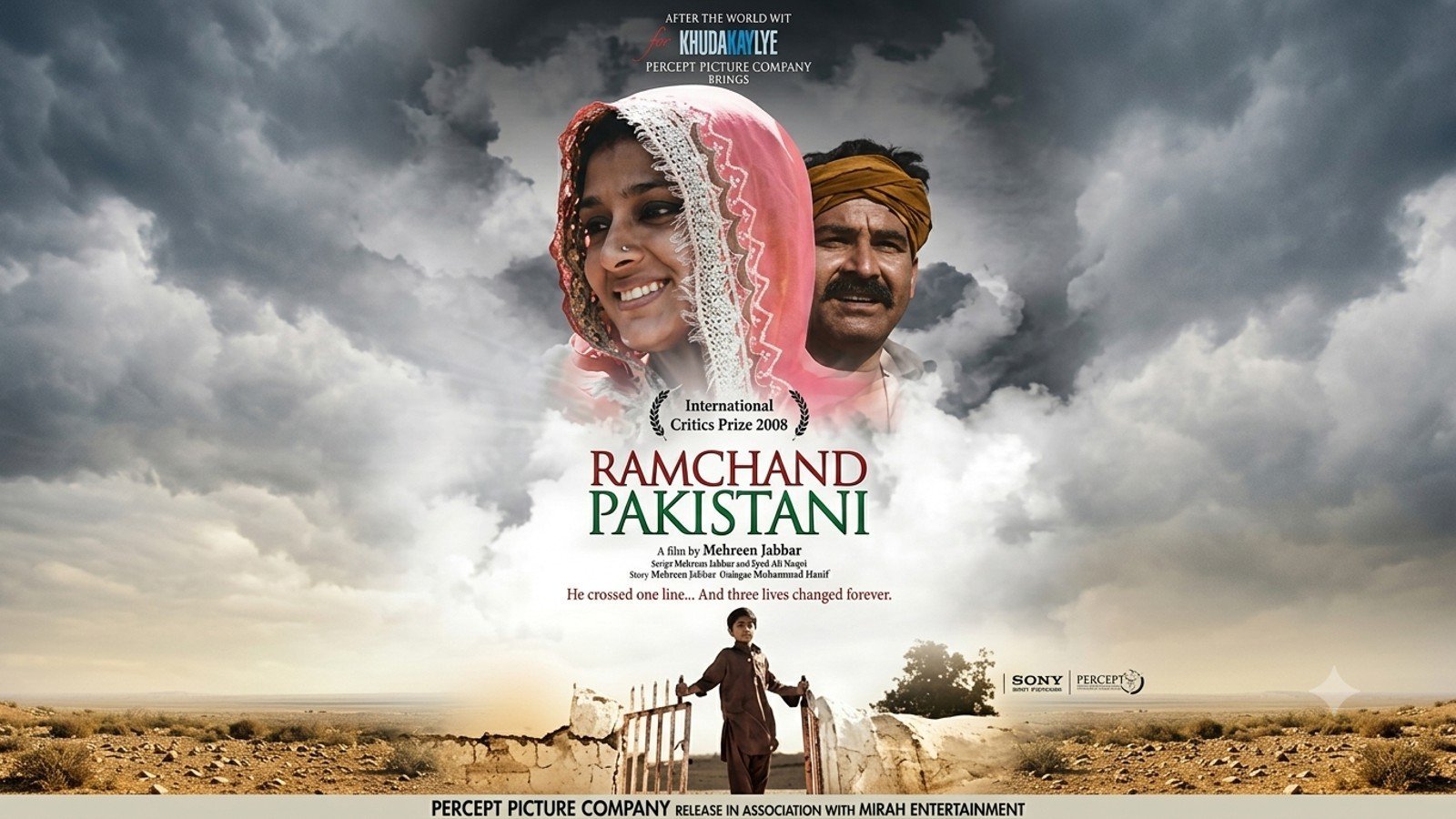
Ramchand Pakistani (2007)
Cast: Nandita Das, Rashid Farooqui, Syed Fazal Hassan, Noman Ijaz, Maria Wasti
Director: Mehreen Jabbar
Music Director: Debajyoti Mishra
Synopsis: Topical film about a young boy and family trapped in a political quagmire
Reviewed by: Omar Khan
This digitally shot Pakistani production finally arrived after considerable anticipation and, thankfully, it does not disappoint. Mehreen Jabbar had already earned a reputation as one of Pakistan's more thoughtful television directors, producing dramas that rose well above the brain-dead mediocrity dominating much of the local airwaves. Ramchand Pakistani marked her first major feature film, reportedly made for around US$700,000—a modest sum by international standards but a sizeable investment for Pakistani cinema at the time.
Most importantly, it demonstrates exactly where Pakistani cinema should have been heading.
It is also worlds apart from the bombastic, Bollywood-inspired piffle associated with the likes of Javed Sheikh. While his productions often seemed trapped in an outdated cinematic language inherited from 1980s commercial Hindi cinema, Ramchand Pakistani aspires to something altogether more intelligent and humane.
Shot largely in the deserts of Sindh by a predominantly American technical crew, the film tells the story of a young Hindu boy who accidentally crosses the Pakistan-India border while chasing after a pig. Arrested by Indian border guards, he is imprisoned, and when his father crosses in search of him, he too is arrested. The pair suddenly find themselves trapped inside the Indian prison system, forgotten by both governments and condemned to years of bureaucratic limbo.
One interesting observation is the depiction of the prison itself. While certainly overcrowded, it is presented as surprisingly clean and orderly—perhaps cleaner than many Pakistani viewers might expect from a prison on the other side of the border. Whether intentional or not, it is a small detail that quietly avoids descending into simplistic nationalist caricature.
The early portions of the film are set in rural Sindh, although one cannot help noticing that what must surely be the only Urdu-speaking village in the province has somehow found its way onto the screen. The villagers converse in immaculate Urdu when, in reality, attempting such conversations in the interior of Sindh would probably leave one relying on sign language before long.
This is clearly a deliberate creative decision rather than an oversight. By using Urdu instead of Sindhi, Jabbar ensured the film remained accessible to audiences across Pakistan and, importantly, to viewers in India, where the film was also intended for release. It was an understandable compromise, even if it sacrifices a little authenticity.
Where the film truly succeeds is in its quiet humanity.
Rather than relying upon melodrama or overt political grandstanding, Jabbar simply tells the story with remarkable restraint. The harsh beauty of the Sindh desert becomes a character in itself, while the film gently exposes the realities of poverty, feudal oppression and the arbitrary cruelty of borders that divide people who often have far more in common than politicians would care to admit.
The performances are uniformly strong.
The young actor playing Ramchand is instantly likeable, natural and entirely free of the precociousness that has often plagued child performances in Pakistani cinema. His innocence provides the emotional core of the picture. The actor playing his father is equally convincing, quietly conveying the despair of a man powerless to protect his own child.
Maria Wasti acquits herself well, her dialogue and mannerisms feeling authentic enough to avoid becoming distracting.
The prison inmates, portrayed largely by familiar faces from Pakistani television, are a mixed bag. Some performances are understated and believable, others feel a little too theatrical, though none seriously undermine the film. One inmate's chronic flatulence provides occasional comic relief—a slightly curious diversion in an otherwise restrained drama—but thankfully these moments never overwhelm the story.
Among the supporting cast, Salim Meraj once again demonstrates why he remains one of Pakistan's finest actors. Despite having very little dialogue, he communicates volumes through expression alone.
The standout performance, however, belongs to Nandita Das.
As Ramchand's abandoned mother, suddenly left to fend for herself within a harsh feudal society, Das delivers a performance of extraordinary dignity and emotional honesty. She never reaches for easy sentiment, and her quiet resilience becomes one of the film's greatest strengths. Like every project she touches, she elevates the material simply by being present.
The music is equally effective, with one or two memorable songs by Shubha Mudgal adding emotional texture without ever overwhelming the narrative.
At the time of its release, comparisons with Shoaib Mansoor's Khuda Kay Liye were inevitable. While Mansoor's film wore its politics openly and often delivered its themes through speeches, Ramchand Pakistani adopts a far more understated approach. Mehreen Jabbar trusts silence, observation and character rather than rhetoric. It is, in many respects, the more subtle and arguably the more mature piece of filmmaking.
The film is not without flaws. The second half occasionally loses momentum, and the climax never quite delivers the emotional knockout one expects after such a powerful build-up. Yet perhaps that very restraint is also one of its virtues. Life does not always culminate in grand cinematic catharsis, and Jabbar refuses to manufacture one merely to satisfy convention.
Viewed today, Ramchand Pakistani occupies an important place in the history of Pakistani cinema.
When it appeared, the local industry seemed to be entering its final decline. Cinema halls were closing, productions were becoming fewer each year, and genuinely ambitious filmmaking had become increasingly rare. In that bleak landscape, Mehreen Jabbar's debut felt like a beacon of hope—a film demonstrating that Pakistani cinema was still capable of intelligence, compassion and artistic ambition.
Fortunately, history proved more optimistic than many of us dared imagine. The revival that followed would eventually produce a new generation of filmmakers, but Ramchand Pakistani remains one of the important stepping stones that helped point the industry in a better direction.
Thoughtful, beautifully crafted and deeply humane, it remains one of the landmarks of modern Pakistani cinema and a film every serious student of South Asian cinema should experience.

0 Comments
Leave a Comment