
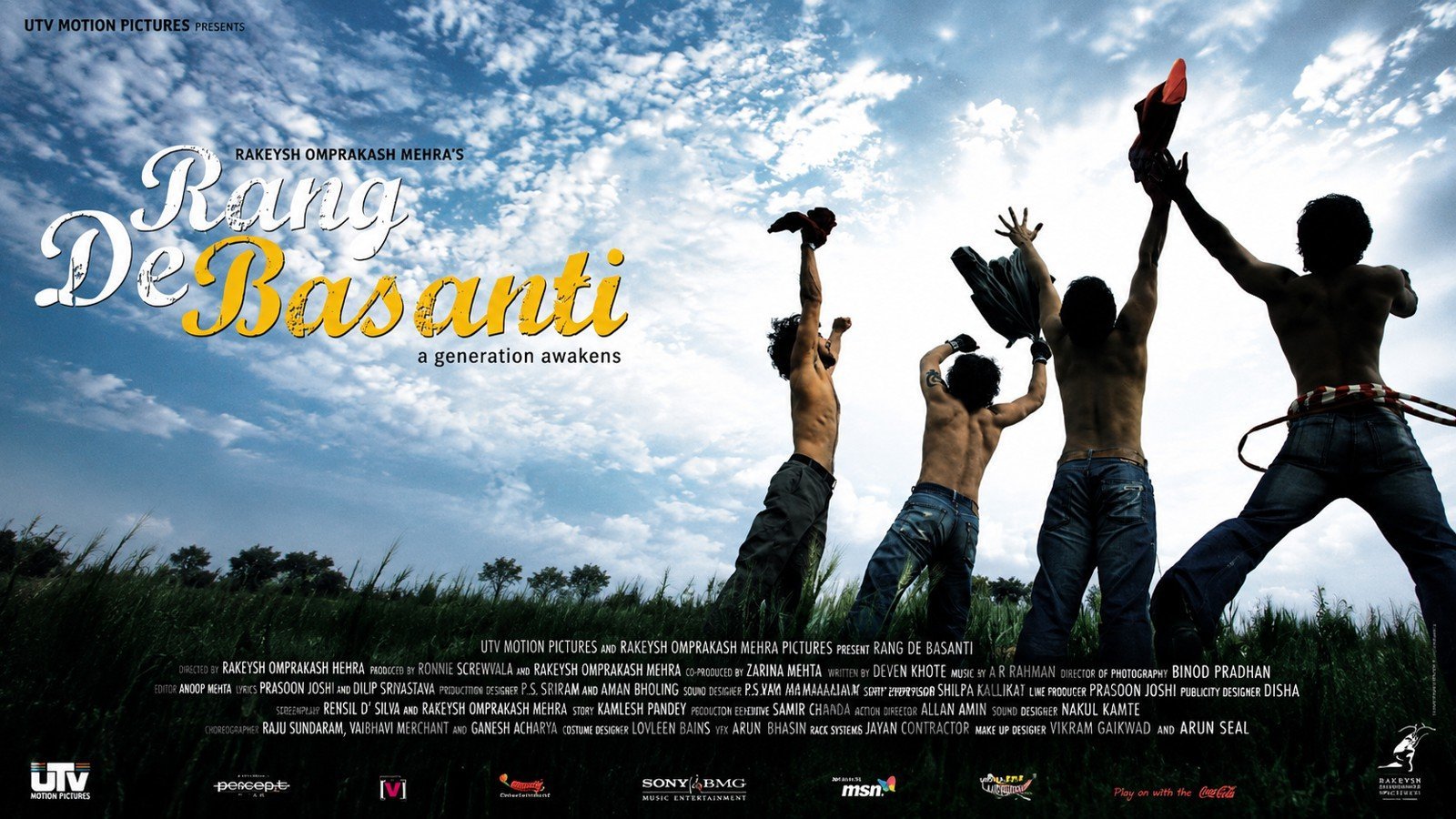
Rang De Basanti (2006)
Cast: Aamir Khan, Siddharth, Atul Agnihotri, Kunal Kapoor, Alice Patten Soha Ali Khan
Director: Rakeysh Omprakash Mehra
Music Director: A.R Rahman
Synopsis: Brilliant "coming of age" tale of the youth of today.
Reviewed by: Faiz Khan
Rang De Basanti (2006)
What does history offer the youth of today? Detached from the struggles and sacrifices of previous generations, history often appears little more than a dusty relic, something confined to textbooks and examination halls. Consumed by materialism and surrounded by corruption that permeates every layer of society, many simply adapt to the world they inherit, painting their own colours upon its canvas while forgetting the significance of one colour above all others—yellow, the colour of sacrifice.
The ideal of the "American Dream" has long since travelled far beyond America's shores, but in our part of the world it has often been stripped of its original meaning. Success at any cost has become the mantra, and that cost can all too easily include dishonesty, exploitation, corruption and worse. Against this backdrop, Rang De Basanti asks a deceptively simple question: can history still inspire a generation that believes it has nothing left to learn from it?
The film opens with sepia-toned images of Bhagat Singh and his fellow revolutionaries walking towards the gallows, linked to the present through the diary of a British jailor, Mr McKinley. His granddaughter Sue (Alice Patten) travels to India to make a documentary about the freedom fighters, aided by her friend Sonia (Soha Ali Khan).
Finding actors proves difficult until Sonia introduces her circle of friends: DJ (Aamir Khan), Karan (Siddharth), Sukhi (Sharman Joshi), Aslam (Kunal Kapoor) and eventually the fiercely nationalistic Laxman Pandey (Atul Kulkarni). They seem the least likely candidates imaginable.
DJ, now well beyond his university days, refuses to let go of student life because adulthood offers little beyond disappointment. Karan, the cynical son of wealthy businessman Mr Singhania (Anupam Kher), dreams only of escaping to America. Aslam struggles with the religious divisions within his own family, while Sonia simply enjoys life alongside her friends. Laxman Pandey, meanwhile, views anyone outside his own rigid ideology with open hostility.
Politics, patriotism and history mean almost nothing to any of them.
Nevertheless, Sue persuades them to participate in her documentary. Initially, it is little more than an amusing diversion, but as they immerse themselves in the lives of Bhagat Singh, Chandrashekhar Azad, Ram Prasad Bismil, Rajguru and their fellow revolutionaries, something begins to change. The ideals they are portraying slowly seep into their own consciousness.
As Ajay Rathore (R. Madhavan), Sonia's Indian Air Force fiancé, memorably observes, "Ghar ki safai mein kaun haath gande karna chahta hai?" Who wants to dirty their hands cleaning their own house?
It is his fate that ultimately becomes the catalyst for the group's awakening. Past and present begin to blur, history echoing through contemporary India until it becomes impossible to separate one from the other. The enemy may have changed, but the struggle against injustice remains remarkably familiar.
Rakeysh Omprakash Mehra has crafted something genuinely special. This is a political film that rarely feels political, a patriotic film that never descends into hollow sloganeering, and an intensely emotional drama that earns every one of its powerful moments. Corruption, communalism, idealism, apathy and the responsibilities of citizenship are explored without reducing the characters to mere mouthpieces for ideology. Mehra trusts both his audience and his story, allowing ideas to emerge naturally from the drama rather than preaching at every opportunity.
The screenplay itself is the film's greatest triumph. The seamless weaving together of past and present gives Rang De Basanti a narrative energy that rarely falters, transforming what could easily have become an earnest lecture into something vibrant, moving and deeply involving.
The film simply would not exist in quite the same form without Aamir Khan. As the only established superstar in the cast, he could easily have dominated proceedings, demanding the grand speeches, the heroic close-ups and the emotional spotlight. Instead, he retreats into the ensemble, allowing every character the room to breathe. That confidence is precisely what makes his performance so remarkable.
DJ begins as the carefree, wisecracking Punjabi who refuses to grow up, yet Aamir charts his transformation with extraordinary subtlety. By the time grief finally overwhelms him, his breakdown with Sue becomes one of the film's most emotionally devastating moments. It is a performance built not upon theatrics but quiet conviction.
The supporting cast is uniformly superb. Siddharth brings real depth to Karan's journey from detached cynic to committed idealist. Kunal Kapoor gives Aslam a quiet dignity, while Sharman Joshi provides warmth without ever reducing Sukhi to comic relief. Atul Kulkarni is outstanding as Laxman Pandey, avoiding caricature and creating a man whose certainties are slowly dismantled by friendship itself.
R. Madhavan leaves a lasting impression despite relatively limited screen time, while Soha Ali Khan delivers perhaps the finest performance of her career. Natural, unaffected and beautifully understated, she brings warmth and humanity to every scene she inhabits.
Special mention must also go to Kirron Kher, magnificent as DJ's mother, and to Waheeda Rehman, whose brief appearance carries extraordinary emotional weight.
Finally there is Alice Patten. Foreign performers in Hindi cinema have too often been reduced to decorative stereotypes, yet Patten never once feels out of place. Her Hindi is convincing, her performance entirely natural, and she becomes the emotional bridge between India's past and present with remarkable ease.
A.R. Rahman's score is nothing short of sensational. Blending contemporary rock with traditional Indian musical influences, he creates one of the defining soundtracks of modern Hindi cinema. Binod Pradhan's cinematography captures both the youthful exuberance of Delhi and the haunting beauty of the historical sequences with equal assurance, while the dialogue consistently rings true.
At a time when Bollywood seemed increasingly content to recycle Hollywood thrillers and churn out one uninspired remake after another, Rang De Basanti arrived like a breath of fresh air. Honest, original, passionate and profoundly moving, it demonstrated that mainstream Hindi cinema could still entertain while engaging with meaningful ideas.
More than simply a fine film, Rang De Basanti became a cultural event. Few contemporary Indian films have managed to capture the spirit of an entire generation while simultaneously reminding it that the freedoms it enjoys today were purchased through sacrifice yesterday.
A remarkable achievement, and unquestionably one of the defining masterpieces of modern Indian cinema.

0 Comments
Leave a Comment