
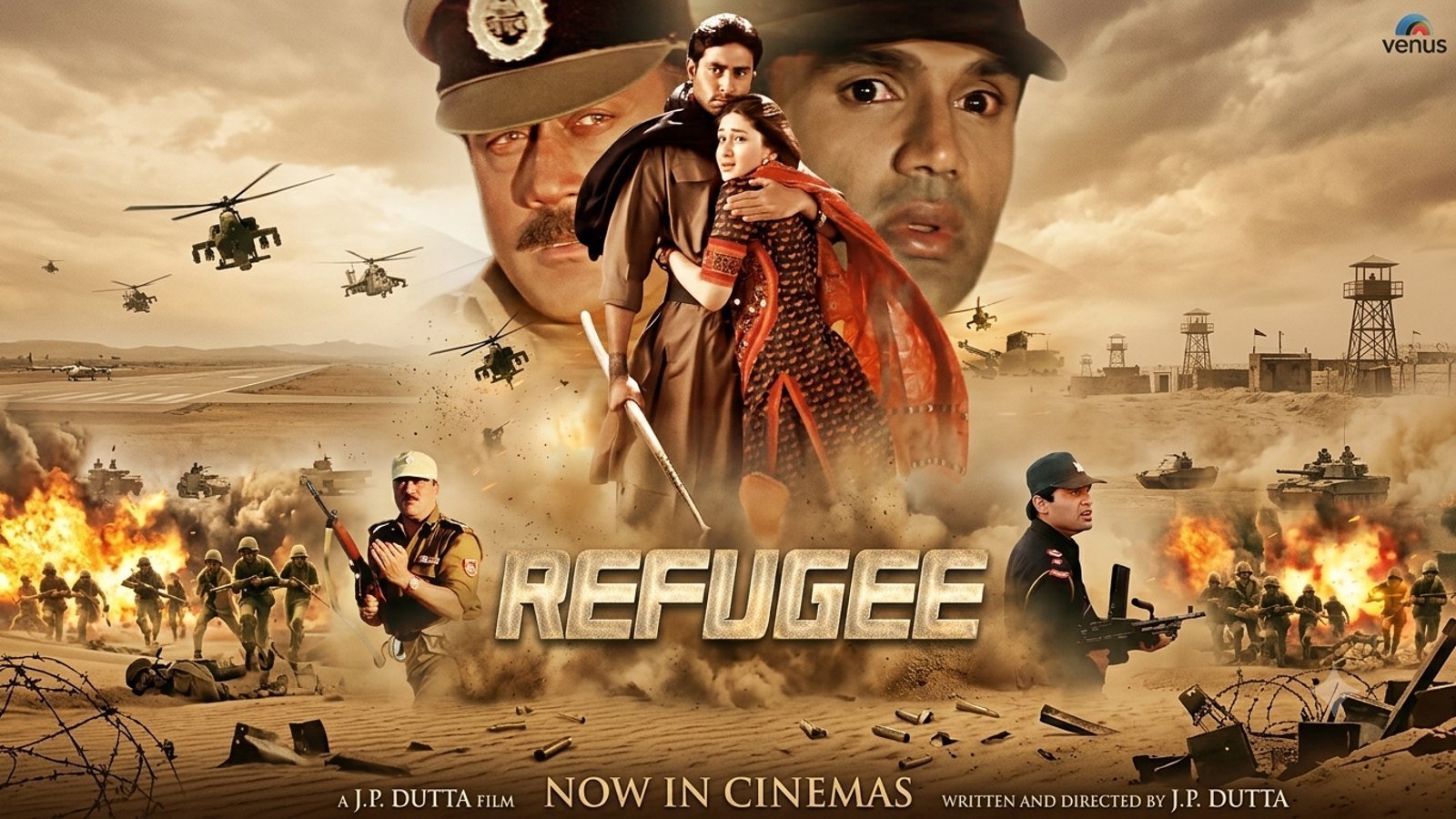
Refugee (2000)
Starring: Jackie Shroff, Sunil Shetty, Abhishek Bachchan, Kareena Kapoor.
Director: J.P.Dutta
Synopsis: J.P. Dutta, king of the sprawling Epic does it again....Abhishek Bachchan debuts.
Reviewed by: Faiz Khan
The film opens with a voice-over explaining the migration of thousands of Muslims from Bihar to what was then East Pakistan during Partition.
Rejected by many in East Pakistan, these Urdu-speaking migrants eventually found themselves confined to refugee camps after the creation of Bangladesh, living in the hope that one day they would be repatriated to what was now Pakistan. Some attempted the perilous journey across India, hoping to reach the Pakistani border through illegal routes.
From this backdrop begins Refugee.
Two families escape Bangladesh and arrive in a remote village near the border, waiting to be smuggled into Pakistan. Their passage is arranged by Jan Mohammad (Anupam Kher), while the dangerous crossing itself is entrusted to a mysterious young guide known simply as "Refugee" (Abhishek Bachchan).
He has no surname.
No nationality.
No identity.
He could be Hindu, Muslim or Christian.
He belongs nowhere.
Among those making the journey is Naaz (Kareena Kapoor), and inevitably love blossoms during the hazardous crossings between India and Pakistan. But this being a Bollywood romance, true love is destined to encounter obstacles, misunderstandings and eventually the arrival of a far more socially acceptable suitor in the shape of Pakistani officer Mohammad Ashraf (Suniel Shetty).
Refugee arrived carrying enormous expectations.
Not only was it J.P. Dutta's first film after the success of Border, it also launched two of the industry's most famous star children—Abhishek Bachchan and Kareena Kapoor. Watching it with a packed audience, Abhishek's first appearance was greeted with thunderous whistles and applause. The audience desperately wanted him to succeed.
Perhaps that very expectation works against him.
I found myself wondering afterwards whether I had judged him too harshly because of his illustrious parentage. Yet honesty compels me to admit that I came away rather disappointed.
His performance lacks the emotional intensity the role desperately requires. Refugee is a fascinating concept—a man without a country, drifting between borders while helping others find a homeland—but the screenplay never allows us inside his head. We never truly understand what has made him reject identity, why he empathises so deeply with those crossing the border, or what emotional wounds he carries beneath his quiet exterior.
There are visual hints of transformation. His wardrobe evolves from sombre black to hopeful white after meeting Naaz, suggesting that love restores something he had lost. Yet emotionally the character remains frustratingly opaque.
It is only a debut, and there is certainly promise, but I never felt the fire that should have burned beneath the surface.
Kareena Kapoor, by contrast, is a revelation.
She is wonderfully natural from her very first scene, completely at ease before the camera and effortlessly believable. Whenever she appears, the film comes alive. It is a remarkably assured debut and immediately announces the arrival of a major talent.
Suniel Shetty enjoys one of the film's strongest supporting roles as a Pakistani police officer. Although sincerity is never lacking, he remains somewhat stiff in places and never entirely convinces. Jackie Shroff contributes a brief but dependable performance in his customary style.
Anu Malik's music is unquestionably among the finest work of his career.
Mere Humsafar, Panchhi Nadiyan and Aisa Lagta Hai are all beautifully composed and exquisitely rendered by Sonu Nigam and Alka Yagnik. Panchhi Nadiyan, accompanied by breathtaking images of flamingos soaring above the wetlands, lingers in the memory long after the film has ended.
As one would expect from J.P. Dutta, Refugee is handsomely mounted and magnificently photographed. The landscapes become characters in themselves, beautifully capturing the vast emptiness of the borderlands.
Its greatest weakness is length.
Running well over three hours, the film simply outstays its welcome and could comfortably lose thirty minutes without sacrificing anything essential.
The screenplay also suffers from several inconsistencies.
Most notable is Refugee's impassioned speech while being beaten by Pakistani police, during which he suddenly speaks emotionally about his homeland. This sits rather awkwardly with a character who has spent the entire film insisting he belongs nowhere.
There is also a small but obvious linguistic slip. During one interrogation Refugee uses the word vishwas. Any native Urdu speaker would immediately recognise that as a Hindi usage rather than the more natural Urdu equivalent. It is a tiny detail, but one that stands out given the film's attention to Indo-Pakistani identity.
Yet despite these flaws, Refugee remains a deeply sincere film.
J.P. Dutta's heart is unmistakably in the right place. Rather than dwelling on political rhetoric, he asks a remarkably simple question:
We speak the same languages.
We eat the same food.
We look the same.
Why, then, do we hate one another?
His answer—that ordinary people are too often divided by politicians, armies and history—may seem simplistic, perhaps even naïve, but there is undeniable truth within it. One senses that Dutta genuinely believes in the possibility of reconciliation, and that sincerity gives the film an emotional honesty that transcends many of its dramatic shortcomings.
Perhaps I ultimately expected something richer dramatically, something that rose above the familiar romantic clichés of mainstream Hindi cinema. Instead, Refugee settles for a more conventional love story wrapped around an admirable message of peace.
For that message alone, and for the conviction with which it is delivered, the film deserves both respect and a viewing.

0 Comments
Leave a Comment