
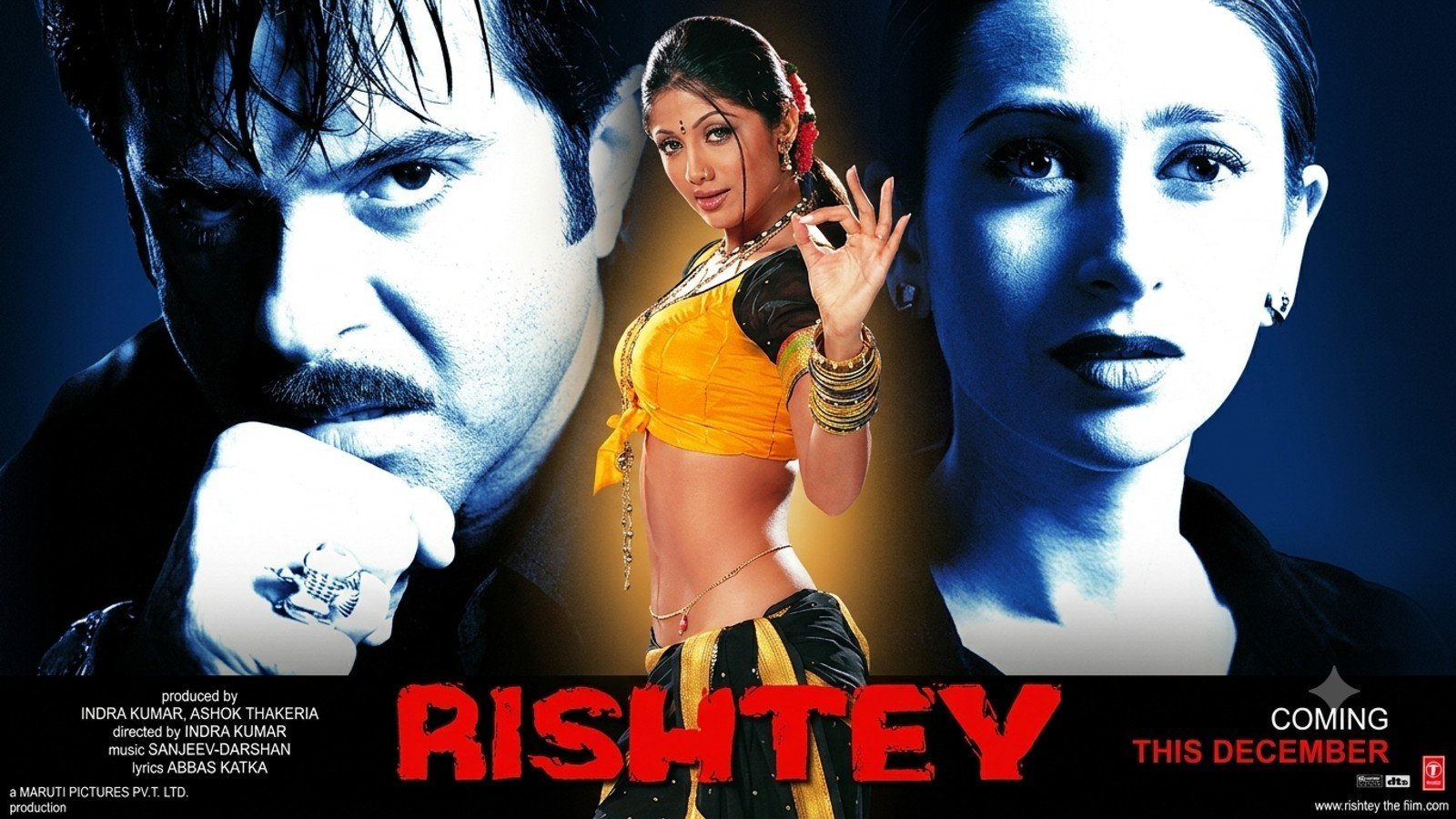
Rishtey (2002)
Cast: Anil Kapoor, Karisma Kapoor, Shilpa Shetty
Director: Inder Kumar
Music Director: Sanjeev Darshan
Synopsis: stale, dated hotch potch of a pot boiler that fails to get bubbling
Reviewed by: Faiz Khan
Indra Kumar enjoyed a remarkably successful run with films like Dil, Beta and Raja before finally stumbling with Mann, a film so desperate to please every conceivable audience that it drowned beneath an avalanche of syrupy melodrama. He followed that debacle with the lamentable Aashiq and now serves up yet another exercise in emotional excess with Rishtey.
The film opens with Suraj (Anil Kapoor) fleeing with his infant son while hired thugs, dispatched by his Machiavellian father-in-law (Amrish Puri), pursue them relentlessly. Escaping, Suraj raises the child in a humble basti, where the voluptuous Vyjayanti (Shilpa Shetty) has designs on the devoted single father.
Except, of course, he isn't really a widower.
The inevitable secret from his past emerges once Vyjayanti proposes marriage, and the film plunges headlong into a labyrinth of flashbacks, misunderstandings and melodrama.
Suraj, a humble street boxer, had once fallen in love with wealthy heiress Komal (Karisma Kapoor). Her father naturally disapproved, the couple married anyway, and the enraged patriarch devoted the remainder of his existence to destroying their marriage and, for good measure, murdering his own grandson.
Komal, meanwhile, is written as an extension of the neurotic, possessive wife Karisma had already played in Haan Maine Bhi Pyaar Kiya. Jealousy governs her every waking moment.
Suraj attempts to reassure her with immortal lines such as:
"Jiski chaand jaisi mehbooba ho, woh bujhte hue lantern ko kyun dekhega?"
It is precisely this brand of overwrought dialogue that permeates the entire film.
The absurdities soon begin piling up.
A nightclub vamp (Deepshikha), who has spent much of her screen time aggressively throwing herself at Suraj, somehow manages to sneak into his apartment on precisely the day Komal returns home accompanied by her reconciled father. She conveniently plants lipstick marks on Suraj's kurta, leaves behind an earring and quietly disappears before anyone notices.
How she enters the flat, why nobody sees her, or how she stages this elaborate deception is apparently beneath the screenplay's concern.
Naturally Komal believes everything instantly.
Naturally she goes into labour.
Seven years later she has transformed into a permanently distraught violin-playing socialite seemingly prone to dramatic balcony scenes. Having rediscovered her son, she embarks upon a legal battle to reclaim him through a combination of lies, manipulation and courtroom theatrics until the inevitable righteous judge restores justice to the universe.
Indra Kumar delivers a film that feels every bit as ancient as its clichés.
There are obvious echoes of The Champ, traces of Kunwara Baap, and countless other melodramas from decades gone by. Unfortunately, Kumar directs everything with the subtlety of a demolition crew. Every scene is played at full volume, every emotion exaggerated beyond recognition, every confrontation designed to wring yet another tear from an already exhausted audience.
The formula that somehow worked—however questionably—in Beta and Raja has finally collapsed under its own weight.
Anil Kapoor remains sincere throughout and works hard to lend credibility to material that rarely deserves it.
Karisma Kapoor looks beautiful, particularly in the elegant sarees she is given to wear, but the character itself is hopelessly underwritten. One cannot help wondering what attracted her to such a thankless role.
Shilpa Shetty undoubtedly receives the loudest whistles from the gallery and carries herself with confidence, but she remains every bit as loud and theatrical as ever. She possesses undeniable glamour, a striking screen presence and a wonderful figure, yet her performances still rely far too heavily on exaggerated expressions and broad gestures. She often resembles one of the more flamboyant heroines of the 1960s and 70s—working tremendously hard, but never quite convincing.
Amrish Puri fares even worse.
His villain belongs to another era altogether. The only thing missing is a smuggling syndicate hidden beneath his mansion. Frankly, it is something of a miracle that Indra Kumar resisted adding one.
Sanjeev-Darshan contribute an entirely forgettable soundtrack, and when one song begins sounding suspiciously indebted to Michael Jackson's Jam, it becomes painfully obvious that inspiration has run dry.
Perhaps it is finally time for Indra Kumar to abandon the formula that served him so well in the past and discover a new one.
Because this one is beyond repair.
Dire.

0 Comments
Leave a Comment