
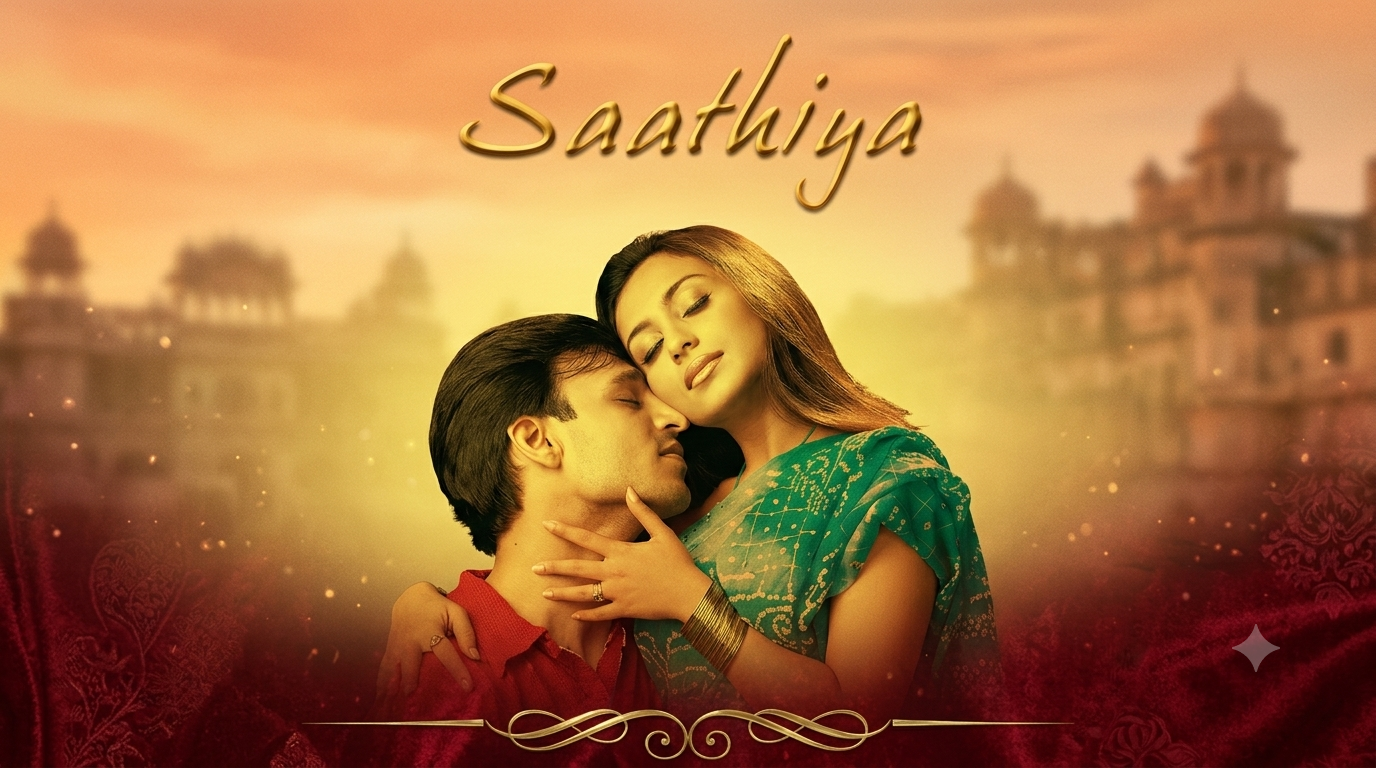
Saathiya (2002)
Cast: Rani Mukherjee Vivek Oberoi Tanuja Sharad Saxena Swaroop Sampat Satish Shah
Director: Shaad Ali
Music Director: A.R Rahman
Synopsis: -------
Reviewed by: Faiz Khan
Saathiya (2002)
"Teri ik haseen ke badle, meri yeh zameen le le... mera aasmaan le le."
Long after the closing credits have faded, those words continue to linger in the mind. They perfectly capture the tenderness and emotional sincerity that make Saathiya such an affecting little love story.
A remake of Mani Ratnam's Alaipayuthey, the basic plot could hardly be more familiar. Rich boy meets middle-class girl, parents object, lovers rebel. There is nothing remotely original in its premise.
So why does Saathiya work so beautifully?
The film opens with Aditya (Vivek Oberoi) waiting anxiously at a railway station for his wife Suhani (Rani Mukerji). Train after train arrives, but she never appears. Where is she? Why has she vanished? The mystery becomes the framework through which the film gradually unfolds, taking us back through the story of their relationship before returning full circle to the present.
Suhani comes from a modest middle-class family and dreams of becoming a doctor. Aditya belongs to an affluent household and first notices her at a wedding. His pursuit is relentless but charming, following her onto trains, outside college and eventually to her home. Love blossoms naturally and inevitably.
When Aditya's wealthy parents formally approach Suhani's family with a marriage proposal, class prejudice destroys any possibility of reconciliation. Humiliated by Aditya's snobbish father, Suhani's parents throw them out. Rather than surrender, the young couple secretly marry, convinced they can reveal the truth when the time is right.
That moment never comes.
Instead, they begin married life alone, discovering that romance and marriage are not always the same thing. Small domestic disagreements gradually replace youthful passion, and it is these ordinary marital tensions that become the emotional heart of the film.
Mani Ratnam's screenplay bears all the hallmarks of his writing. There is very little novelty in the story itself; the freshness lies entirely in its treatment. First-time director Shaad Ali wisely avoids excessive melodrama, presenting the relationship with warmth, restraint and refreshing honesty. Even the inevitable songs emerge naturally from the narrative rather than interrupting it.
The second half is particularly impressive. Rather than relying on manufactured crises, it finds drama in the everyday compromises, frustrations and misunderstandings that define married life. Those moments feel authentic precisely because they are so ordinary.
The obvious comparison is with Kunal Kohli's debut Mujhse Dosti Karoge!, another Yash Raj production released the same year. Where that film drowned itself in gloss and superficiality, Saathiya possesses genuine warmth and emotional conviction.
Rani Mukerji is perfectly cast as Suhani. Strong-willed yet vulnerable, devoted to her family yet unwilling to deny her own happiness, she delivers one of the finest performances of her career. Watching her here reminds one just how gifted an actress she can be when given worthwhile material.
Vivek Oberoi confirms the enormous promise he showed in Company. Although not conventionally handsome in the mould of many Hindi film heroes, he possesses an effortless charm and commanding screen presence. More importantly, he wisely avoids repeating the intensity of his debut, proving that he is capable of carrying a romantic lead with equal confidence.
The supporting cast is uniformly excellent, particularly Sharad Saxena and Tanuja, whose performances lend genuine emotional weight to the family conflict.
Visually, the film is beautifully photographed and crisply edited, but perhaps its greatest triumph lies in its music. A.R. Rahman's score, coupled with Gulzar's extraordinary poetry, elevates the film to another level altogether. Songs such as "Saathiya", "Chupke Se", "O Humdum Suniyo Re", "Chhalka Chhalka" and "Banjar Hai Sab Banjar Hai" are not simply interludes but emotional extensions of the narrative itself.
Gulzar's imagery is exquisite. Lines such as "Banjar hai sab banjar hai..." or "Chupke se raat ki chaadar tale..." linger long after the film has ended. Above them all stands the magnificent title song, surely one of Rahman's finest compositions and one of Sonu Nigam's greatest recordings. It possesses the same haunting quality that made "Chaiyya Chaiyya" unforgettable.
Saathiya may tell an old story, but it tells it with honesty, grace and emotional intelligence. Shaad Ali announces himself with a remarkably assured debut, while Rahman, Gulzar, Rani Mukerji and Vivek Oberoi combine to produce one of the most satisfying romantic dramas Bollywood has offered in years.
A beautifully judged love story that succeeds not because of its novelty, but because of its heart.

0 Comments
Leave a Comment