
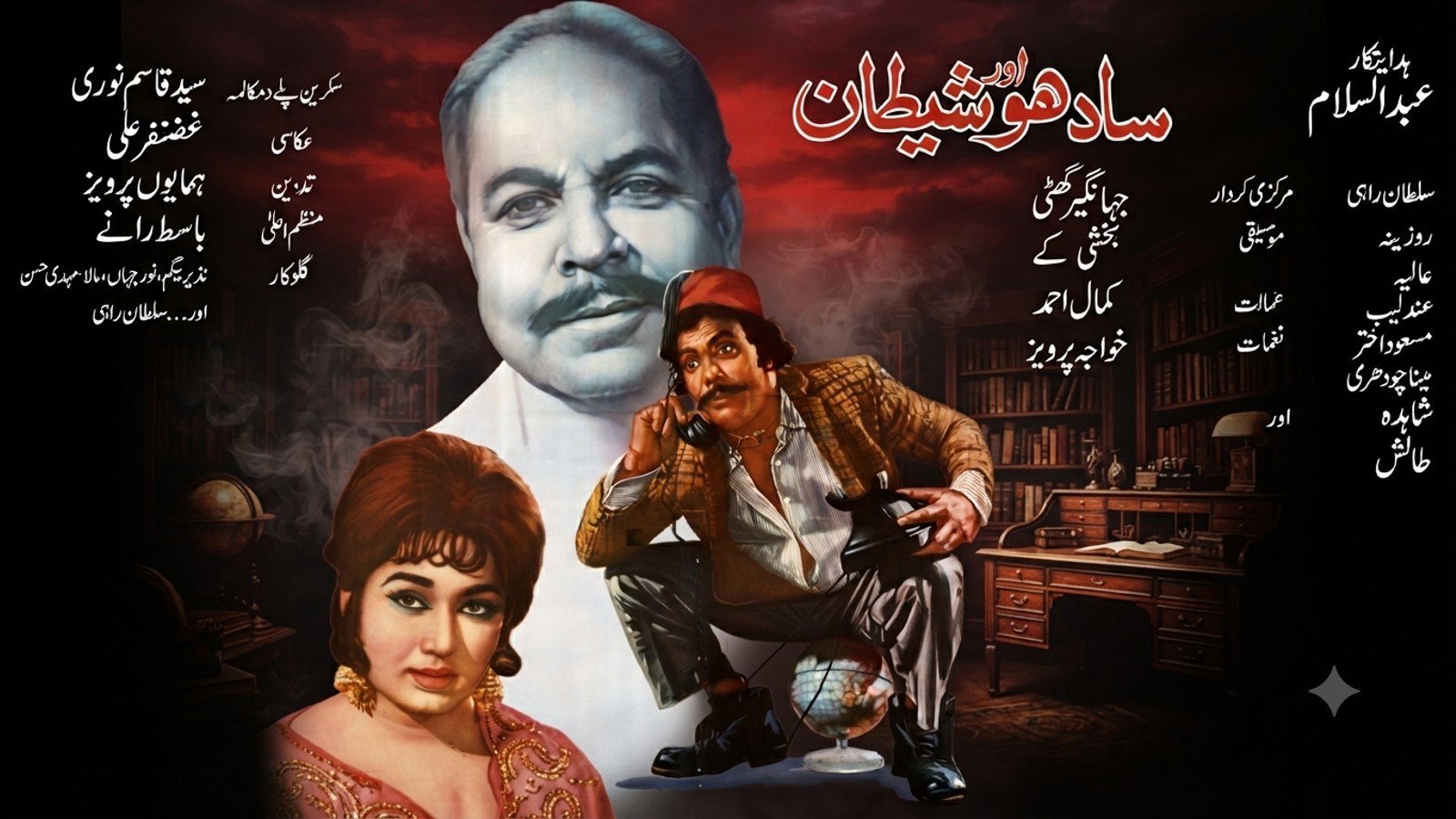
Sadhu Aur Shaitan (1973)
Cast: Rozina, Sultan Rahi, Talish, Andaleeb, Masood Akhtar, Ali Ejaz, Meena Chaudhary, Naeem Hashmi, Shahida, Tamanna, Sheikh Iqbal, Jahangir Mughal, Chakram, Kemal Irani, Naina
Director: Jehangir Bhatti
Synopsis: Two Dumb & Dumber village simpletons head to the city in an attempt to provide for their poverty-stricken families and get snared in a nasty web of intrigue.
Reviewed by: Omar Khan
Sadhu aur Shaitan is a film that arrived in cinemas without much fanfare despite the Basheera pairing of Rozina and Sultan Rahi. By the early ‘70s, most Urdu films had moved on to colour productions, and only those with shoestring budgets remained stuck in the old Black & White era. In 1973, a Black & White Urdu film was a pretty unattractive proposition for the Urdu filmgoer, and Sadhu aur Shaitan suffered at the Box Office due to this handicap.
After a novel title sequence, the film settles down to a hackneyed plot, mixing long periods of infantile comedy sequences in its first half with the second half devoted to the usual drama, tears and intrigue.
Raja (Sultan Rahi) and his buddy Dulari (Ali Ejaz) are two buffoons living a carefree life in the village with ailing parents to support. They cannot find work and are happy to while away the days as overgrown children. Raja has a disabled sister who no one will marry, increasing the burden on their folk, but they carry on oblivious, without a shred of responsibility. Finally, they head out to the city for work because matters are desperate at home, with their family’s survival at stake.
Landing in the city as two village bumpkins, they find themselves in a head spin, and utterly clueless about the ways of the city. They also make little headway in finding any work as they are unskilled, illiterate and unqualified for decent employment. One afternoon, bumming around as usual, they hear screams for help and rescue Rozina and her wealthy friends out for a picnic, attracting some goons who are intent upon raping them in broad daylight. Rozina and her best friend, students at a hostel, are smitten by their rescuers despite their grubby appearance and buffoonery. Rozina is the daughter of a highly respected city businessman, played by Talish.
Back in the village, Raja’s mother succumbs to her illness, leaving the disabled sister Shammo unable to cope. A kind uncle initially takes her in, but the wife Tammana’s monstrous ways are insufferable, and she too leaves for the city, hobbling on crutches without a penny to her name. She hopes to find her brother Raja in the town but doesn’t know how that might occur.
Meanwhile, Rozina’s infatuation with Raja and her friends with Dulari reaches a point of obsession, and they frequently burst into a song to vent their feelings. Jehangir plays an earnest police inspector who has good relations with Talish, and one day he too hears screams for help and rescues poor Shammo, who is on the verge of being ravaged by would-be rapists and saves her just in the nick of time. Jehangir, who in later years would make a mark as a top-notch villain, is quite the opposite in this film and brings helpless Shammo home, where he asks his mother to give her shelter.
Halfway through the film, the drama picks up when Raja and Bahadur attempt to find work. They find themselves entangled in a situation where though innocent, they could be implicated in a murder, and they strike a deal with a shady figure to keep them from trouble with the law. They are kitted out in city clothes and become operatives
Sadhu Aur Shaitan in a crime syndicate based in a seedy nightclub, a place where Meena Chaudhary is the star dancer.
A shocking twist arrives with the revelation of the Boss of this criminal organization, and matters now start to get a little sticky. Raja, Dulari and his club cohorts rob the city almost daily in broad daylight, but at the same time, jealousies and complications arise among their fellow criminals.
Matters slowly come to a head when Raja almost knocks his sister Shammo over in a getaway which torments him, and Rozina presses him to ask Talish for her hand in marriage. The plot thickens steadily, heading towards a climax with some shocking revelations made. Along the way, there are several saucy club dances by the delectable Meena Chaudhary, and the usual fight scenes with evil Jehangir Mughal doing his thing to good effect. Perhaps the most surprising event along the way is a song recorded by Sultan Rahi as a playback singer, where he manages to hold a tune reasonably well. There is a court scene, some tears, and some joy as all plot threads come together in an underwhelming but satisfactory manner to bring events to a conclusion. The drama doesn’t quite spark to excite audiences, nor does the film hit the tear ducts in a way to render it a “Ladies first choice” affair.
The first half of the movie is tedious. It contains some dreadful overacting by Ali Ejaz and especially Sultan Rahi, both trying too hard to be amusing but failing miserably. Rozina and Andaleeb don’t have the scripts to get their teeth into, but the former mainly displays some of her signature dance moves. Kemal Irani occasionally appears, playing a weirdo in a pivotal part.
The film has the usual ingredients of a formula for success but falls short in the dramatics, the execution and the glamour. It also has no memorable hit songs to draw in the crowds, and it lacks sparkle, glamour and fizz, and being in Black & White, it was doomed to failure.
Not funny enough, not dramatic enough, not sleazy enough and not enough of a tearjerker to click with audiences. The film barely lasted a few weeks in cinemas which is no surprise.

0 Comments
Leave a Comment