
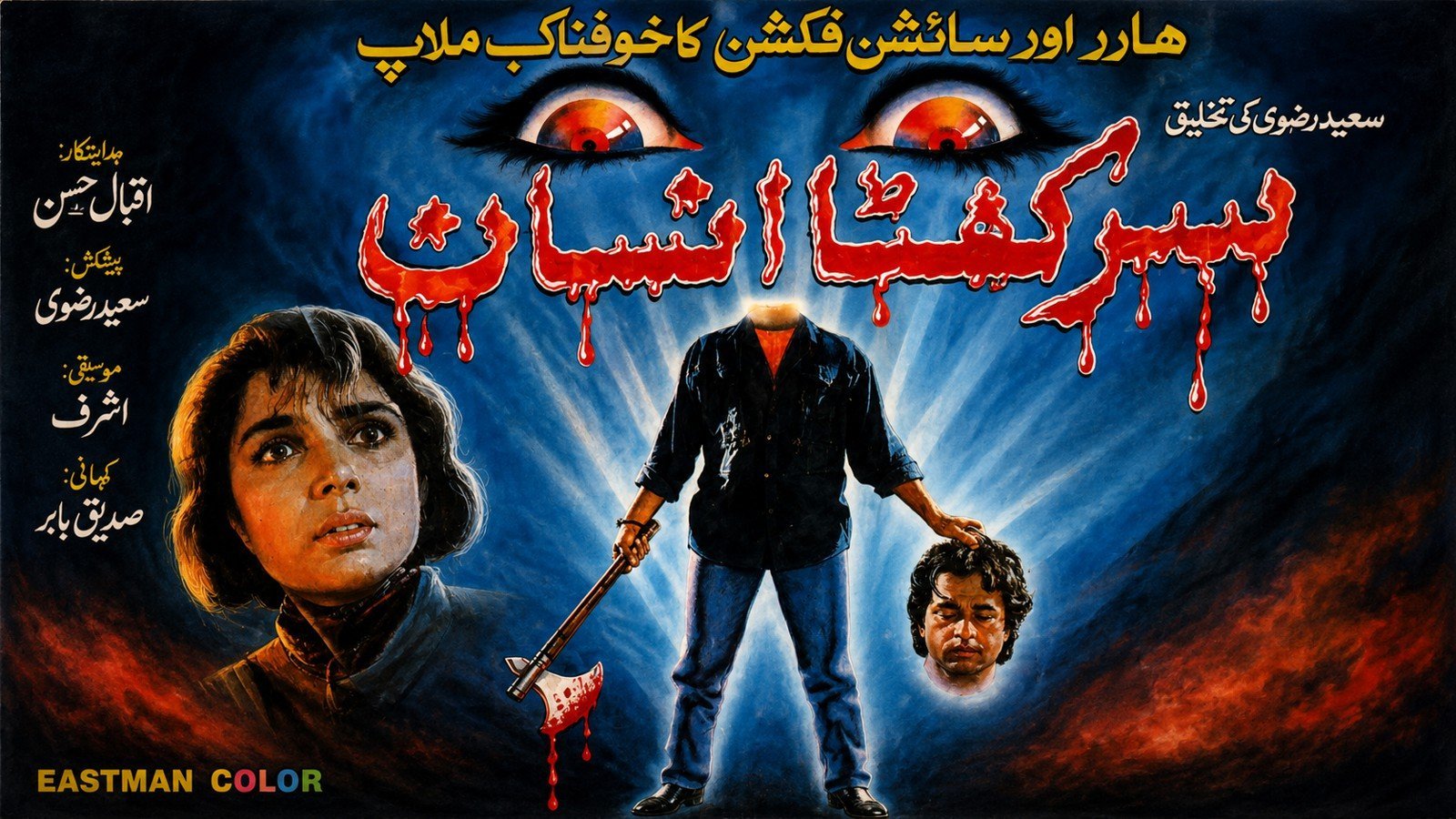
Sar Katta Insan (1994)
Cast: Ghulam Mohiuddin, Babra, Nayyar Sultana, Izhar Qazi, Qavi, Asif, Adeeb
Director: Saeed Rizvi
Synopsis: Frankenstein meets Dirty Harry in Lollywood’s BEST FILM of 1994 winner.
Reviewed by: Omar Khan
The Rizvi family of filmmakers from Karachi ought to be lauded for their risk-taking/experimenting. Several of their home productions have at least attempted to break away from the stale Lollywood formula of “light” romantic comedy, violence, and mushy dramatics. These devout Karachi folk built their studios, so they wouldn’t have to travel to Lahore each time they shot a film.
In 1989, the Rizvis released a much-hyped “first science fiction film of the sub-continent,” named Shanee, which proved popular and managed to bag an award or two.
Encouraged by his success with science fiction and hooked on special effects, the senior Rizvi began to concoct his next magnum opus. A film that would again be heavily reliant on special effects and make-up, but instead of the Raiders of the Lost Ark-like scenario of 1989’s Shanee, this new film would have a sort of desi-gothic setting with horror as the story’s backbone. The Rizvi’s signed up several actors from Shanee, including Babra Sharif, Nayyar Sultana, Asif Khan, Izhar Kazi and Talish. Ghulam Mohiuddin signed on in the key role of the Sarkata Insaan.
This film follows a similar pattern to Shanee’s—a “dead” man returns from the “outside” to find that he appears to have a mission to accomplish, tracking down those responsible for his premature death. However, while Shanee was more of an adventure film, Sarkata Insan is an outright horror film that includes fleeting moments of spectacular gore, memorable imagery, and thinly disguised political references. It’s a horror film that attempts to be somewhat profound—a noble effort, but whether it succeeds in this endeavour is rather questionable.
1967 witnessed Lollywood produce a version of Bram Stoker’s Dracula. This time, Rizvi appears to be taking more than a leaf out of Shelley’s Frankenstein, as the film begins with a mad scientist (Qavi) attempting to bring a carcass back to life. This experiment has a strange twist, involving getting the dead back to life and merging one man’s head with another man’s body. Here’s the twist, the head (freshly killed) belongs to a brilliant police officer, Anwer (Ghulam Mohiuddin), while the body he is attached to is that of a cold-hearted murderer!
The mad scientist’s diabolical experiments are being funded by a notorious group of international terrorists, who aim to destabilize the country for their nefarious purposes. Unfortunately, like all mad scientist’s deranged schemes, this one, too, goes horribly wrong, and “Super Mission,” as the creature is known, walks up to the severed head, attaches it to his neck, and walks off triumphantly, having caused Qavi’s lab severe damage.
The creature seems to be ruled by the brain of the instinctively good police officer by day. Still, by night, the creature’s body is taken over by the murderous spirit of its previous inhabitant. It takes to remove the head from its neck and walk around town with a sharp axe
Sar Katta Insan in one hand and the severed head in the other—not a pretty picture. The good Anwer tries to subdue the killer instincts of the mass murderer but fails as the body count continues to mount. Then he realizes that he has to harness and channel the murderous rage by turning it against that criminal terrorist network responsible for his death less than a week ago. So, the headless creature stalks at night, searching out the scummy terrorists.
Meanwhile, an impish Lois Lane-type Ambreen (Babra Sharif), develops a massive schoolgirl crush on the dead creature, leading to awkward complications. This desi fusion of the typical revenge masala film and the Frankenstein story must be commended, if only because it differs from the drab, run-of-themill norm. However, it suffers from the usual problems that films of this nature from the sub-continent share—they don’t quite know if they want to be a horror film or a romance, or a typical “commercial” film.
Filmmakers seem so straight-jacketed by their reliance on “the prescribed formula” that they have to pander to all the ingredients of the magic “formula”. Thus, you get horror films being injected with romantic subplots and extended comedy routines, as well as songs that destroy any semblance of tension that the story might have been able to create.
Another rigid formula that seemingly has to be followed is one of running length—it seems that the filmmakers perceive that unless they provide films that are over 2 hours and 20 minutes, they will be seen to be ripping off the public. Sarkata Insaan could have benefited enormously with some judicious and extensive cutting.
The plus points are a restrained performance by Ghulam Mohiuddin, which won him the Best Actor Nigar award, and some effective camerawork and lighting, both of which also won awards. The film’s low point is an abysmal disco number picturized on Babra Sharif that features a particularly loathsome Ninja Turtle, and his equally nauseating friends bopping along with the impish Ms. Sharif to a song that is beyond unlistenable.
The special effects, which needed to be very impressive to give the film any credibility, are spectacularly and laughably bad, though there are moments when they scrape by. The film was awarded the Best Film of the Year Nigar Award for 1994 (a total of 8 Nigars won), perhaps due to its sensitive, thoughtful and positive portrayal of the creature and his quest to rid the nation of nasty anti-state elements.
A sober, noble effort from the Rizvi clan but a word of warning for lusting horror fans—this ain’t no Zinda Laash!


0 Comments
Leave a Comment