
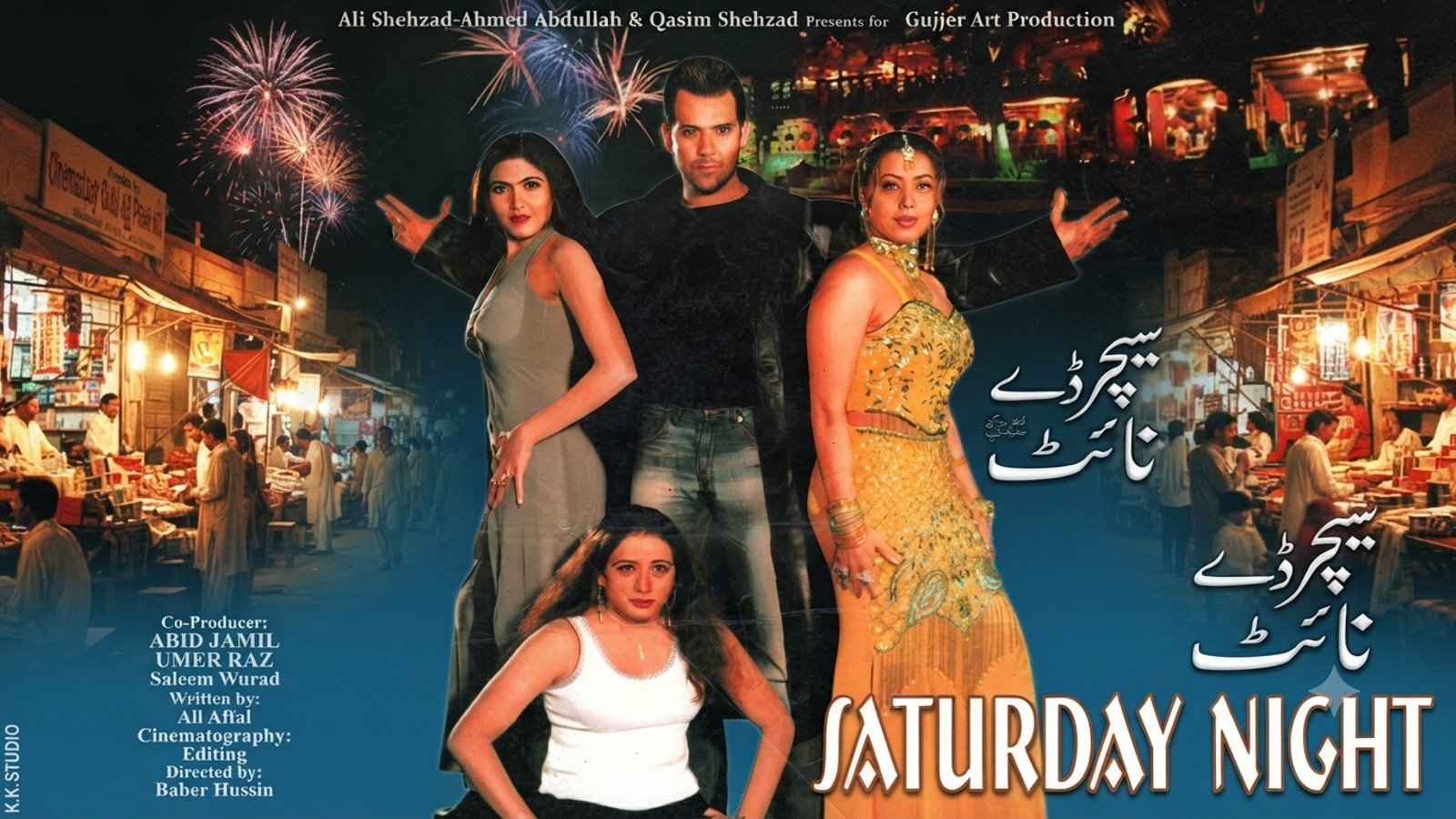
Saturday Night (2006)
Cast: Moammar Rana, Megha, Aqsa, Haya, Diya, Abida Baig
Director: Rashid Doggar
Music: Ali Afzal
Synopsis: A serial Killer is slicing up the “dirty” girls of Lahore on Saturday Nights!
Reviewed by: Omar Khan
Dumbfounded watching a giant masterwork of crap called Black Devil Doll from Hell, and desperately seeking an antidote in the form of A dark serial killer thriller from Lollywood called Saturday Night (or in Urdu, Sachaday Night) which might prove to be the right prescription.
The film takes place in the heart of Lahore’s not-so-thriving film and “entertainment” industry, around the motley alleys of Royal Park. In the opening act, set in the seedy theatre world, a producer is worried about it being Sachaday Nite and that he doesn’t have enough juice to entertain his punters, who are lusting and drooling for their weekly dose of sleaze. So, he encourages one of the peroxide blondes to “lift her shirt” a few times during her dance number to keep the salivating smut hounds at bay! She acts coy but obliges with a thundering sleazy dance number (a replica of the kind performed on the live stage theatre shows these days in predominantly Punjab, which thrives on double entendre and sexual innuendo). After her saucy number, she hops into a rickshaw and ends up on some dark street where she receives a phone call, after which a man driving a splashy black car with a Fast and Furious-style red streak on both sides picks her up. They strike a deal, and off she heads with the mysterious punter, a man of wealth judging by the house they drive up to. A shady chowkidar (guard) lets them in and chillingly starts preparing a shallow grave for his master’s prey.
Every Sachaday Nite, the same grisly scene is repeated, and the bodies pile up high with the police force stumped. Meanwhile, Chaudhary Ghulam Rasool, a god-fearing man with a striking hairstyle, returns from Ammarica, a mythical land adjacent to the United States. He thanks his lucky stars as he reckons all Pakistanis are under mortal threat there (statistics would tell him many more are dying daily in his homeland than anywhere else on Earth).
Rasool returns home to be greeted by a wife interested only in money and her newly acquired status as the Women Welfare Association’s president. While his son runs a failing Car Showroom, his daughter flits around town trying to pick men up off the street using a broken-down car as her bait. Poor Rasool finds himself more and more marginalized in his own house, and he turns into a simpering, meek, and pathetic gimp while his wife and kids run amok, but rest assured, being a Lollywood film, the day will come when the nasty creeps get their just rewards, and so it proves.
Rasool masterminds a scheme by which he has his wife sign over her money to his account and then tricks his family into selling the house and all their belongings to shift back to the US (as now Rasool appears to be less fearful of living there for reasons best known to him). So, in the lust of going to the “promised land,” the greedy, wicked wife hands him over the keys to the house, and off they head
Saturday Night for the airport, only for the witch and her evil daughter’s dream to go pear-shaped, while Rasool flicks strands of greased hair triumphantly right and left.
Meanwhile, the nasty, evil, ungrateful son in the clutches of a local tart is enraged when he discovers that she has been carrying on her trade while professing undying love for him, and he guns down the entire kotha in a mad rage!
The police finally catch up with the Sachaday Nite serial killer and his accomplice, who turns out to be his father cum Chowkidar. Years ago, Dad took a second wife who turned out to be an evil promiscuous woman, which led to his hatred of all women who were “bad” and “dirty” like Mom.
Instead of apprehending the serial killer, the police decide that his quest is noble. Due to the fear and terror he created, many stage dancers stopped going to work. Thus, “dirty women” were being contained from spreading their vice.
The movie has no merit, making it perversely compelling. The entire style of the film is a giant step towards the theatre-type scenario, with the presentation of the dances in the way that the stage dances are choreographed—very vulgar, crude, and grim. The songs were atrocious, with Ali Afzal’s compositions plunging Lollywood music to its lowest depths.
Why an actor of the relative stature of Moammar Rana signed this film only he will be able to explain—it was the utter dregs and, quite possibly other than the odd Pushto monstrosity, quite the worst Urdu film yet encountered in decades of watching.
What made it even worse were the stinking double standards that this film bears. It sells itself on the strength of sleazy, cheap dance numbers. Yet, the film’s moral is that these women are dirty and sleazy—enough to justify their eradication! The film advocates the murder of “dirty” women and encourages citizens to help purge society of such evil women. While making this point, it conveniently relies on that very sleaze it condemns to attempt to pull in the punters for the Box Office returns.
The film pretends to cloak itself in a sermon denouncing vice and vulgarity, and yet it consists of nothing but that—cheap vulgarity and crude innuendo-laden dialogues. It is a testament to the double standards surrounding us, where a man can grow facial hair and magically transform from a villain into a saint.
Whatever the tactic, it didn’t work. The film bombed miserably at the Box Office.

0 Comments
Leave a Comment