
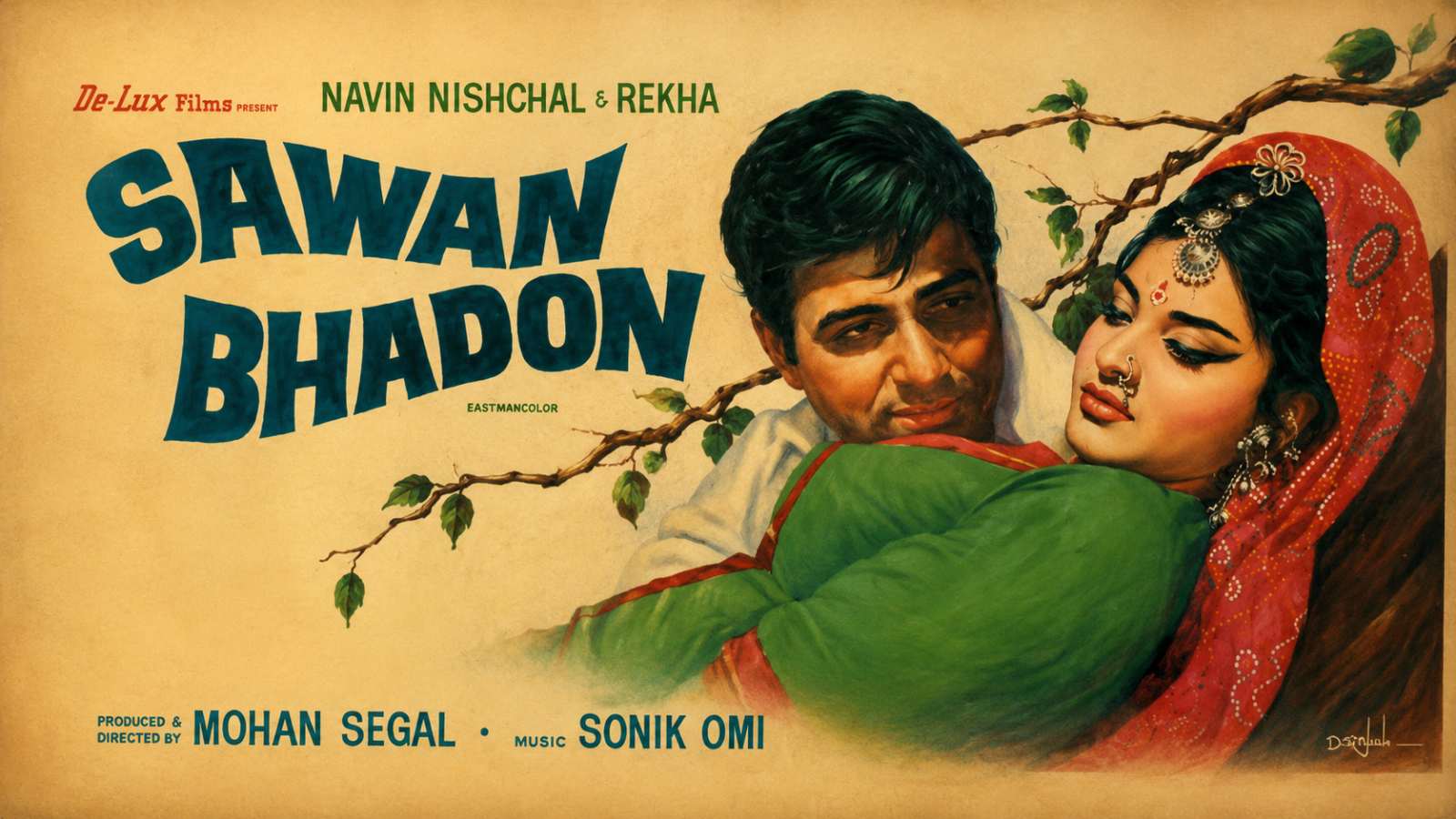
Sawan Bhadon (1970)
Cast: Rekha, Naveen Nishal, Shyama, Jayshree T, Iftikhar
Director: Mohan Segal
Music Director: Sonik-Omi
Synopsis: Vintage Bollywood family drama potboiler full of twists and intrigue - epic!
Reviewed by: Omar Khan
No wonder people look back so fondly on the 1960s and 70s as Bollywood's Golden Age. Family entertainers extolling traditional home-grown values dominated the screens, while westernised lifestyles were usually portrayed as morally suspect and ultimately self-destructive. These were the years of the great "family socials", epitomised by classics such as Rajesh Khanna and Mumtaz's smash hit Do Raaste—modern films set in contemporary India, yet proudly championing thoroughly desi values while mocking the materialistic temptations of the "evil" West.
Rekha was only fourteen when Sawan Bhadon was released.
By the late 1960s Dilip Kumar had already scored a huge success with Ram Aur Shyam, another fairy-tale fable built around wicked relatives, hidden fortunes and family intrigue. At the end of the day, traditional values triumphed, while the westernised modern set invariably ended up with egg on their faces—if not considerably worse. Ram Aur Shyam was itself remade as Seeta Aur Geeta, an even bigger success, and Sawan Bhadon belongs firmly to this gloriously melodramatic tradition.
The film will always be remembered first and foremost as Rekha's Hindi debut.
Rekha, of course, went on to become one of Bollywood's greatest legends and remains a towering figure decades after Sawan Bhadon first reached cinemas. The film itself is a glorious throwback to the vintage family melodramas that Bollywood—and particularly South Indian filmmakers—crafted so expertly during those years. It's worth remembering that a remarkable number of Bollywood hits were simply remakes of successful regional films, picked up by producers with an eye for commercial gold.
Rekha's debut happened almost by accident. She had already signed with the notorious Pal Brothers of East Africa (not to be confused with the Pang Brothers of South-East Asia) for Anjana Safar when she was barely thirteen. Fortunately for her, that production became mired in censorship problems and failed to secure a release. Because she had signed while still a minor, Rekha escaped the contract and received an unexpected second chance when producer-director Mohan Segal cast her opposite the promising young Naveen Nischol. She could barely speak Hindi, had never really danced before, and remarkably wasn't even given a screen test. Segal and his assistant were simply convinced that young Bhanu Rekha—as she was then known—was the genuine article.
Their instincts proved correct.
Sawan Bhadon became a major commercial success, celebrating Silver Jubilees in an astonishing thirty-four centres and launching Rekha into an immediate signing spree of eighteen films. Naveen Nischol also enjoyed a temporary boost, although it soon became apparent that the amiable young actor simply lacked the charisma to become a major leading man. Before long he found himself becoming something of a familiar face in Ramsay and Bhakri horror films throughout the dreadful 1980s.
As for the plot...
Geek-like, self-righteous heir apparent Vikram (Naveen Nischol) returns home from Europe following his father's death, greeted only by the faithful family driver Qasim, while the rest of his step-family are far too occupied with their own interests to bother collecting him from the airport.
At first glance everything appears perfectly cordial. His glamorous stepmother welcomes him home, while little sister Dolly has somehow transformed from the innocent child he remembered into a hot-pants-wearing, go-go dancing siren. His thoroughly westernised mother-in-law enjoys cigarettes, cocktails and the occasional dance, while various freeloading relatives—including gambling addict Mama and the oily Madan—hover around the family fortune like vultures waiting for a particularly unhealthy camel to collapse.
Only loyal driver Qasim seems genuinely pleased to see Vikram.
It doesn't take long before Vikram realises that everyone around him views him as little more than an obstacle standing between themselves and a rather substantial inheritance. Meanwhile he meets spirited village belle Chanda (Rekha), who promptly steals his heart.
The scheming relatives eventually conclude that the simplest solution is to murder Vikram outright.
Which they duly do.
No sooner have the celebrations begun than a dead ringer suddenly appears claiming not only to be the supposedly deceased Vikram, but also the rightful heir to the entire estate.
With celebrations abruptly curtailed, open warfare erupts between the magnificently wicked stepmother and her collection of wonderfully unscrupulous relatives on one side, and the mysterious "returned" Vikram together with Chanda and her family on the other. Chanda herself isn't entirely convinced that this newcomer is really Vikram, while the villains decide that, having already blown up one Vikram with a time bomb, poisoning the replacement seems the logical next step.
Believe it or not, there are still several delicious twists left after that.
Director Mohan Segal keeps proceedings moving at an impressive pace throughout a film running close to two and a half hours. The momentum rarely flags, and everyone appears to know precisely what sort of glorious melodrama they're making.
Rekha is astonishingly assured considering she was only fourteen and had virtually no experience before the cameras. Acting was clearly in her blood. Even at this tender age she possesses an unmistakable screen presence and an effortless confidence that announces the arrival of a genuine future star.
Poor Naveen Nischol, on the other hand, simply doesn't have what it takes.
Whenever he launches into one of Sonik-Omi's cheerful Mohammed Rafi numbers, accompanied by dance moves that resemble an unfortunate cross between the Funky Chicken and a one-legged ostrich, one fears less for Rekha's affections than for his balance. He remains one of Bollywood's most endearingly awkward leading men, and one spends almost as much time wondering whether the luxuriant hair atop his head is genuine as one does watching his performance.
Shyama is absolutely marvellous as the magnificently wicked, foul-mouthed stepmother, while Jayshree T provides perfect support as the gloriously airheaded bimbo daughter. Soon afterwards Bindu would arrive to inherit Bollywood's crown as Queen Bitch, but Shyama reminds us here exactly why she held that title so successfully beforehand. Iftikhar also enjoys one of those rare opportunities to play somebody other than a police officer and makes the most of it.
The weakest department is undoubtedly the music.
Sonik-Omi never quite graduated beyond Bollywood's lower divisions, generally picking up assignments that the bigger composers had declined. Their music was pleasant enough, but when placed alongside the astonishing riches being produced by the leading composers of the era, this soundtrack feels distinctly ordinary. Their speciality always seemed to involve recycling Punjabi folk tunes into film songs, and very little of their work has endured in the public memory. Offhand, the only Sonik-Omi tune I can immediately recall is the delightfully daft "Cheecho Cheech Ganderian"—and that's from another Rekha-Naveen Nischol collaboration whose title escapes me at the moment.
Such was Sawan Bhadon's popularity that it was remade during the late 1980s as Mera Haq, with Sanjay Dutt taking over Naveen Nischol's role and Bindu inheriting Shyama's deliciously villainous footsteps. The remake proved reasonably entertaining, although it never captured the gloriously overripe charm of the South Indian-flavoured original.
One of the film's most wonderful giveaways to its southern origins is the gloriously gaudy opening title sequence, where kaleidoscopic colours explode across the screen while the credits roll—a visual trademark instantly recognisable to anyone familiar with South Indian cinema of the 1960s and 70s.
I also wholeheartedly second the opinion of the superb reviewer Muffy St. Bernard, whose appreciation of Sawan Bhadon is essential reading for anyone interested in Bollywood cult cinema or what she delightfully christened the "Insane Architect Movie."
Sawan Bhadon may not rank among Bollywood's artistic masterpieces, but as a gloriously entertaining slice of vintage commercial Hindi cinema it is irresistible. It launched one of the industry's greatest stars, perfectly encapsulates an era of family melodrama, and remains enormous fun from beginning to end. Above all, don't be tempted to fast-forward those admittedly rather ordinary songs—you'll rob yourself of the priceless spectacle of Naveen Nischol enthusiastically performing what can only be described as the Funky One-Legged Ostrich.

0 Comments
Leave a Comment