
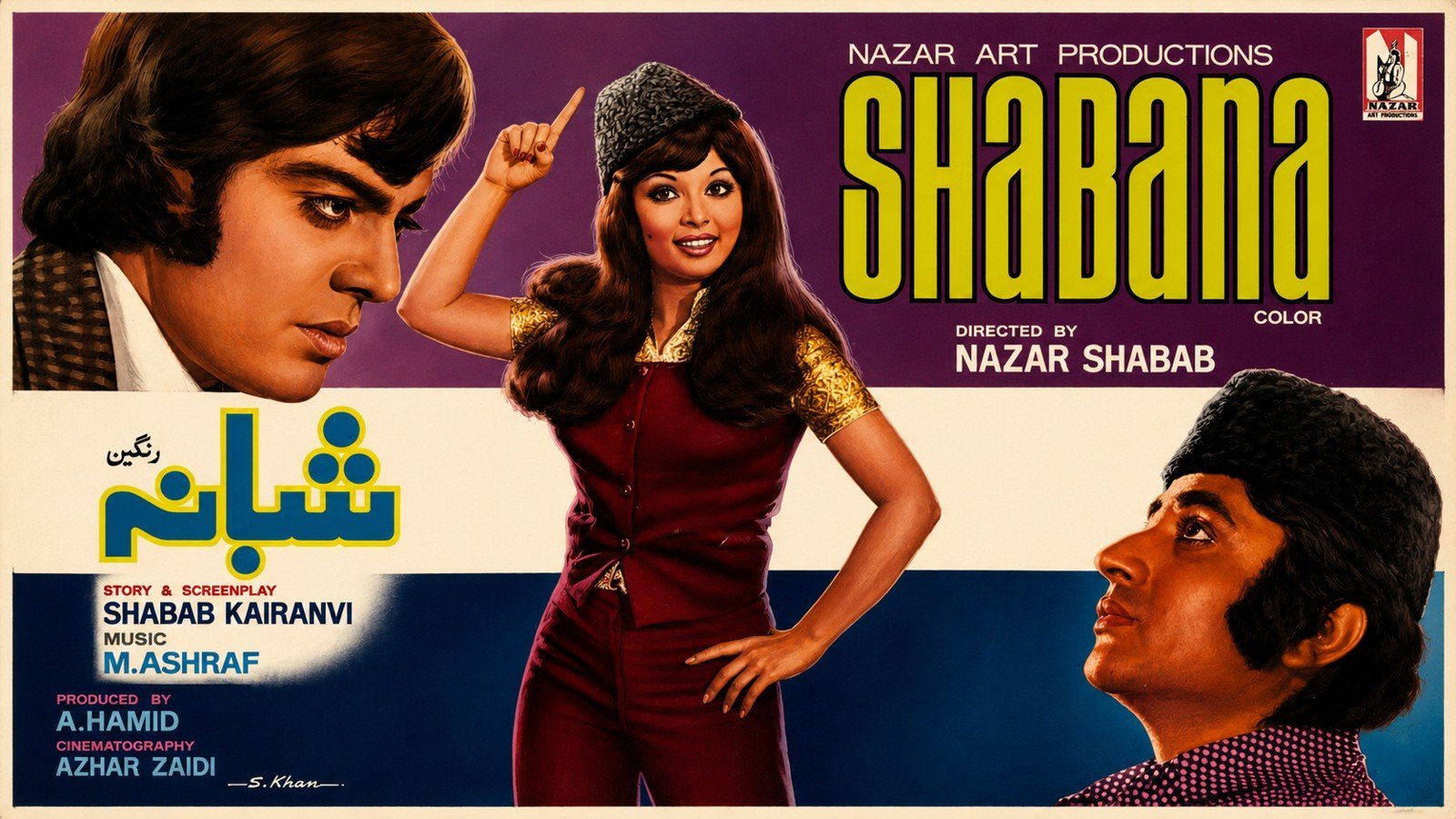
Shabana (1976)
Cast: Babra Sharif, Shahid, Waheed Murad, Tamanna, Nanna, Parveen Boby
Director: Nazar Shabab
Synopsis: Stupendous, smash-hit dramatic comedy which catapulted Babra to the top.
Reviewed by: Omar Khan
Shabana was the sensation of 1976 and signalled an adjustment in the Lollywood hierarchy, catapulting pint-sized Babra into the “A” league beside reigning queen Shabnam. The film created Lollywood history when it became the first to cross the double “Diamond Jubilee” barrier (a 200-week theatrical run) and landed a bunch of Nigar awards as icing on a highly lucrative cake.
The film was an enormous money-spinning bounty for its producers. The soundtrack became a craze, particularly the song Tere Siva Dunya Main Kuch Bhi Nahin, recorded separately by Mehdi Hassan and Nahid Akhtar. The film’s success is all the more remarkable considering how ordinary it is, with nothing new to offer in the storyline.
Events begin with Shahid, a lecherous rich man’s spoilt son with two stooges who cater to his needs for fresh booze and women on a nightly basis. Shahid is the epitome of debauchery; one day, he takes a fancy to the petite (read midget-like) Farzana (Babra), a steno-typist at his office. We learn that though Farzana is the demure, dutiful, saintly type, her sister is spunky, vivacious and, dare we say, bubbly type, full of enthusiasm and mischief who enjoys a good party. This second sister may not be as “correct” as her puritanical elder sister, but she is a tough character.
Despite her partying lifestyle, she doesn’t allow men to exploit her. While the frivolous Shabana is partying it up, her sister is about to be ensnared in slime-ball Shahid’s dastardly trap. He spins a web of deceit around the unsuspecting Farzana and traps her into a secret marriage only attended by his closest aides and a dubious maulvi. Having consummated his marriage, Shahid informs his stunned bride that her services are no longer required, and when she objects, he tosses her out of the apartment window to oblivion.
Farzana survives, and when she returns home crippled, her mother and sister Shabana are horrified to hear the tale of woe that befell her. The mother (Seema) kicks the bucket upon hearing about her daughter’s tragedy. Still, the resilient Shabana swears to take revenge on the scumbag who deceived her saintly, legless and now also pregnant sister.
Meanwhile, Shahid’s luck turns for the worse when his Taliban father finds him merrymaking and proceeds to cut him off from the family fortunes in favour of his younger brother. The latter is due back from abroad, having completed his education.
Shahid reels in horror when Shabana returns to the office pretending to be a resurrected Farzana and resumes her duties as the secretary. At the same time, Shahid’s younger brother, played by Waheed Murad, arrives home to find his elder brother flustered and behaving abnormally. Now Shabana’s plan kicks into gear, and she begins to blackmail Shahid about the attempted murder and makes him pay for the cruelty he inflicted on her sister.
Meanwhile, Waheed falls for Shabana (pretending to be Farzana), finding her array of knockout bell bottoms irresistible. The two get married, having serenaded each other with disco dances by a rather un-picturesque Rawal Lake. The movie’s best songs are ruined by the
Shabana most horrendously tacky cinematography, with Babra and Waheed looking utterly ludicrous, discoing it up in the countryside. The song picturisation is slow-mo and split-screen, with the director placing various shiny objects in the lens for the “effect.”
Ultimately, when Shabana has tortured Shahid sufficiently by singing to him and behaving like a punch-drunk demented dwarf, her plan goes awry when her loving and devoted husband, Waheed Murad, overhears them. He assumes they are having a raging affair and were married before meeting her. Finally, all is revealed in a shattering climax, and injustices are addressed at long last.
The film is remarkable for how utterly unremarkable it is. However, for those who like that sort of thing (and millions out there who did), Babra gives her typically frothy, spunky and utterly moronic performance that audiences find so endearing for some inexplicable reason. In many movies, she repeated the exact persona of the naughty (ch)imp-like girl who would bounce around making demented facial expressions and speaking in a giddy, girlie voice.
This was the Babra Sharif movie persona; many contend that this is how she is in reality—a sobering thought. The point is that the public at large loved this moronic persona that Babra created and played up, and she scored numerous hit films playing, in essence, the same character. Shahid looks paunchy but turns in a pretty decent performance, displaying a particular penchant for comedy. Waheed Murad looks jaded but plays his role with conviction.
The film is carried on the tiny shoulders of Babra Sharif, whom Shahid ably supports. One cannot underestimate the hit song’s effect on the film’s raging success despite the fabulously cheesy picturisation. The song Tere Siva Duniya Main is a catchy tune worthy of its status as a Lollywood classic. Yet, it is inspired by Rajesh Roshan’s music from the film Julie, particularly the Kishore Kumar song Dil Kya Kare Jab Kisi Ko Kisise Pyar Ho Jaye. The film should also be remembered for the nightmarish wardrobe provided to the actors, those flares that Babra sports could house an entire locality.
Shabana won 5 Nigar Awards, including Best Actor and Actress for Shahid and Babra, respectively, best music director, best lyrics and best male singer (Tere Siva) for Mehdi Hassan.


0 Comments
Leave a Comment