
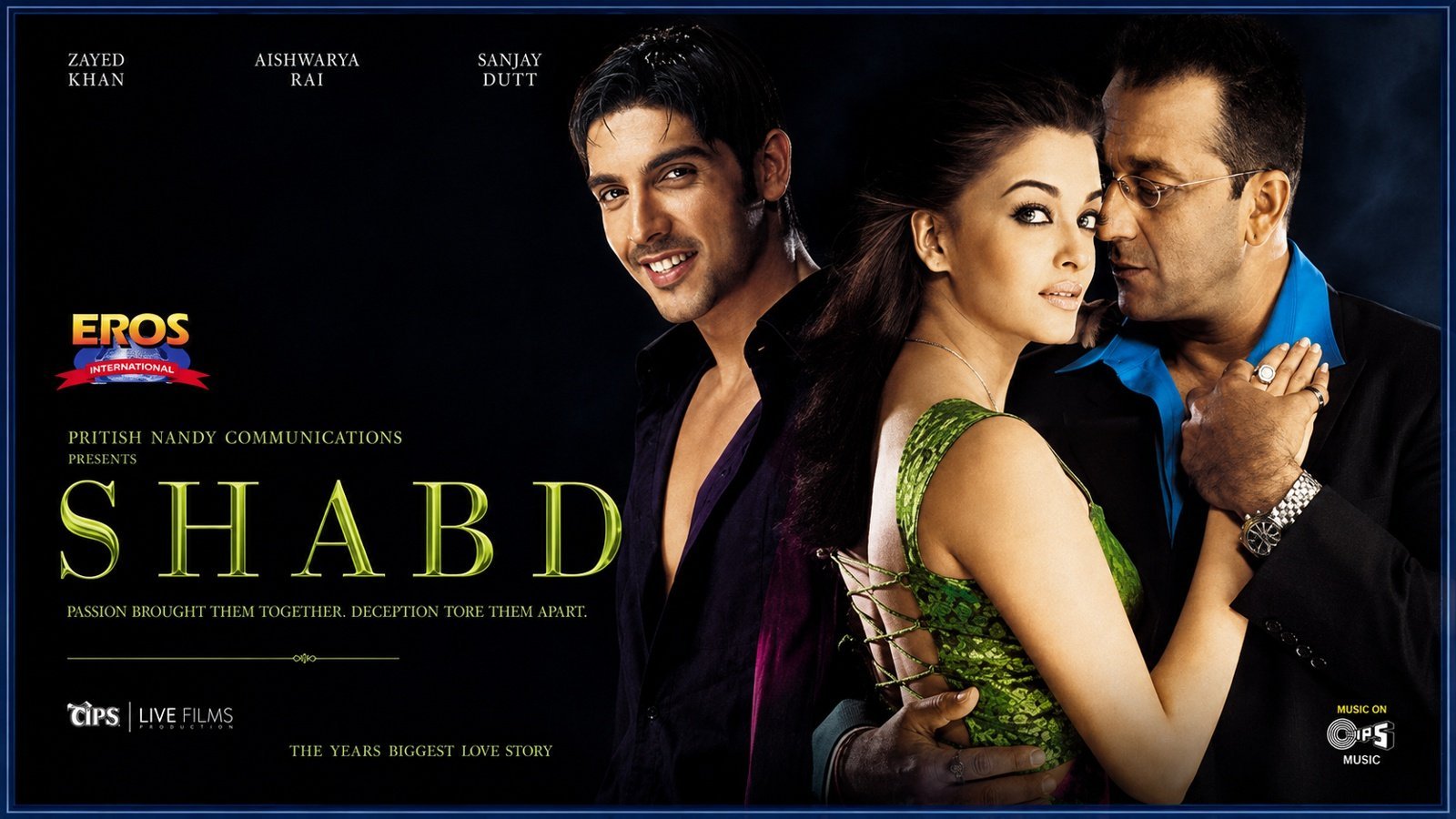
Shabd (2005)
Cast: Sanjay Dutt, Aishwarya Rai, Zayed Khan.
Director: Leena Yadav
Music Director: Vishal Shekhar
Synopsis: An ambitious project by Leena Yadav doesn't quite click as expected
Reviewed by: Faiz Khan
Shabd is a difficult film, not merely in terms of its storyline but also its execution. Its central premise lies well outside the normal parameters of mainstream Hindi cinema, and whilst many filmmakers have attempted to push those boundaries, they still have to do so within the limits of emotional credibility. I deliberately avoid the word realism, because Shabd constantly blurs the line between reality and fiction. Unfortunately, it is precisely that ambiguity which Leena Yadav never quite manages to bring under control.
The film opens with celebrated novelist Shaukat Vashisht (Sanjay Dutt) basking in the glory of winning the Booker Prize, only for his next novel to be met with critical indifference. Married to the much younger and strikingly beautiful Antara (Aishwarya Rai), Shaukat appears to enjoy an enviable life, yet beneath the surface he is suffering from crippling writer's block.
In an effort to rediscover his creativity, he decides to abandon fiction in favour of reality. His latest heroine, Tamanna, is modelled directly on Antara herself. The manuscript, however, refuses to come alive until Antara casually mentions a newly appointed photography lecturer at the fashion college where she teaches. Yash (Zayed Khan), youthful, carefree and instantly attracted to Antara, unexpectedly becomes the catalyst for Shaukat's imagination.
What follows is the film's central conceit.
Rather than discouraging Yash's attentions, Shaukat urges his wife to indulge them. He even instructs her not to reveal that she is married. His reasoning is extraordinary: he believes that by allowing Antara to explore another relationship she will ultimately choose to return to him freely, not because marriage obliges her to, but because she genuinely wishes to.
On paper, this may have sounded psychologically intriguing.
On screen, it simply doesn't convince.
The fundamental weakness of Shabd lies in asking the audience to accept behaviour that feels emotionally impossible. Shaukat and Antara are not portrayed as a loveless couple drifting apart. On the contrary, they appear affectionate, companionable and deeply comfortable in each other's company. There is no emotional void that might explain Antara agreeing to participate in such an elaborate deception. She goes along with it largely because her husband asks her to, but Yadav never persuades us why any woman in her position actually would.
Nor does Antara's emotional journey ever become clear.
Is she genuinely falling in love with Yash? Is she merely acting? Has the pretence become reality? Or is she simply trapped by guilt and obligation? The film flirts with all of these possibilities without ever committing to one. As a consequence, Antara remains curiously static throughout. She never appears seriously tempted by Yash, yet she never forcefully rejects the bizarre game either.
Shaukat himself is no easier to understand.
There are moments when the film hints at a writer descending into obsession, blurring the boundaries between fiction and life until he can no longer distinguish one from the other. Had Yadav fully embraced that idea, Shabd might have developed into a fascinating psychological study. Instead, those ideas remain frustratingly abstract. They exist more as concepts than dramatically realised emotions.
The result is a film that continually raises intriguing questions but rarely answers any of them.
Antara quite reasonably asks Shaukat why it shouldn't matter that she returns home at four-thirty in the morning. His reply—that he wants her to return because she chooses him rather than because she is his wife—is intellectually interesting but emotionally hollow. One understands what the screenplay is trying to say, yet never believes the characters living it.
Even smaller symbolic touches fail to register. Yadav attempts to suggest Antara's growing independence through her changing from the respectful "aap" to the more intimate "tum". Yet the symbolism collapses because she is already using "tum" in one of the film's earliest scenes. The progression simply isn't there.
There is also the unavoidable question of audience acceptance. The premise itself is likely to prove difficult for mainstream Indian audiences, yet rather than fully embracing the dark psychological possibilities, Yadav compromises by introducing a conventional romantic triangle. The relationship between Antara and Yash unfolds through familiar Bollywood clichés, robbing the film of the disturbing ambiguity that could have made it genuinely memorable.
One cannot escape the feeling that Shabd contains the blueprint for a far richer film.
The themes are fascinating: artistic obsession, emotional manipulation, identity, the collision between reality and fiction. Yet Yadav seems more interested in style than substance. Gorgeous imagery, letters floating across the screen, the relentless clatter of Shaukat's old-fashioned typewriter—these become visual motifs searching for dramatic meaning. Watching Sanjay Dutt hammer away at a typewriter in the twenty-first century even brought to mind David Cronenberg's Naked Lunch, another film exploring the uneasy relationship between fiction and reality, albeit with infinitely greater imagination.
Sanjay Dutt deserves considerable credit for stepping away from the gangster roles that had come to define him. His performance is restrained, intelligent and quietly effective. Aishwarya Rai is luminous throughout and demonstrates once again that, given a capable director, she can be a far more accomplished actress than many of her detractors allow.
The weak link is Zayed Khan.
Entirely miscast, he never convinces as the man capable of destabilising a mature marriage. He appears more like a college student who has wandered in from the sets of Main Hoon Na than an object of irresistible emotional temptation. Whether this is the fault of the writing or the casting hardly matters; the film's central triangle never acquires the credibility it desperately needs.
Technically, however, the film is difficult to fault. The cinematography is beautiful, the production design elegant and atmospheric, and the soundtrack contains moments of genuine beauty, even if the songs occasionally slow an already measured pace.
Shabd deserves admiration for attempting something different. It reaches for ideas rarely explored in mainstream Hindi cinema and refuses to follow conventional formula. Unfortunately, ambition alone cannot sustain a film. Its central premise never becomes emotionally believable, its psychological themes remain frustratingly underdeveloped, and what promised to be an intelligent meditation on creativity and obsession ultimately dissolves into a rather confused love triangle.
It is a film that promises considerably more than it finally delivers.

0 Comments
Leave a Comment