
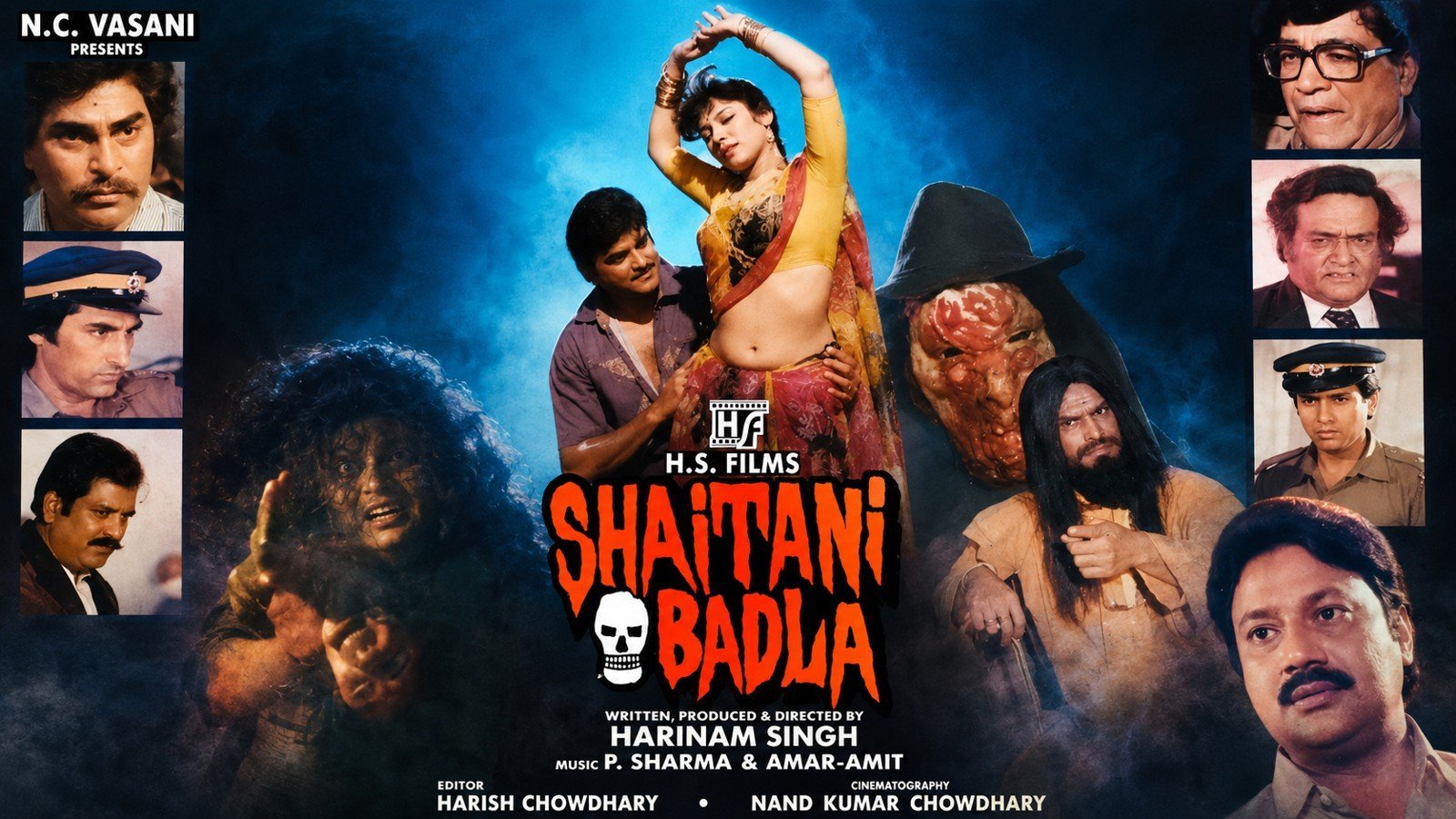
Shaitani Badla (1993)
Cast: Kunal Singh, Ali Khan, Soniya Thakur, Mahesweta, Harinam Singh
Director: Harinam Singh
Nutshell: Lustful girls on heat throw a memorable Kitty Party on the eve of Valentine's Day with terrible consequences.
Reviewed by Omar Khan
Harinam Singh's sheer audacity in creating some of the most sublimely dreadful yet marvellously deranged films has rightfully earned him a devoted following and a place among the legendary masters of bargain-basement horror. Most of his creations appear to have been shot on budgets that barely existed. Rubber masks and plastic fangs could probably have been purchased from a children's shop for a handful of rupees, while the actors he cast were mostly unknown and the music directors often equally obscure.
Yet it would be a mistake to cast doubt on Harinam Singh's credentials. These were proper films, made in recognised studios—admittedly often of the fleapit variety—and somehow he kept making them.
Shaitani Badla dates back to his earlier period and, in many respects, can be seen as a stepping stone towards one of his masterpieces, Khooni Dracula. Made some six years earlier, it shares many of the same elements. Some of the actors are familiar, but more importantly, its style, execution and storyline contain plenty of the ingredients that Harinam Singh would later perfect in Khooni Dracula.
The film has numerous situations involving young, nubile women in various states of undress, lying in bed reading film magazines before being stalked by a shadowy figure who menaces them and scares them half to death with his rubber mask. There are almost as many scenes of the same beauties taking showers or baths before the mysterious intruder turns up once again. This formula would be recycled extensively in Khooni Dracula, where it virtually serves as the basis for the entire movie.
The unfortunate young women are invariably murdered or wake up screaming, only to be reassured by their parents that it was merely a nightmare and there is no killer anywhere to be found.
Meanwhile, the police force—consisting of what appears to be about three idiots—is completely stumped.
Is the murderer a bhoot? A serial killer? Or some vengeful spirit seeking revenge upon these young women, all of whom happen to belong to the same university class?
The film chugs merrily along, littered with scenes of semi-naked women being stalked and attacked by the mysterious figure. Tellingly, some of the victims appear to recognise their attacker immediately before being dispatched, but the audience is denied a proper look at his identity.
Harinam Singh keeps us guessing.
Could it be one of the randy college boys? Could it be some former lover who had been involved with several of the girls? And what exactly happened during the mysterious picnic on February 13th, an event constantly referred to and which has apparently left somebody mighty peeved—peeved enough, in fact, to embark upon a murderous rampage?
As the body count mounts, the university students decide that enough is enough and begin pressurising the police to take some action, failing which they threaten to go on strike.
Even more remarkably, half the police force resigns because they have become convinced that a genuine ghost is carrying out the murders. They apparently fear being ridiculed for admitting that they believe in something quite so preposterous.
Eventually, the truth begins to emerge.
One of the girls, Noori, who has a boyfriend called Rozer—or possibly Roger—remembers an incident when she nearly ran over a drunken man in the street. Confronting him, she discovers a miserable, rather chubby fellow who explains that he has taken to drink because he cannot find work and has become suicidal with despair.
Noori takes pity on him—and also appears to rather fancy him.
She brings him home and persuades her father to employ the unfortunate fellow as their servant. The man, Shyam, is immensely grateful for the opportunity and diligently sets about his duties. Unfortunately, Noori also begins flirting with him regularly, until one day the increasingly flustered Shyam asks if she might dress a little more demurely, as he is having considerable difficulty controlling his natural urges.
Noori takes great offence.
She tells him, essentially, to piss off and that she will dress any way she damn well pleases.
Their flirtation comes to an abrupt end, and she turns decidedly nasty towards him.
Then comes the fateful party of February 13th.
The girls gather together, dolled up to the hilt and in particularly frisky spirits, and decide to make the occasion rather more exciting by turning it into a "Kitty Party". Soft drinks are produced and liberally spiked with alcohol. As inhibitions fade, the stereo is switched on and Donna Summer's "Love to Love You Baby" begins, naturally sending temperatures soaring.
Poor Shyam is summoned.
The girls flirt outrageously with him until the already confused fellow responds enthusiastically, at which point they suddenly turn on him. During the ensuing commotion, one of them cracks him over the head and kills him.
Faced with the slight inconvenience of having a dead servant lying around after the party, the girls decide that the most sensible course of action is to dump his corpse in a ditch among the nearby undergrowth and carry on with their lives.
Unfortunately for them, Shyam appears to have other ideas.
The increasingly terrified survivors eventually seek the advice of a local tantrik, who informs them that they are clearly being stalked by the vengeful spirit of somebody they murdered and wronged. If they have any hope of surviving, he explains, they must repent and beg forgiveness from the rubber-masked apparition before he finishes off the remainder of them.
Will a belated apology satisfy the murderous ghost, or will the remaining girls suffer the same fate as the five friends who have already gone before them?
Who exactly is Rozer/Roger, apparently recognised by some of the victims immediately before they are killed? Is the tantrik correct in his assessment, or will the murders continue until nobody is left?
Shaitani Badla never quite reaches the dizzy heights of Khooni Dracula, which benefits enormously from its fabulous theme song, its unforgettable rubber-masked vampire and some wonderfully surreal sequences that elevate it into another realm altogether. Yet the two films are remarkably similar in tone and construction, and Shaitani Badla occasionally feels almost like a dry run for the masterpiece that was to follow.
The moral of the story appears to be fairly straightforward: don't flirt outrageously with your male servant, get him drunk, encourage all your friends to do the same and then crack him over the head and dump his corpse in a ditch. There is always the possibility that he may return wearing a rubber mask and seek revenge.
Sound advice, really.
This isn't quite one of Harinam Singh's classics, largely because it lacks the glorious surrealism that became such a trademark of his later films. Still, it offers a clear indication of the brilliance that lay ahead and could almost be regarded as a spiritual prequel to the sublimely hideous Khooni Dracula.
Strictly for Harinam Singh admirers and those who appreciate the peculiar art of some of the most incredibly tacky cinema ever created.
0 Comments
Leave a Comment