
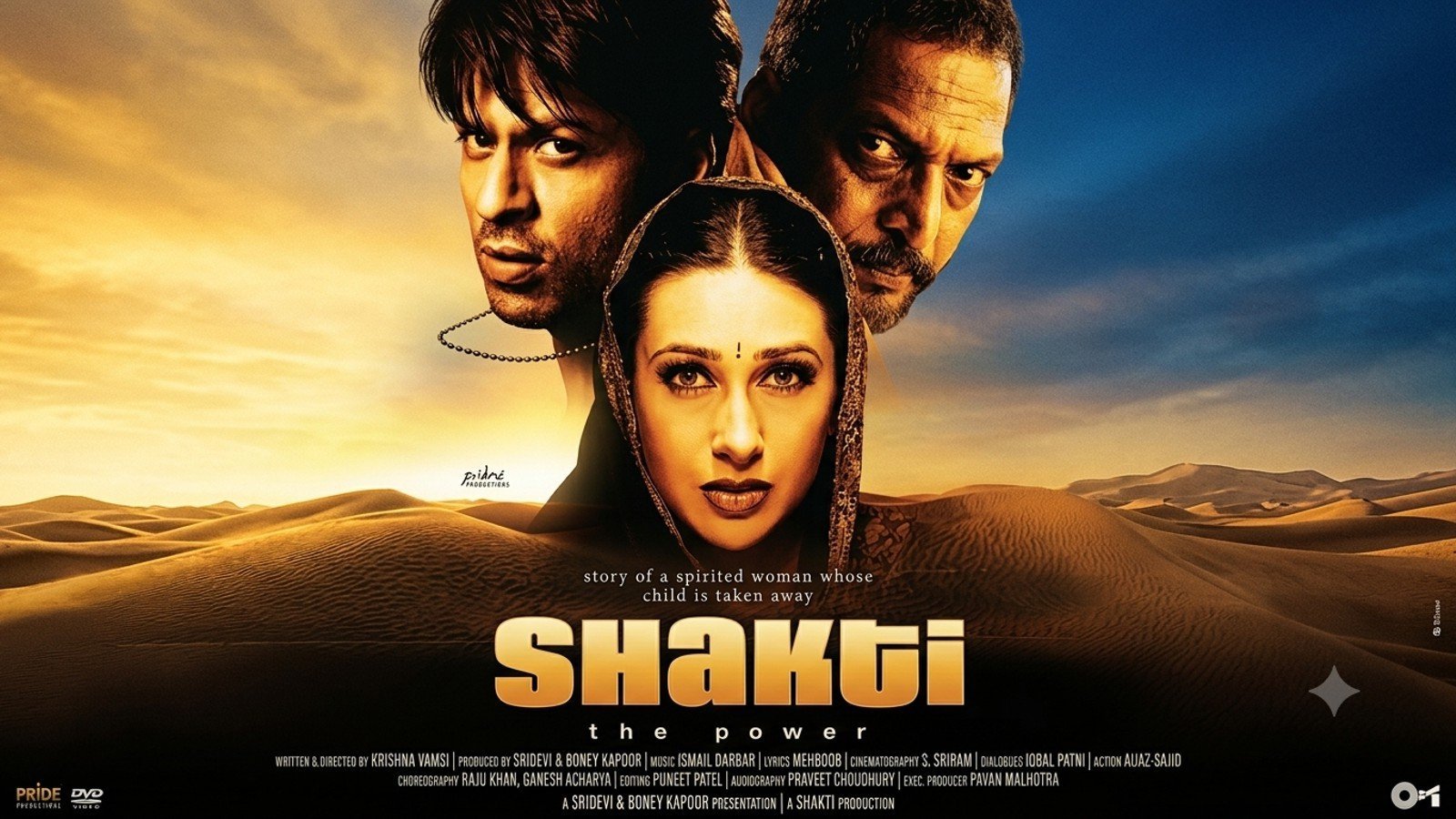
Shakti - The Power (2002)
Cast: Karisma Kapoor, Nana Patekar, Shahrukh Khan
Director: Krishna Vamsi
Music Director: Ismail Darbar
Synopsis: Sridevi's debut as producer is "inspired" by Not Without My Daughter
Reviewed by: Faiz Khan
Shakti: The Power marks Sridevi’s first venture into film production and was initially intended as her comeback vehicle. Pregnancy intervened, the role was reportedly offered to Kajol, who turned it down, and eventually landed in Karisma Kapoor’s lap. On paper, it is the sort of role any actress would relish. The film is adapted from the rather risible Sally Field vehicle Not Without My Daughter, but its basic premise certainly had the potential to be transformed into a powerful Bollywood drama.
Nandini (Karisma Kapoor) is an expatriate living in Canada with two rather ineffectual uncles and no parents in sight. She marries Shekhar (Sanjay Kapoor), and within the space of a song the years pass, their marriage blossoms and a baby boy grows conveniently through the final stanzas.
One day Shekhar suddenly decides that he must return to India, offering his wife very little explanation. It transpires that he comes from a remote part of Rajasthan where his family remains trapped in a bloody feud and violence continues to breed further violence. He takes Nandini and their son home, only to discover that nothing has changed.
For Nandini, this is an entirely alien world. She is unaccustomed to the dirt, the harshness, the primitive customs and the constant undercurrent of fear. Shekhar’s father, Narsimha (Nana Patekar), is a tyrannical, chauvinistic and deeply regressive patriarch. There is not an ounce of compassion or liberal thought in him. His code is simple: an eye for an eye and a tooth for a tooth, ensuring that the cycle of savagery continues without end.
Shekhar wants to escape with his wife and son, but his mother persuades him to remain. It proves a fatal decision. During one of his journeys he is ambushed and murdered. Nandini now wants only to leave India with her child, but Narsimha refuses to allow his grandson to be taken away. What follows is Nandini’s desperate struggle to escape this barbaric household and return to Canada.
There is the making of a powerful film here, but director Krishna Vamsi becomes far too enamoured of the violence. Instead of concentrating upon the mother’s terror and her gradual transformation into someone capable of fighting back, the film repeatedly subjects her to beatings, imprisonment and humiliation. Nandini spends much of the running time being battered black and blue or locked away, and what could have been a story of female resistance becomes yet another spectacle of female suffering.
There is no real feminist triumph here. Nandini certainly refuses to surrender, but ultimately she remains dependent upon the intervention of a man, and unfortunately that man arrives in the form of Shah Rukh Khan’s Raja.
His introduction almost destroys the film.
While Narsimha is savagely beating Nandini, Raja cavorts through a police station in a comic sequence clearly designed to provide light relief. The juxtaposition is grotesque and completely misjudged. One scene asks the audience to recoil at brutal domestic oppression, while the next expects it to laugh at Shah Rukh’s antics. The two tones simply cannot coexist.
The fault is not Shah Rukh Khan’s but the conception of the character itself. Raja has plainly been inserted to give the film a commercial boost, provide comic relief and ensure that the heroine is ultimately rescued by a recognisable male star. The strategy is transparent and deeply manipulative. His presence slows the narrative, dilutes Nandini’s struggle and shifts attention away from the woman whose story this is supposed to be.
The song with Aishwarya Rai is another commercial gimmick, undoubtedly included to attract an audience for a quick dekho, but it further weakens the film’s dramatic momentum.
What Shakti does convey very effectively is the suffocating horror of an intensely patriarchal rural society where women possess almost no agency and the male heir is treated as the centre of the universe. Had Nandini’s child been a girl, there would probably have been no story at all. That fact alone says much about the society being depicted. Unfortunately, the film never fully develops this observation. It hovers uneasily between serious social drama and overblown Bollywood melodrama before eventually surrendering almost entirely to the latter.
Karisma Kapoor gives a committed and physically exhausting performance. She throws herself into the role and carries much of the film, but the writing restricts her. Although she is ostensibly the central character, the screenplay rarely allows Nandini to take true control of her own destiny.
The film ultimately belongs to Nana Patekar.
It has been far too long since he was given a role worthy of his intensity, and Narsimha is perfect casting. Nana dominates every scene, creating a figure of terrifying authority and moral decay. He is repellent, unpredictable and completely convincing.
Deepti Naval plays the submissive wife with quiet effectiveness, although her final outburst is written and performed at such a heightened dramatic pitch that it feels somewhat at odds with the character established earlier. By that point Narsimha should perhaps have simply turned to ash.
Sanjay Kapoor is an actor who always appears to be trying very hard, and unfortunately ensures that the audience is aware of every ounce of that effort.
Ismail Darbar’s music is not without merit, although most of the songs feel imposed upon the narrative rather than emerging naturally from it.
Shakti: The Power contains the raw material for an angry and compelling film about a woman trapped within a violent male order. It occasionally offers glimpses of that film, particularly through Nana Patekar’s performance and the atmosphere of fear surrounding Narsimha’s household. But the excessive brutality, tonal confusion and commercial distractions repeatedly blunt its impact.
It seeks to convey power, but too often mistakes punishment for strength.
Not bad, but not particularly good either.
0 Comments
Leave a Comment