
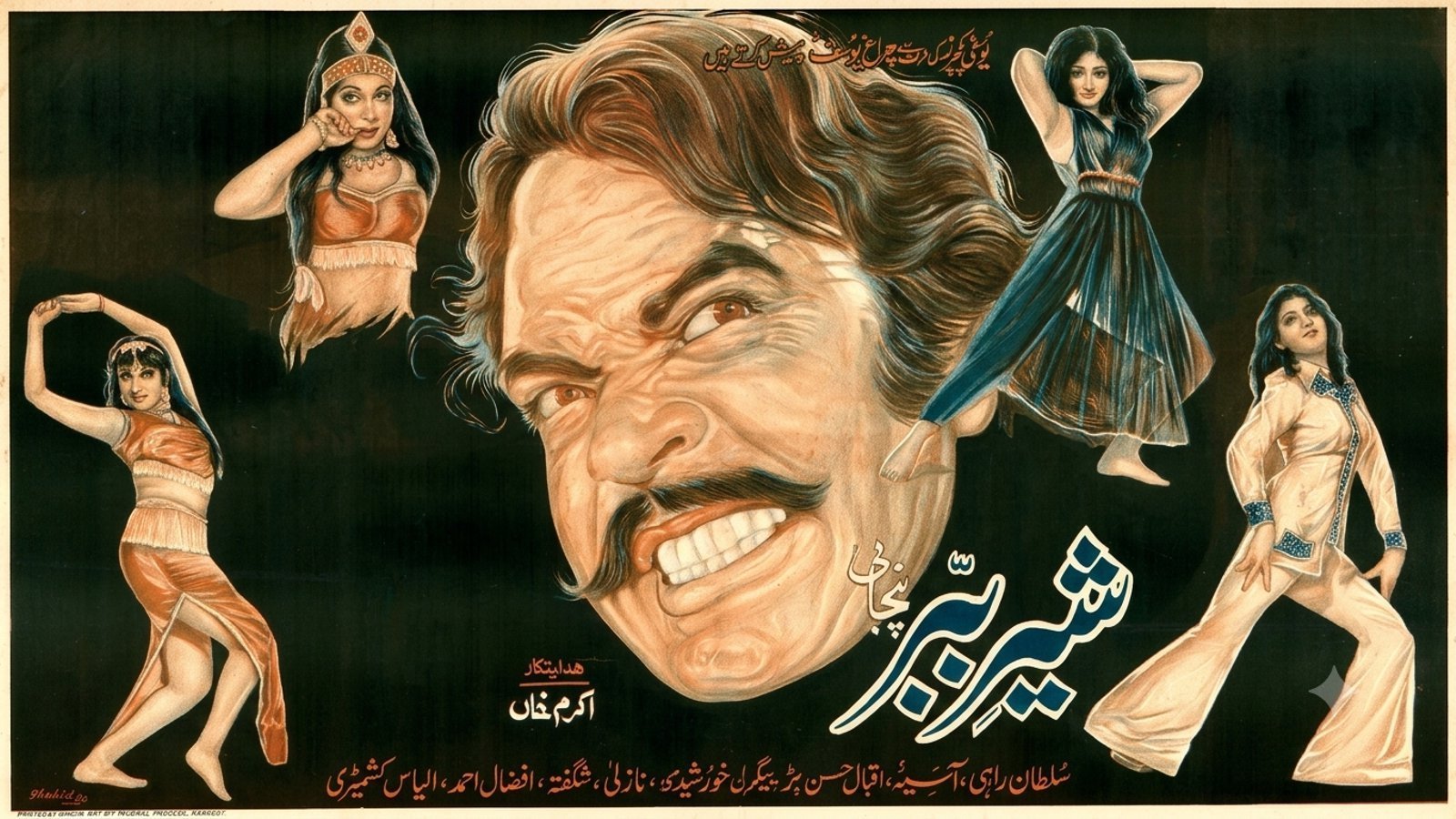
Sher Babbar (1977)
Cast: Sultan Rahi, Aasia, Iqbal Hassan, Najma, Ilyas Kashmiri, Nasira
Director: Akram Khan
Synopsis: The story of an honourable man fighting against injustice. (Yawn!)
Reviewed by: Omar Khan
Sher Babbar was director Akram Khan’s follow-up to the wonderfully cheap and sleazy Aaj da Badmaash, which had sadly run into trouble with the censors due to its upfront, no-nonsense vulgarity. This movie arrived in 1977, just as the military was about to start a decade-long dictatorship, pointing the country down an accelerated path to extremism and intolerance. The harmless sleaze and vulgarity of these pathetic (and perversely charming) films were purged from the cinemas and replaced by twisted neo-Islamic values and a deeper entrenchment of fascism and, with it, a gloating self-worship under the guise of patriotism. The arrival of the Atomic “Islamic” Bomb had its own subtle but insidious influence on the Pakistani psyche.
Sher Babbar is par for the course for an Akram Khan movie— super cheap, gritty, edgy, utterly inept, and containing a healthy dose of typically sleazy and vulgar dances. The film offers a plot as stale as can be within the Punjabi genre. The “ghairatmand” (honourable) man fights to maintain his “ghairat” (honour), and this he can only do by taking revenge on the man who has killed his father (peeo da Qatil syndrome).
So essentially, you have a scenario where one person has to avenge another. The opponents have to avenge a third party, and the third party has to avenge the first party, and on and on its goes—just a merry-go-round of revenge and mayhem, all to uphold “ghairat.” It’s hardly surprising that this country suffers from the curse of the barbaric custom of honour killing as much as it does, because it is something that is so strongly emphasized, encouraged, and reinforced in popular mainstream cinema.
This film is about Shera (Sultan Rahi), who is a brave and fearless and naturally “ghairatmand” young man who dares to take on the system, and do what he believes is right (murder). In the opening scenes, we have Shera languishing in prison for murder (“aik ghairatmand bhai ki ghairat ka sawaal si” it was a matter of an honourable brother’s honour”). During a prison inspection, Shera learns that a bunch of particularly shady inmates are about to jump the warden and escape, so he does what one would not normally expect a Sultan Rahi character to do—to help authority and law and order in any manner. In thwarting the ambush, he has the rest of his sentence deferred.
Upon hearing about Shera’s freedom, the notorious landowning clan of Malik Hasham, decides to carry out their justice against Shera for the death he caused to their brood. Malik Hasham is also doubly incensed because Shera incites the poor to rebel against Hasham’s brutal justice. Rahi has a terrific showdown with Malik Hasham and kills him in broad daylight.
On his way to prison, Shera’s convoy is attacked by Hasham’s two disgruntled sons, who insist that Shera should receive justice from them and not the law, but in the ensuing scuffle, Shera escapes. When Nazli (Malik Hasham’s daughter) learns of her brothers’ failure to
Sher Babbar destroy Shera, she announces that she shall succeed where her brothers have failed. She arrives at Shera’s and tries to seduce him with a song in a skimpy see-through night dress, but only receives a stinging slap from Shera, who tells her that he loathes women in all shapes and forms. We discover that Shera’s sister Reshma is the reason for his hatred of women.
Reshma had been happily married with a toddler but returned home one day, claiming her marriage was over. Shera feels something fishy is up as no good Muslim woman can walk out on her husband no matter what. His suspicions prove well-founded when he discovers her cavorting around with a paramour at night—a man she intends on marrying. But too late, she has already caused irreparable damage to the family “ghairat” and must bite the bullet for daring to hope for a life of her own. Rahi blows her away as any “ghairatmand” brother would, and this evil beghairat sister of his has become the subsequent cause of his hatred of women in general.
Rahi brings up his murdered sister’s young son to be a criminal like himself, and the young tot soon grows into rugged, handsome, and tubby Iqbal Hassan. Together, the two prowl the country in search of Malik Hasham’s sons for vengeance. However, the plan goes awry when Iqbal falls for bewitching, bum-twitching beauty Aasia, who happens to be the granddaughter of Malik Hasham and, therefore, a sworn enemy.
Shera now turns on Iqbal for having let the side down and taken up with a “snake” in the form of Aasia, a spawn of the enemy clan.
Things end with many comical fights and an infernal stretch of comedy lasting about half an hour. A healthy injection of cheap dances helps, but these dances occur in the villain’s den rather than at the local club. Therefore, they don’t quite have the class or zing that club dances inherently enjoy—it’s just a fact of life—cheap and vulgar dances work best in the “kilub” scenario!
Also, the songs themselves, though composed by a master of vulgar music, Tafo, aren’t quite to the level that one has come to expect, especially after Aaj da Badmaash, which featured a set of stunning songs; this one is a bit of a letdown. There are a couple of Madame Noor Jehan songs that do tend to grow on one gradually, but on the whole, they aren’t up to what one would expect from an Akram Khan sexploitationer.
Sultan Rahi puts up a solid show and displays his incredibly virile looking torso for the film’s best part. Aasia thrusts, heaves, twitches, and plunges with commendable vigour during her song sequences. Her few dialogues are delivered with the fire one associates with a true feisty Punjabi belle. Iqbal Hassan, AKA The People’s (C)Hunk, cuts a dashing figure and does his bit with customary aplomb. Najma, in a brief role, turns in a sizzling dance in a snake costume, and the background music is fabulous—yet it’s not one of Akram Khan’s vintage slices of sleaze and didn’t do particularly well at the Box Office either. Nonetheless, it contains his trademark edgy, gritty cinema verite style and enough doses of sleaze to satisfy most punters well. The tragic thing about this movie (and countless others of the genre) is that it advocates honour killing.


0 Comments
Leave a Comment