
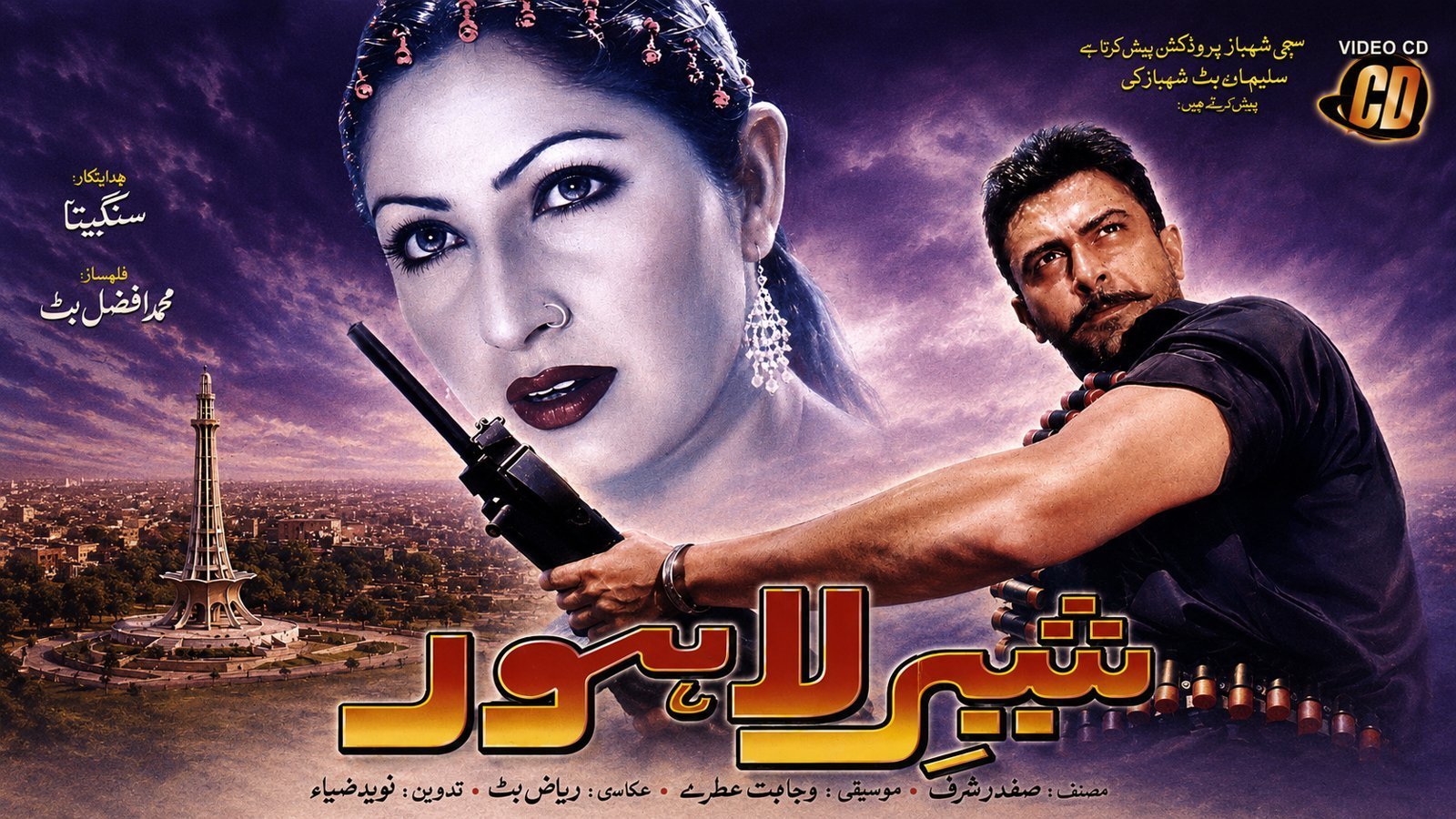
Sher E Lahore (2001)
Cast: Shaan, Saima, Moammar Rana, Sangeeta, Nirma, Tariq Shah
Director: Madame Sangeeta
Synopsis: Madame Sangeeta’s Box Office busting smash hit from the post 9/11 days.
Reviewed by: Omar Khan
Bonny, a young college lass, is harassed and “eve teased” by some local goons on her way home. At the same time, a gnarled and wise oldie reminisces about the Raj days, remarking that nobody dared to look disrespectfully at anybody’s daughter or sister.
Independence has brought us very little that is positive and tangible. Meanwhile, the college girl has had enough of the daily harassment at the hands of the goons. She announces to her bemused parents her intention to quit her education altogether.
Both parents are adamant that she continue her studies, and the father, a righteous and honest soul, decides that from the next day on, he will accompany his daughter on her way to and back from college. The goons inevitably menace the father and daughter the next day on the way to college. A battle to the death ensues, with both father and daughter slaughtered by the evil goons in broad daylight, with no apparent fear of police intervention.
Moments later, the matriarch, played by Madame Sangeeta in her highly anticipated return to the screen arrives and wails away in typical style, promising the worst vengeance upon the murderers of her daughter and her husband. Baying for revenge like Maula Jatt’s mother Dani once did, she lets out a mighty call for her son Ali Sher, who ,like the great Maula Jatt, has extraordinary sensory capabilities.
Seconds later, he arrives at the scene and dishes out some true Maula Jatt-style justice, slaying the beasts instantly before letting out a guttural cry of victory!
A proud mother gloats at her son’s brilliant and swift, bloody justice as he is led off to the notorious Macch Jail, bellowing loudly that her son is to be known, not as Ali Sher but as The Sher-e-Lahore to which her son growls his approval while swaggering off.
The news of the goons’ deaths reaches the notorious underworld kingpin, Bandial (Tariq Shah), who promises to unleash his terrible vengeance for the murder of his sons. So a deadly, obligatory blood feud between the Sher-e-Lahore and Bandial and his nasties is set in motion, as is the scenario of every Punjabi movie in Lollywood.
For some inexplicable reason, this film turned into a bumper success. The usual posturing, gung-ho violence, and demented machismo, peppered with the occasional saucy dance number, complete the magic formula prepared so lovingly by Madame Sangeeta. At the same time, so many that appear utterly identical in style, execution, plot, subject matter and indeed cast seem to fail dismally. Why does a film like Sher-e-Lahore score a bull’s eye while twenty others seem to miss the mark?
Perhaps some of the elements that contributed to its success were that Madame Sangeeta has managed to keep the film’s pace from flagging at any time during proceedings. It is also helped by a weird background score, some typically loaded dialogues and sound performances. The film is never dull. Perhaps the ingredient that had the drooling masses returning for repeat film doses was Nirma’s hot dance numbers, which sent local (100%) male audiences into a fever. Some ecstatic audience members resorted to firing at Lahore’s
Sher E Lahore
Capital cinema to ensure their favourite song was repeatedly projected! There are a couple of sensual rain songs in which Nirma is writhing around in a typically suggestive manner, which seems to have delighted the masses. Naturally, Madame Sangeeta has made sure that she wears white in one of her numbers so that when drenched, her clothes are rendered virtually see-through, and the clothes are all designed to reveal the maximum amount of flesh.
The film is a blueprint of the typical revenge-based Lollywood Punjabi formula in the Maula Jatt mould—loads of shouting and comic book machismo, tons of violence, the glorification and worship of guns, a solid bellowing mother figure, loaded dialogues, fat men running around with toy guns and some super saucy crowd-pleasing dance numbers.
Of the performers, Shaan does his Sultan Rahi thing with relish, growling ferociously and cackling grotesquely when the moment calls for it. Moammar Rana has learned how to shout like a true Punjabi hero and has thus recently gained acceptance as a “proper hero”. Saima, as ever, looks older than Shaan, but effectively provides some comic relief along the way. She, too, performs some crowd-pleasing dances but nothing to match the vulgarity of the Nirma numbers.
The film’s surprise package is the sensational return to the screen of yesterday’s man-eating siren, Madame Sangeeta, who turns in a riveting performance and even joins the slightly younger girls for a climactic song and dance! Madame Sangeeta shows that her unique beauty is like the finest wine, improving until it reaches a vintage level. Here, the Madame indicates that she hasn’t lost her magnetic screen presence but that her beauty has only improved with time. Sangeeta proves that classic beauty is eternal and age is just a flippant, meaningless number.
Sher-e-Lahore was one of several aces that the Madame fired on her triumphant return to directing Punjabi films. She enjoys being the Top Dog of the Lollywood Punjabi scene—a considerable feat or a dubious honour, depending on how you view Punjabi



0 Comments
Leave a Comment