
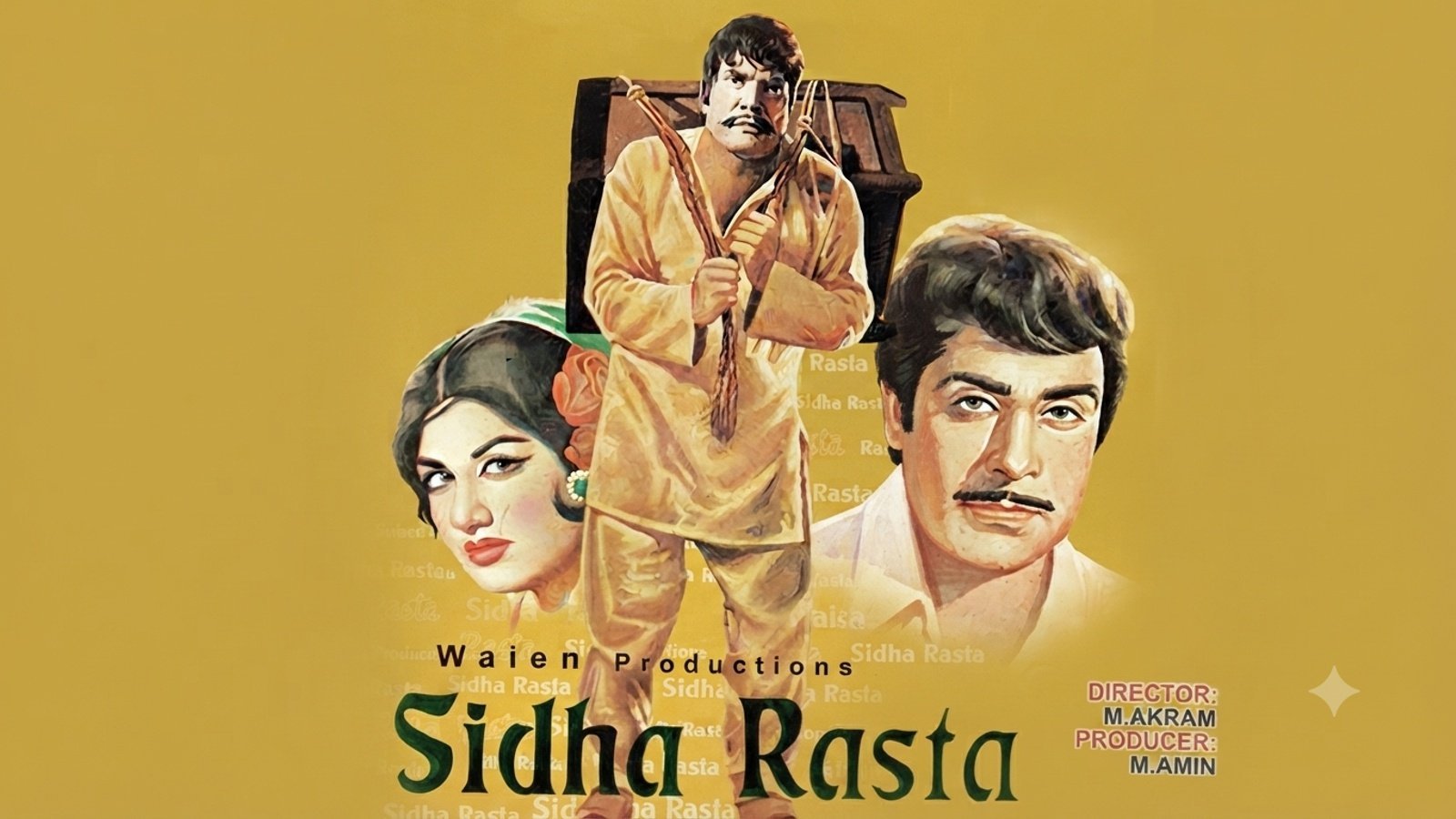
Sidha Rasta (1974)
Cast: Naghma, Yousuf Khan, Sultan Rahi, Mumtaz, Asad Bukhari, Ali Ejaz, Nasira, Afzaal Ahmad, Saiqa, Sahira, Sheikh Iqbal, Naeem Hashmi, Ragni
Director: M. Akram
Synopsis: Written by Saifuddin Saif, a film about characters trying to reform and break the label of being cursed in society.
Reviewed by: Omar Khan
The action begins promisingly with two friends out in Lahore, where they encounter a crowd gathered at a cock-fighting contest. One of the friends objects to animals used by humans for their mindless entertainment. Yusuf Khan tells Ali Ejaz to let it go, reminding him that humans are callous enough to one other, let alone animals. It’s an insignificant scene, but it's refreshing that a script references animal cruelty.
Moments later, they come across four men trying to abduct a young woman in broad daylight and manage to rescue her. They give the rescued Naghma a ride to her residence, where later on, Ali Ejaz tells Yusuf was in Heera Mandi, the Red Light area and that she scurried away up into one of the buildings where the Kotha is. Yusuf Khan is not convinced, as Naghma seems to be a timid and decent woman. So they decide to go and find out for themselves by seeking her out the following day even though a Kotha is not usually their scene being of “Shareef” (good stock) families.
They venture off to Heera Mandi the following evening, encountering a breed of city dwellers living on the edge of immortality. There appears to be the law of the jungle where the big fish are constantly exploiting weak ones. They have a bit of a scuffle at the local chai hangout, where bullying is the way of life.
Later, they find their way to the Kotha and find a similar audience of badmaashes and Thugs and their minions. They expect to watch Naghma perform for them, but instead, there is the shapely Mumtaz, who holds court. Another scuffle ensues between them, and some gangsters throw their weight about during this scuffle; Ali Ejaz momentarily catches a glimpse of Naghma. After the skirmish, they run into a cocky but friendly character who appears entirely in sync with the environment. Daara Badmash asks Yusuf and Ejaz to accompany them to his den and introduces them to his line of work, running a gambling and drug den where the city’s underbelly hangs out. Daara appears to be doing very well financially, and Mumtaz, the dancer at the Kotha, has a soft spot for him even though he doesn’t seem interested in reciprocating.
Ali and Yusuf head home to respectability, while Daara (Sultan Rahi) heads back home, which he shares with his mother and sister, for whom they seek a good husband. Nasira is the Madam of the Kotha and is indignant that Naghma, one of her two daughters, refuses to join the trade and earn money dancing for punters every night. She seeks help from the shady Afzal Ahmed, who had, years ago, abducted Naghma from her family and sold her to Nasira. Mumtaz, who believes herself to be the younger sister of Naghma, is her fiercest defender and tries her utmost to allow her sister to follow her chosen path rather than become a dancing girl. The greedy Nasira remains adamant about breaking Naghma’s will and turning her into a cash cow at the Kotha.
Another notorious Badmash is played by Asad Bukhari, who is part of the triangle of evil headed by Nasira and Afzal Ahmed. Asad is a champion strong-man who has people challenge him in a local form
Sidha Rasta of fangled arm wrestling, where his grip has to be broken by the challenger. One day, Yusuf and Ejaz are tempted when they encounter Asad to take him on at the challenge, especially as a whopping Rs.500 is ridings on it. Ejaz tries his best but is no match for Asad, but Yusuf fares much better and defeats the evil, Asad, making off with the Rs. 500 gleefully.
Nasira confronts Naghma again, forcing her to dance and earn for the Kotha. Still, she resists defiantly, telling the
Madam, she would wash, clean, and sew for an earning rather than stoop to become a Kotha dancer. The frustrated Nasira plots and schemes with her cohorts and tries to find a way to entrap Naghma and get her to dance to the tune that she wants. Yusuf learns about Naghma’s entrapment by circumstances and how she stands firm against the wishes of Nasira, and he falls further in love with her than he already is.
Naghma happens to be employed sewing the bridal clothes for Sultan Rahi’s sister, who appears to have found a decent potential wedding partner. One day, when Rahi’s mother and sister are away, Naghma visits with the clothes she has prepared, and Rahi finds himself able to take advantage of her and makes his move. As he tries to force himself on Naghma, she turns on him, delivering a stinging moral lecture that has him in a head-spin. Naghma turns the tables on him decisively, resulting in Rahi having a massive moment of introspection. Rahi decides to repent from his life of vice and badmashi and seek forgiveness for his sinful, wicked ways.
With his taking a 360-degree turn, he now heads off to a wise Maulvi and attempts to purge his sins by the sweat of honest toil. In the interim, some tuneful Madam Noor Jehan songs filmed on Mumtaz’s alluring dances that were popular in their day. Also, a dream sequence song on Naghma that was massively popular and in Ik Ik Shay Channa, one of Madam Ji’s greatest hits ever.
The drama gets complicated as Sultan Rahi’s sister’s wedding faces hurdles because of his dodgy past as a Badmaash. At the same time, Yusuf’s mother is adamant that she will never accept a Kotha dancer as her daughter-in-law. Nasira, Afzal and Asad try to seize the moment and appear to be on the way to achieving their evil aim. However, Sultan Rahi and Yusuf Khan, though down, are not out, and an almighty struggle with plenty of stirring fight sequences follow as the film’s climax and resolution approaches.
Sidha Rasta has all the ingredients of a masala film that will satisfy cross sections of the cinema-going audience. There is enough melodrama for the ladies and plenty of action, bravura and comic banter for the men. The songs are generally top-notch, with one massive chartbuster among them. Mumtaz provides the oomph while Sultan Rahi and Yusuf turn on the charm. The trio of villains are well cast, and everything clicks most satisfactorily.
The film is two and a half hours long, but the action moves along without getting bogged down, and the pacing is even moving forward to an obvious but satisfactory conclusion. The film was a roaring success at the Box Office and the last massive hit for Naghma as a leading lady in Punjabi movies. Sultan Rahi has a significant role yet is not the film’s main hero, and a couple of years on was about to give up on a film career altogether. His fortune was to change dramatically with Maula Jatt and the arrival of the era of vengeance and violence typical of the Zia Ul Haq decade. The rest is history.



0 Comments
Leave a Comment