
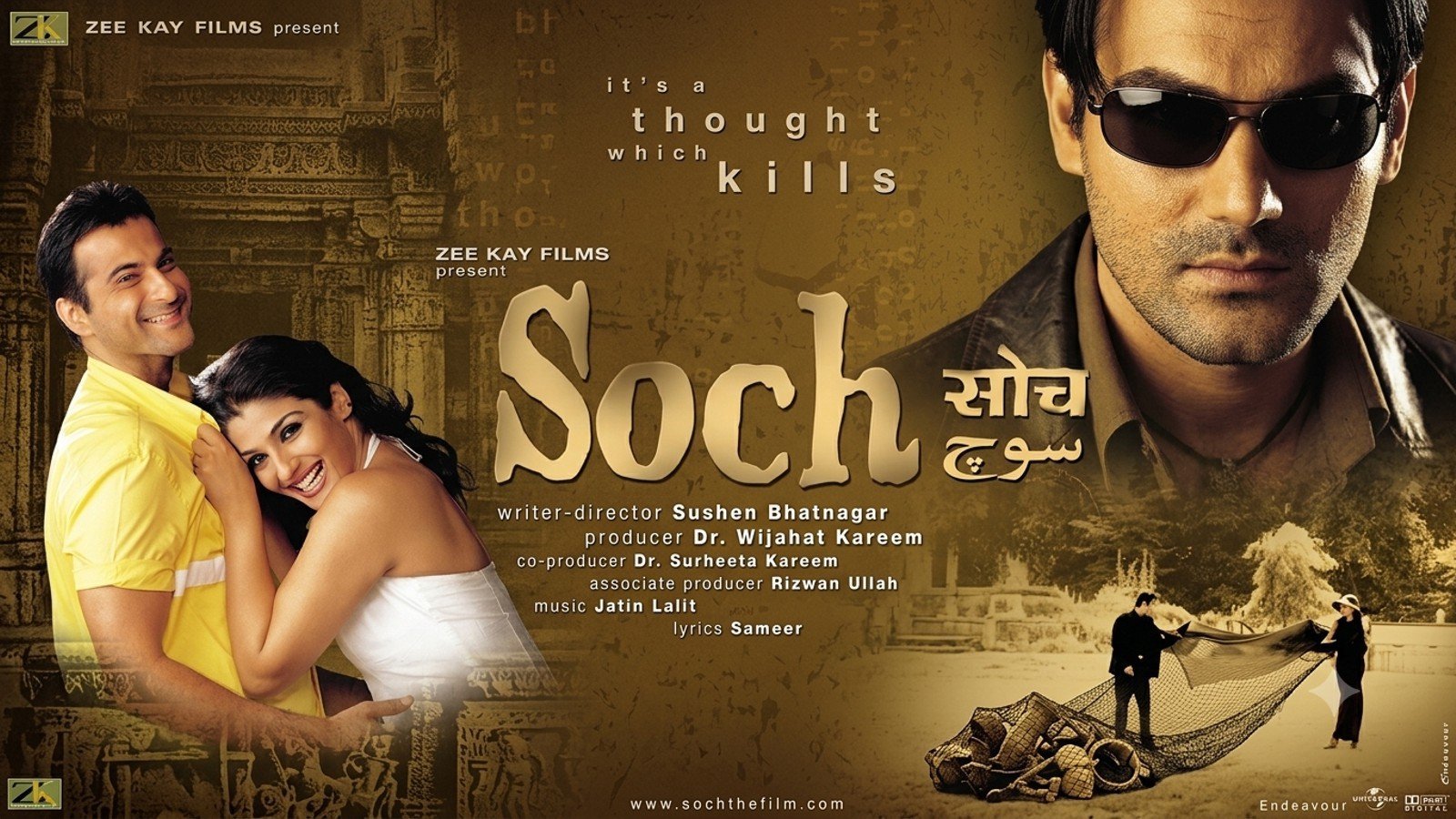
Soch (2002)
Cast: Sanjay Kapoor, Arbaaz Khan, Raveena Tandon
Director: Sushen Bhatnager
Music Director: Jatin-Lalit
Synopsis: a totally flat thriller lacking any shred of tension or suspense - time waster!
Reviewed by: Faiz Khan
It seems that Raveena Tandon has become the unfortunate custodian of Bollywood's ongoing mission to vandalise Alfred Hitchcock. Earlier this year she found herself trapped in the laughable Officer, a film that cheerfully mangled Vertigo. Now she returns in Soch, where director Sushen Bhatnagar performs equally grievous bodily harm on Hitchcock's Strangers on a Train.
Raj Matthew (Sanjay Kapoor) appears to have the perfect life. He is married to the stunning but fiercely possessive Madhu (Aditi Gowariker), whose chronic jealousy convinces her that he is conducting an affair with film director Priti (Raveena Tandon). Raj, however, remains blissfully unaware that whilst he harbours no romantic feelings for Priti, she quietly nurses some for him.
Into this domestic melodrama strolls Om (Arbaaz Khan), a complete stranger who arranges to meet Madhu in a nightclub before calmly shooting her dead.
The police naturally arrest Raj as the prime suspect until Priti unexpectedly provides him with an alibi—one that clears him of murder but simultaneously casts suspicion upon the nature of their relationship.
So far, so good.
The explanation behind the murder, however, belongs in another film altogether.
Om reveals himself to be an escaped psychiatric patient who has murdered Raj's wife simply because, during a chance encounter, Raj once joked about how much easier life would be without her. Om, meanwhile, had complained about his own abusive father. From this casual conversation, the lunatic concludes that he should murder Madhu, leaving Raj morally obliged to return the favour by killing his father.
Quite why Om, who apparently has no hesitation in murdering his own mother and brother, cannot simply dispose of his father himself is one of many awkward questions the screenplay prefers not to answer.
From this point onwards the film settles into an interminable cat-and-mouse game between Raj and Om. Except there is very little cat, very little mouse and virtually no suspense. Instead we are subjected to an overlong procession of familiar Bollywood clichés leading towards a finale visible from several miles away.
Good triumphs over evil.
Hero gets heroine.
Hit song plays over the closing credits.
Yawn.
Sanjay Kapoor delivers another of his typically earnest but curiously ferret-like performances. At one point he even resurrects the bizarre haircut from Koi Mere Dil Se Poochhe, accompanied by a physique that appears to have been assembled from strategically padded body armour rather than a gymnasium.
Raveena Tandon has very little to work with and never really rises above the material. Arbaaz Khan once again essays the role of the unstable psychopath, territory he covered far more effectively in Daraar. Here he is reduced to glaring maniacally for two hours, and it quickly becomes tiresome.
Newcomer Aditi Gowariker, on the other hand, makes a reasonably confident debut, successfully portraying Madhu's insecurity and jealousy before the screenplay abruptly removes her from proceedings.
Sushen Bhatnagar directs without any real sense of tension or atmosphere. Hitchcock understood that suspense comes not from violence but from anticipation. Soch mistakes noise for excitement, continually interrupting its already sluggish thriller with an assortment of forgettable songs that only succeed in draining away whatever momentum remains.
The title, Soch ("Thought"), receives endless verbal reinforcement throughout the film as characters solemnly ponder whether merely thinking something can amount to a crime. It is an interesting philosophical question.
Unfortunately, the film surrounding it isn't nearly as interesting.
As an adaptation of Strangers on a Train, Soch strips away everything that made Hitchcock's masterpiece so compelling—the psychological duel, the moral ambiguity and the unbearable suspense—and replaces it with formula, melodrama and predictability.
A waste of time, and another Hitchcock casualty.
0 Comments
Leave a Comment