
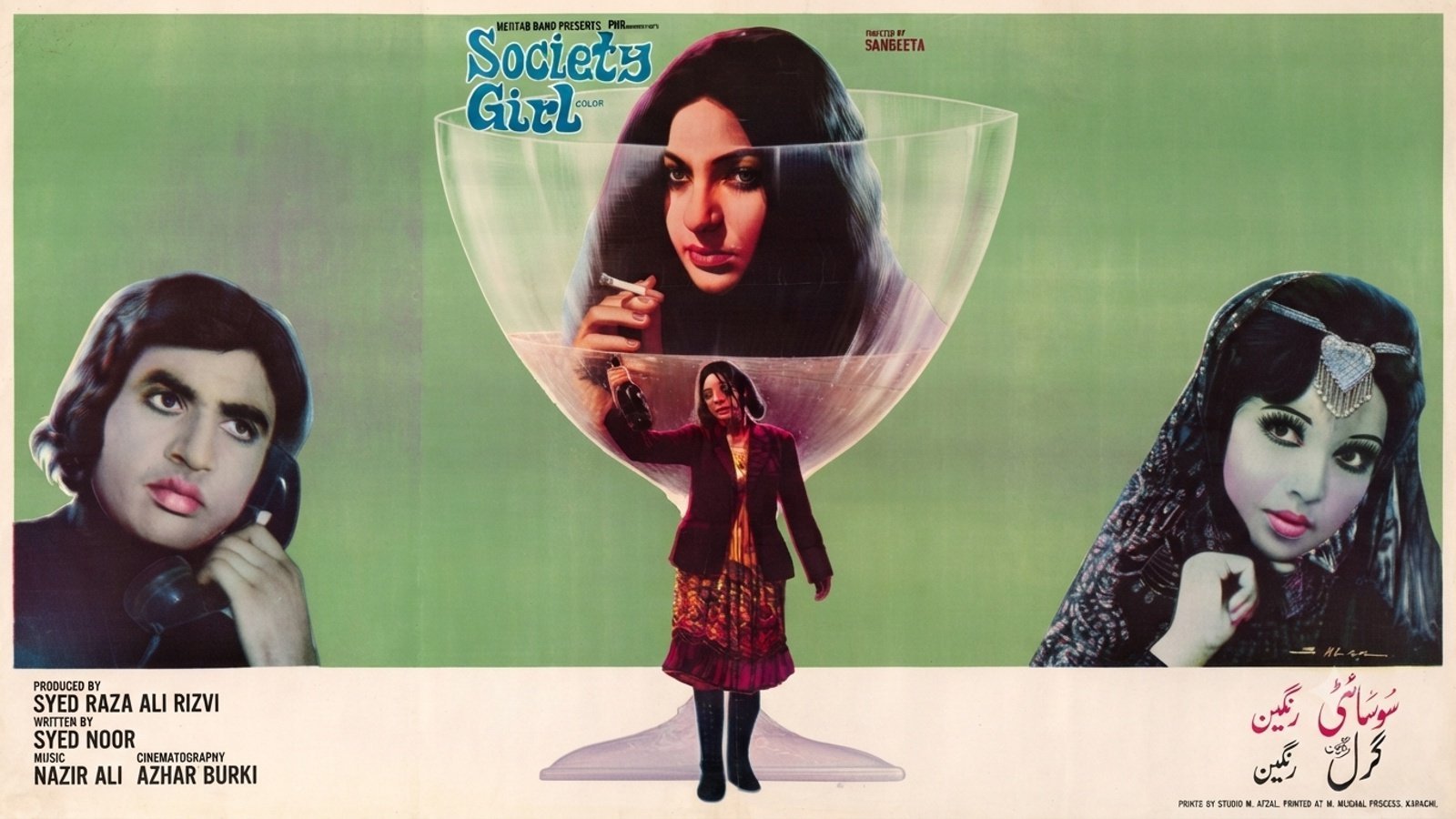
Society Girl (1976)
Cast: Sangeeta, Kavita, Bahar, Ghulam Mohiuddin, Aslam Parvez, Perveen Boby
Director: Sangeeta
Synopsis: Sangeeta’s searing social critique is considered a huge Lollywood classic. By some inexplicable accident, this film is regarded as a rare classic of Pakistani cinema and spoken of in glowing superlatives to this day. Society Girl was released in the mid-70s—a period most Pakistani cinema analysts considered as the crest of a “golden era” when new and sometimes even bold subjects were being tackled on screen, if only for purely exploitative purposes.
Reviewed by: Omar Khan
Society Girl was the directorial debut of Sangeeta, who has become one of the world’s most prolific female directors with over 40 features to her credit—a list which grows longer every month. Sangeeta plays the title role of the Society Girl, Ms. Juliana Wilson, a girl who is forced to sell her body to the highest bidder by night to support her ailing mother and her young sister Moona through an education.
During the day, Juliana works as a secretary, but at night, she is transformed into the sultry, seductive club going, chain-smoking Society Girl. Julie stuns her captive audience at night, swinging and jiving to her signature theme.
“Life is a dance. Let’s Enjveye Don’t Think Veye Don’t be Silleeee
Come and Dance” Though Beneath this façade of a carefree, happy-go-lucky Society Girl, there lurks the tortured soul of a woman who longs to be accepted, understood, and valued as a person, not just a lump of flesh. Unfortunately for Julie, she meets outright rejection whenever she presents herself as anything but a society girl to her club-going society friends. They are least interested in Julie, the broken woman with a hundred shattered dreams; all they want is their pouting, saucy piece of crumpet, and once they have had their money’s worth, off these men go simpering back to their loving wives to play dutiful husband and father. We learn that Julie’s life was turned upside down one day when she was barely a teenager. She had gone to the local warehouse to fetch rice for her mother when she was cornered and raped by the owner. (Sorta Roti, Kapda aur Makaan inspired).
The incident has devastating repercussions for the family as Julie’s father hangs himself in despair rather than face the shame of being the head of a family that has allowed the honour of their daughter to be compromised. Julie must provide for her sick mother and young sister; she only has to offer herself, thus her unfortunate descent into the flesh trade.
Julie also seeks to escape – An escape she can only find in endless gulps of whiskey. “Get fast” is her normal exhortation to an astounded barman, who warns that she will kill herself going the way she is. Julie responds that that is precisely why she drinks so much—to end all the misery. Julie finds solace and understanding in the shape of another broken-hearted soul (Gullu) hanging out at the club, looking glumfaced. Ghulam Mohiuddin’s character is trying to recover from the devastating loss of his wife (Nisho), who drowned in a stream after a riding accident. Gullu and Julie strike up a deep understanding, and
Society Girl he seems to be the only person who values Julie for what lies within rather than the saucy tart on the exterior.
The film builds to a terrific climax as Julie’s church-going sister (Kavita), her fiercest opponent, now promises to get help for her ailing sister by going to the very club and selling her soul. Still, Julie rises from her death bed (with rotting liver and all) and returns to the club to beg one of her customers to consider her his bride, not for the usual one night, but for the time to come. She is mocked relentlessly by the shallow clubbers. “Once a Society Girl, always a Society Girl” remind her that A Keep is the best offer she manages to evoke, but no genuine sympathy. Will Juliana fail to stop her younger sister from following in her sordid steps to the club, or will poor Kavita end up yet another victim of the vile club society?
The film is a Sangeeta show, and she does a great job as Juliana Wilson, giving a captivating performance as the doomed Society Girl—the bad girl with a good heart. Kavita was still in her gormless, moronic days, and her dialogue delivery was painfully sorry. Bahar coughs and splutters rather effectively in her role as the kind-hearted, forgiving mother of Julie and Moona (Kavita). Ghulam Mohiuddin does well as the dashing but tragedy-struck businessman, and Nisho’s is just a very brief appearance. Aslam Parvez is simply superb as the slimy, suave, club-going businessman who is vileness personified. Perveen Boby excels as the sidekick Society Girl and provides a scintillating dance later in the proceedings.
It is a women-centric movie with a potent message for a society riddled with double standards. The top-notch songs include the smash hits Life is a Dance, Andaaz Wohi Apnaya Hai, and Tere Qadmon Main. The film itself celebrated a golden jubilee all over the country. Sangeeta shows considerable promise as a director and manages to keep the movie from getting too bogged down with a strong sense of narrative. Unfortunately, she does not appear to have improved in 25 years of filmmaking, and this film suggests that she has deteriorated considerably in the following years.
However, in her favour, this film is somewhat of a convention breaker because there is no attempt to provide the obligatory romantic formula, which is rather refreshing. Nevertheless, calling the film a classic would push the bounds of generosity. The film is efficiently put together and carries an important message, but worthy of classic status means that the rest of Lollywood fare must be the dregs.
Incidentally, Society Girl was scripted by a youthful Syed Noor, while Mrs Habib Fitwell designed the fabulous outfits!



0 Comments
Leave a Comment