
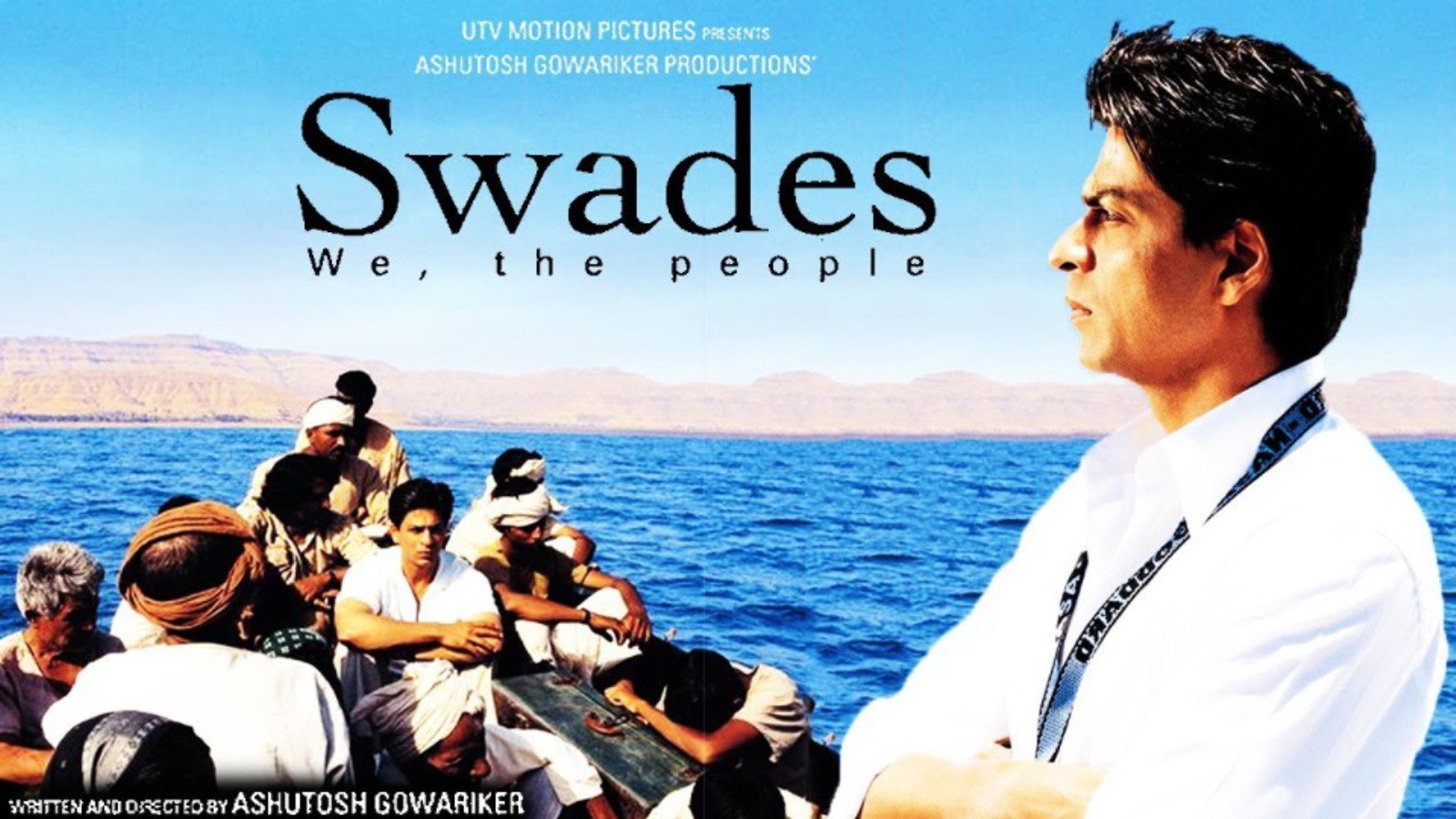
Swades (2004)
Cast: Shahrukh Khan, Gayatri Joshi,
Director: Ashutosh Gowariker
Music Director: A.R.Rahman
Synopsis: An enormous let down after Lagaan, Swades is lavish but deadly dull
Reviewed by: Faiz Khan
Lagaan remains one of the towering achievements of modern Indian cinema. The odds of Ashutosh Gowariker equalling it, let alone surpassing it, were always remote. Nevertheless, expectations for Swades were understandably enormous. Returning once again to rural India, Gowariker appeared to be exploring similar territory, but with a far more intimate and personal story.
Sadly, the results are deeply disappointing.
Mohan Bhargava (Shah Rukh Khan) is an Indian expatriate working as a project manager at NASA. Orphaned at an early age and raised by his devoted nanny Kaveriamma (Kishori Ballal), he returns to India hoping to persuade her to accompany him back to America.
His search eventually brings him to the village of Charanpur, where Kaveriamma now lives with Gita (Gayatri Joshi) and her younger brother.
Mohan quickly concludes that before Kaveriamma can leave, two problems must first be solved: Gita must be persuaded to marry, and her struggling village school must somehow attract enough children to survive.
As Mohan settles into village life he begins to encounter the many hardships that define rural India—poverty, caste discrimination, child labour, illiteracy, entrenched traditions and the limited role afforded to women. During a journey to collect rent from one of Gita's tenants, he witnesses genuine deprivation for the first time, an experience that forces him to question both his own priorities and the comforts of his American existence.
Determined to help, Mohan throws himself into improving village life, attempting to bring electricity to the community and encouraging education and social unity. Along the way, romance inevitably blossoms between Mohan and Gita, although she remains steadfastly committed to her homeland rather than following him to America.
The problems addressed by Swades are real and important. Unfortunately, Gowariker merely skims their surface before resolving them with simplistic dramatic shortcuts. Complex social issues that have plagued rural India for generations are reduced to neat cinematic solutions, often through inspirational speeches or songs. Watching reluctant parents suddenly embrace education after a musical sequence may provide feel-good cinema, but it hardly rings true.
The film begins promisingly but loses momentum almost immediately after Mohan reaches the village. From that point onwards the narrative becomes strangely flat and emotionally detached. Despite the sincerity of its intentions, Swades rarely moves the viewer because it never fully immerses us in the lives of its characters. Instead, it often feels like an illustrated catalogue of social problems rather than a compelling human drama.
The leisurely pace only compounds the problem. Scene after scene unfolds with little dramatic urgency, while the songs repeatedly interrupt rather than enhance the narrative. By the final hour, the film has become an endurance test.
This is particularly frustrating because the ingredients for a genuinely affecting film are all present.
Shah Rukh Khan delivers one of the finest performances of his career, abandoning his usual mannerisms for an understated, mature and quietly confident portrayal of Mohan. It is proof that, when properly directed, he is capable of remarkable restraint.
Gayatri Joshi is equally impressive in her debut. She possesses an effortless grace that recalls the classic heroines of an earlier era, bringing warmth, intelligence and dignity to Gita without ever resorting to melodrama.
A.R. Rahman's score is also somewhat underserved by the film. Apart from the magnificent "Yeh Jo Des Hai Tera," which briefly hints at the emotional heights the film might have reached, the music often slows an already ponderous narrative.
There can be little doubt that Swades is an earnest, sincere and well-intentioned film. Unfortunately, sincerity alone cannot sustain three hours of cinema. Gowariker tackles subjects of enormous importance but rarely explores them with the dramatic depth they deserve, leaving behind a film that is admirable in its intentions yet surprisingly lifeless in its execution.
A major disappointment.

0 Comments
Leave a Comment