
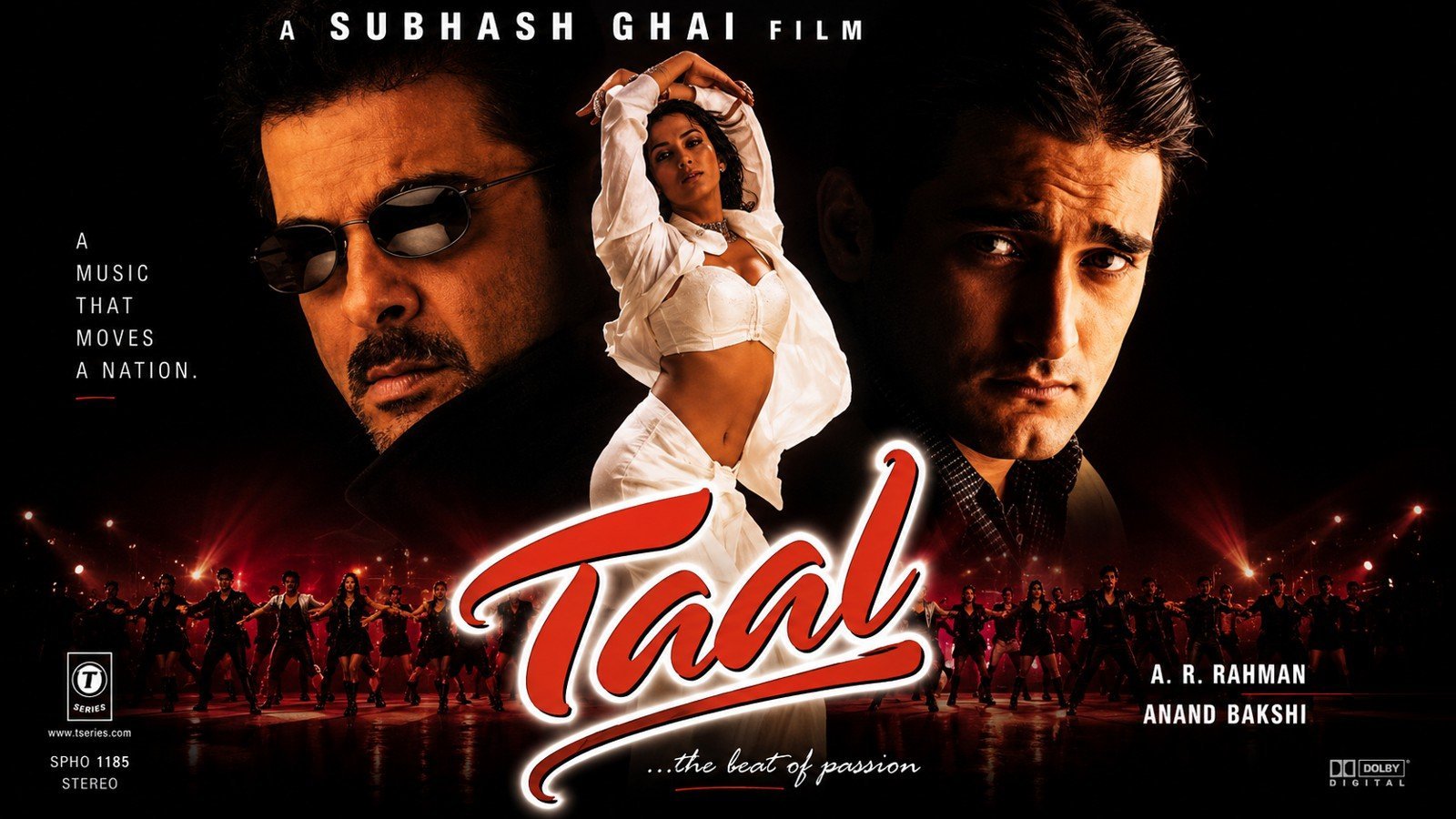
Taal (1999)
Starring: Anil Kapoor, Akshaye Khanna, Aishwarya Rai, Amrish Puri
Director: Subash Ghai
Synopsis: Ghai's follow up to the lukewarm Pardes touches upon many similar themes, but the end result is another disappointment.
Reviewed by: Ali Khan
As with most of Subhash Ghai's films, Taal treads a comfortably familiar path. Raj (Akshaye Khanna), the son of one of England's wealthiest businessmen, returns to his ancestral village where he falls hopelessly in love with Mansi (Aishwarya Rai), the daughter of a respected folk singer.
Predictably, the romance encounters fierce opposition. Family pride, class differences and wounded egos combine to drive the lovers apart.
Complicating matters further is Vikrant Kapoor (Anil Kapoor), an exuberant and wildly successful music producer who recognises Mansi's extraordinary talent and transforms her into a singing sensation. In the process he also falls in love with her, creating the inevitable triangle as Raj attempts to win back the woman he lost.
The most successful Bollywood romances often take familiar ingredients and present them with enough freshness to make us forget we've seen them countless times before. Taal certainly contains all the old ingredients, but unfortunately Ghai never quite manages to disguise how familiar they really are.
The screenplay repeatedly revisits territory already covered in Pardes: the foreign-returned Indian rediscovering his roots, the clash between traditional values and urban materialism, the wholesome village girl contrasted with the superficial modern world. None of these themes is explored with any new insight, leaving the film feeling oddly mechanical despite its lavish scale.
The emotional journey also proves surprisingly shallow. We are constantly told how deeply these characters love one another, yet Ghai rarely allows that love to develop naturally. Instead, emotions are conveyed through increasingly elaborate song sequences rather than believable dramatic interaction.
The performances are equally uneven.
Akshaye Khanna, who displayed enormous promise in his earlier films, appears strangely subdued. His trademark understated style, usually one of his strengths, works against him here, making Raj seem aloof and occasionally arrogant rather than quietly romantic.
Aishwarya Rai is unquestionably one of the film's great visual assets. She looks magnificent throughout, and there is a noticeable improvement in her acting compared with her earlier work. Although she has yet to develop the emotional depth that the role truly demands, Taal marked another significant step forward in her career.
Anil Kapoor, however, divides opinion.
Personally, I have always felt that Kapoor is at his finest when he reins in his boundless energy. As the flamboyant Vikrant Kapoor he gives himself full licence to explode across the screen. It is a colourful, larger-than-life performance—helped considerably by an enviable collection of berets—but it frequently tips into excess. One cannot help wondering whether Govinda, who reportedly declined the role, might actually have been a more natural fit.
Among the supporting cast, Amrish Puri performs efficiently in an underwritten role, while Alok Nath once again alternates between looking hurt, delighted, outraged and saintly—sometimes within the same scene.
The greatest disappointment arrives with the climax.
What should have been the emotional crescendo degenerates into an overlong, overblown muddle that stretches credibility and patience in equal measure. Rather than building dramatic tension, Ghai simply prolongs the inevitable until relief replaces anticipation.
Fortunately, Taal possesses one undeniable trump card.
A.R. Rahman's soundtrack is magnificent.
The songs are not merely memorable; they are among the finest of his career, and Ghai photographs them with enormous flair. Whatever reservations one may have about the film itself, its musical sequences remain a feast for both the eyes and ears.
The cinematography is equally impressive, ensuring that Taal always looks spectacular, even when the screenplay is running on fumes.
Ultimately, however, lavish production values cannot disguise the fact that Ghai is recycling material he has explored before with far greater success. Taal is a handsome film filled with glorious music but burdened by an old-fashioned, overextended screenplay that never quite justifies its epic length.
One final observation.
Could Coca-Cola perhaps exercise a little more restraint when sponsoring films in future?
The soft drink almost deserves top billing.

0 Comments
Leave a Comment