
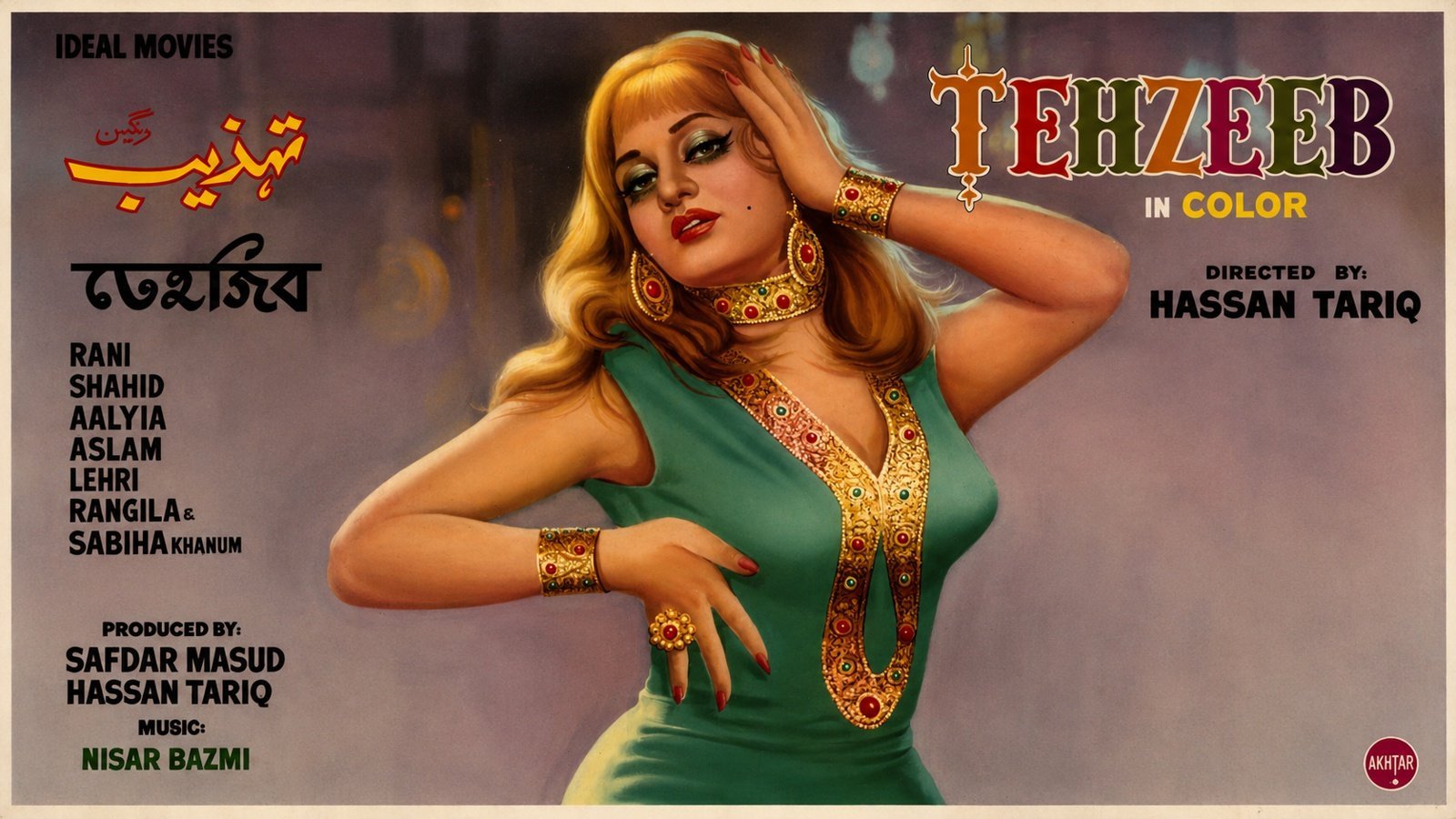
Tehzeeb (1971)
Cast: Rani, Shahid, Sabiha, Aalia, Aslam Parvez, Lehri, Rangeela, Tamanna
Director: Hassan Tariq
Synopsis: Debauched immoral western values wreak havoc on traditional eastern ways.
Reviewed by: Omar Khan
This social drama with a Stinger missile of a message became a runaway smash hit in 1971, establishing Rani as a major force on the Urdu scene—especially as it followed up on the spectacular success, she had enjoyed the previous year with Anjuman.
The director Hassan Tariq and his wife, Rani, became a formidable team with their heady brand of woman-oriented social drama that usually ended in tragedy. Hassan enjoyed casting his wife as the tragedy queen. It seemed so did the public because the dynamic-duo husband and wife team scored a sequence of barnstorming hits with Umrao Jaan Ada and Ek Gunah Aur Sahi, Tehzeeb and Anjuman.
Rani and Hassan Tariq were not the only standard links of the three movies; Sabiha Khanum also became a dominant character actress. She stamps her presence resoundingly on each of the smash successes. A fourth common ingredient is the fabulously sleazy and slimy Aslam Parvez.
Tehzeeb begins with a distraught matriarch battle axe, Sabiha explaining that her family has been destroyed by a vice that has spread like cancer. The winds extend from the West, the land of evil and debauchery. Sabiha rants and raves like a deranged woman about the horrors of the modern ways, claiming humanity is at stake under threat from the sin of lust, debauchery, and indecency that comes with everything associated with the West.
Sabiha recalls the story of her family’s downfall, swallowed up by evil, lustful Western ways. With such a paranoid attitude to life, it’s hardly surprising that Sabiha’s sons and daughters-in-law pray for the day that the old hag keels over, liberating them from the Taliban-like regime that she enforces on the household.
However, while the hardcore fundo Sabiha reclines in her summer retreat in the hills of Murree, her frustrated and fun starved brood starts to live it up big time. Aalia, known as Baby, is a dazzler on the dance floor, and even tubby Tamanna occasionally jigs out. These shallow souls fritter their time away indulging in such heathen debauchery as celebrating New Year’s Eve or throwing obscene Birthday parties and calling each other darling a lot!
The Club is the centre point of social activity, and the family visit with religious regularity, bugging out on the dance floor till the wee hours of the morning, much to the disgust of Rani, who is a bit of a killjoy like her grandmother.
Sabiha feels she is about to kick the bucket and decides to marry simpleton Rani off to Javed, a nephew studying in the heathen lands. She forces Javed (Shahid in his debut role) to wed Rani over the phone (by proxy). When he returns to the homeland, he is horrified to discover that the woman he thought would be a party-going, trendy, English-speaking socialite is a dowdy servant-like bumpkin.
Shahid is disgusted his family tricked him into marriage and takes to dating the curvaceous Baby, frequenting the Club with her almost every night of the week. Unfortunately for Shahid, he has his fabulous
Tehzeeb
Beatle look (hairstyle) ruined by kill joy Sabiha, but he stands committed to Club-land.
The rustic Rani tries to please her husband by following him to the Club. She is like a fish out of water in that debauched, westernized, modern environment where Aslam Parvez prowls for fresh chicken meat.
One night, Shahid is stunned by a new ultra-modern, super fashionable blonde femme fatale who shows up at Club to sample the nightlife. She spins a web of mystery and has Shahid salivating at the thought of her stunning beauty, but he is equally startled by the fact that she resembles his plain Jane wife, Rani, to the hilt. It is as though she is the alter ego of Rani—the modern, souped-up ultra-mod girl as opposed to the moronic, dull as ditchwater, whining hag he is stuck with for a wife.
After tailing the blonde occasionally, he finds that his suspicions are well-founded and that the mystery blonde is none other than his wife. The latter was being trained by interfering granny, Sabiha, to teach her errant husband a lesson or two. The plan works initially but then backfires hugely as Rani and Shahid fall madly in love, but then she decides to allow herself to be moulded into the woman of her husband’s dreams. He trains her to be modern and westernized, and in no time, we have Rani becoming the “Lady of the Night”, indeed the Belle of the Ball at the fleapit club, where she is granted instant membership once she has shown her prowess on the dance floor.
Meanwhile, having forced his wife to start drinking regularly and going out clubbing on a nightly basis, Shahid leaves for a stint abroad, leaving his delectable wife in the hands of his trusted best mate, Mohsin (Aslam Parvez).
In his absence, Mohsin and Chandni (Rani), develop a close relationship and become a steady item on the local club scene. When Shahid returns from his time abroad, he appears to have changed because of having forced his wife into clubbing, a debauched westernized lifestyle; he now seems to have turned a new leaf or become born again as he frowns on the Club and his wife’s modern, western ways.
There is a moment of heavy symbolism when Shahid sees a Barbie doll on the mantelpiece dressed in a sexy sleeveless dress. A moment later, we see a Barbie appropriately dressed according to Eastern values, her head dutifully covered under a black dupatta. At that very moment, Shahid realizes the terrible error of his ways and how he has created an unstoppable Frankenstein’s monster, or perhaps it’s still not too late.
In Mehdi Hassan’s voice, Shahid belts out the show-stopping hit number, Laga Hai Misr Ka Bazaar. But his efforts prove fruitless, and Rani spirals further and further into the debauched lifestyle of the hedonist west. When all appears lost, Shahid arrives in his grandmother’s footsteps to beg forgiveness for his errors and allow her the satisfaction of saying, I told you so.
Meanwhile, Rani is trapped by the reptilian Aslam Parvez, who tells Rani chillingly that he will only let her go once she has become “the other woman”. Will Shahid be able to secure the blessings of Sabiha and rescue his bride from the clutches of the serial rapist Aslam Parvez, or is it too late, and the cancer of western debauchery has spread too far into the system for any redemption at this stage?
The film’s strength is in the bombastic performances of Sabiha Khanum as the prophet of doom matriarch and Rani, who is excellent as the sacrificed woman (her forte). Aalia is breathtaking in her dance numbers and proves she had no equal in the club dancing stakes in the early ‘70s, the pre-Ishrat Chaudhary and Anita days. Shahid impresses in his debut role, and the supporting cast does well, with Lehri excelling.
A feature of the film’s success was the hit music composed by Nisar Bazmi (lyrics by Saifuddin Saif) and especially the song Misr Ka Bazaar.
Tehzeeb The censors had changed to Husn ka Bazaar as the government felt it would offend Egyptian sensibilities. The song attained anthemlike popularity. The racy dances at the Club were also no doubt a major attraction. Yet, the potent and utterly blatant nationalistic message carries the film. The anti-western vitriol spouted by Sabiha is what the most hardened Taliban would approve of. It’s a typical sub-genre of the film within the mainstream—bashing the West for its debauched, evil ways. In the best scene of the film, Rani takes a stinging slap on her face from her husband Shahid but replies by delivering one of her own that is twice as hard!
In this film, Rani looks at her best with a rare waistline while Aalia’s hips are in danger of exploding. There are commendable moments, though, mainly when the women are depicted as strong characters. In one scene, Rani’s character has the guts to stand up to her fickle husband due to his pathetic double standards. Aslam Parvez is sublime in his trademark as woman baiting predator of the club scene. Without a doubt, Tehzeeb endures as a classic of its kind.


0 Comments
Leave a Comment