
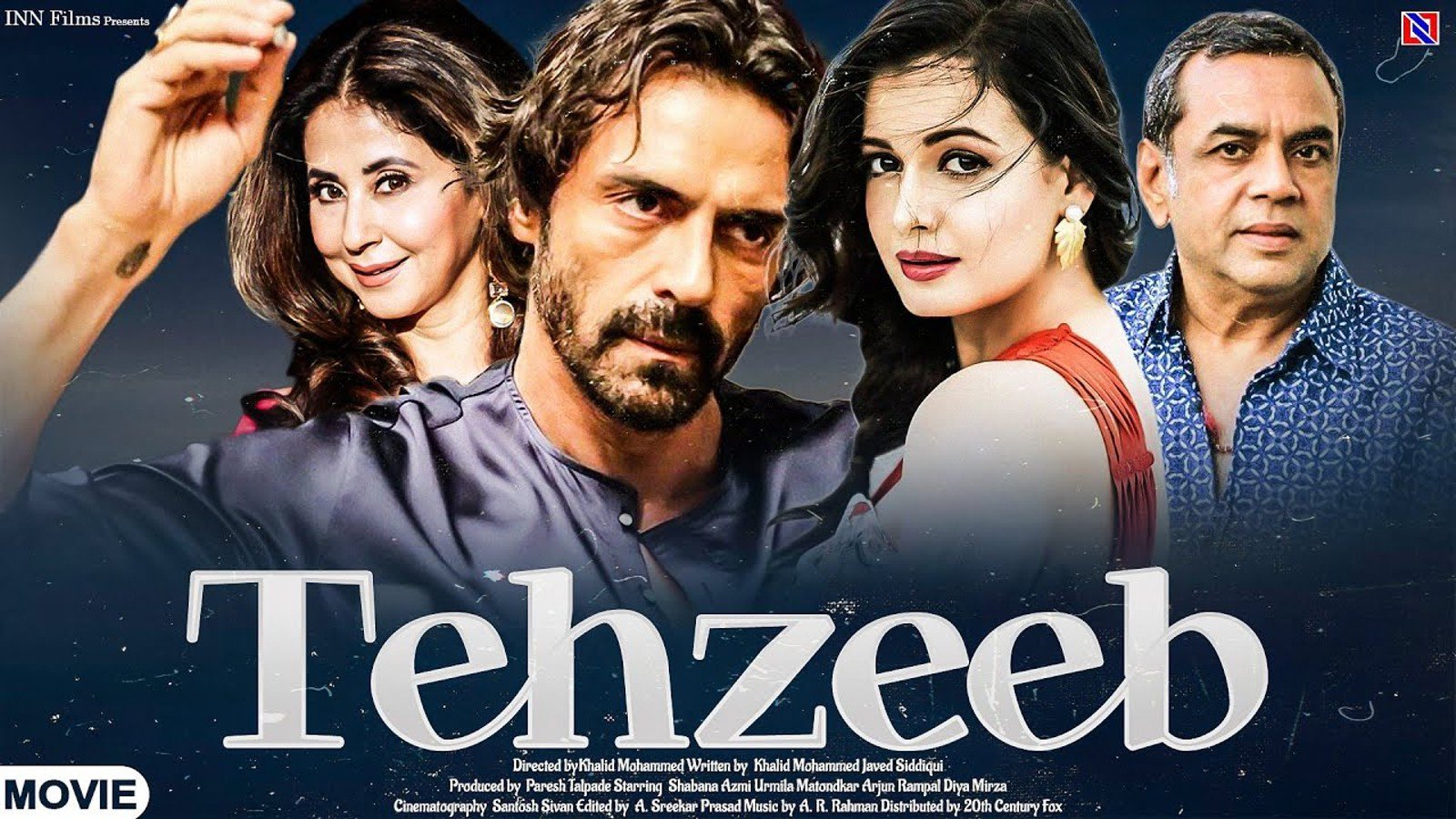
Tehzeeb (2003)
Cast: Shabana Azmi, Urmilla Matondkar, Dia Mirza, Arjun Rampal
Director: Khalid Mohammed
Music Director: A.R.Rahman
Synopsis: Bollywoodization of Bergman's Autumn Sonata goes a little haywire!
Reviewed by: Faiz Khan
Khalid Mohammed is an intelligent man. Few Indian film critics have wielded a sharper pen, dissecting and demolishing countless films with an authority that made his reviews required reading. Tehzeeb therefore represents an intriguing role reversal. It is the moment when the critic himself steps behind the camera—and, unfortunately, discovers just how difficult it is to practise what one has so often preached.
Inspired by Ingmar Bergman's Autumn Sonata, Tehzeeb centres upon the fractured relationship between a mother and daughter.
Rukhsana Jamal (Shabana Azmi) is a celebrated classical singer whose career has always taken precedence over her family. As the opening credits unfold, we witness husband (Rishi Kapoor) struggling to hold the household together while Rukhsana pursues professional success. Her husband's business has collapsed, she has become the family's sole breadwinner, and eventually tragedy strikes when he dies under circumstances that leave lingering questions.
Years later, daughter Tehzeeb (Urmila Matondkar) has built a peaceful life with her husband Salim (Arjun Rampal) and her mentally challenged younger sister (Dia Mirza). Their home is warm, affectionate and refreshingly free of melodrama—until Rukhsana unexpectedly returns after five years of estrangement.
The reunion is painfully awkward.
Years of suppressed resentment erupt as mother and daughter finally confront one another, exposing emotional wounds that have never healed.
Had Khalid Mohammed remained focused on this relationship alone, Tehzeeb might have become a deeply affecting chamber drama.
Instead, he repeatedly abandons it.
The film continually diverts its attention towards Salim, a character who appears to have been expanded far beyond his dramatic purpose. What should have been an intimate examination of two damaged women becomes cluttered with unnecessary subplots involving glamour models, flirtations and diversions that contribute virtually nothing to the emotional core of the story.
The Diana Hayden episode, in particular, feels like it has wandered in from another film altogether. It neither develops character nor advances the narrative, serving only to interrupt the steadily building tension between mother and daughter. The same applies to Namrata Shirodkar's dance appearance and Urmila's beach sequence. These concessions to commercial Bollywood formula feel completely at odds with the serious drama Mohammed is attempting to create.
The irony is difficult to ignore.
The very audience attracted to a film such as Tehzeeb is unlikely to require these diversions, while those seeking commercial entertainment are unlikely to be satisfied by the sombre central drama.
Mohammed finds himself trapped awkwardly between two worlds, pleasing neither.
This is particularly frustrating because the central performances are excellent.
Shabana Azmi is magnificent.
She refuses to portray Rukhsana as a simple career-obsessed monster. Instead she creates a woman whose ambition, emotional failings and genuine vulnerability coexist in fascinating balance. Rukhsana may be difficult to like, but she is impossible not to understand. It is one of Shabana's finest performances.
Urmila Matondkar gives one of the better performances of her career and brings considerable emotional conviction to Tehzeeb. Yet, alongside an actress of Shabana Azmi's stature, one occasionally becomes aware of the mechanics of the performance rather than the character herself.
Arjun Rampal, unfortunately, is badly miscast. Salim should have provided warmth and emotional stability amidst the conflict, yet Rampal remains curiously expressionless throughout. His expanded role ultimately becomes one of the film's greatest liabilities.
Dia Mirza remains likeable but never escapes the familiar clichés associated with portraying mentally challenged characters.
A.R. Rahman's soundtrack proves equally disappointing. Apart from the haunting "Mehrbaan" and one or two pleasant moments, the score lacks the inspiration normally associated with his work.
One cannot help lamenting what Tehzeeb might have been.
The foundation—a Bergman-inspired study of love, resentment, guilt and forgiveness—is an excellent one. Unfortunately, Khalid Mohammed repeatedly loses faith in his own material, interrupting its emotional momentum with unnecessary commercial embellishments that steadily drain away its dramatic power.
The result is a film that promises depth but never quite reaches it.
One suspects Ingmar Bergman would have viewed this interpretation with considerable disappointment.

0 Comments
Leave a Comment