
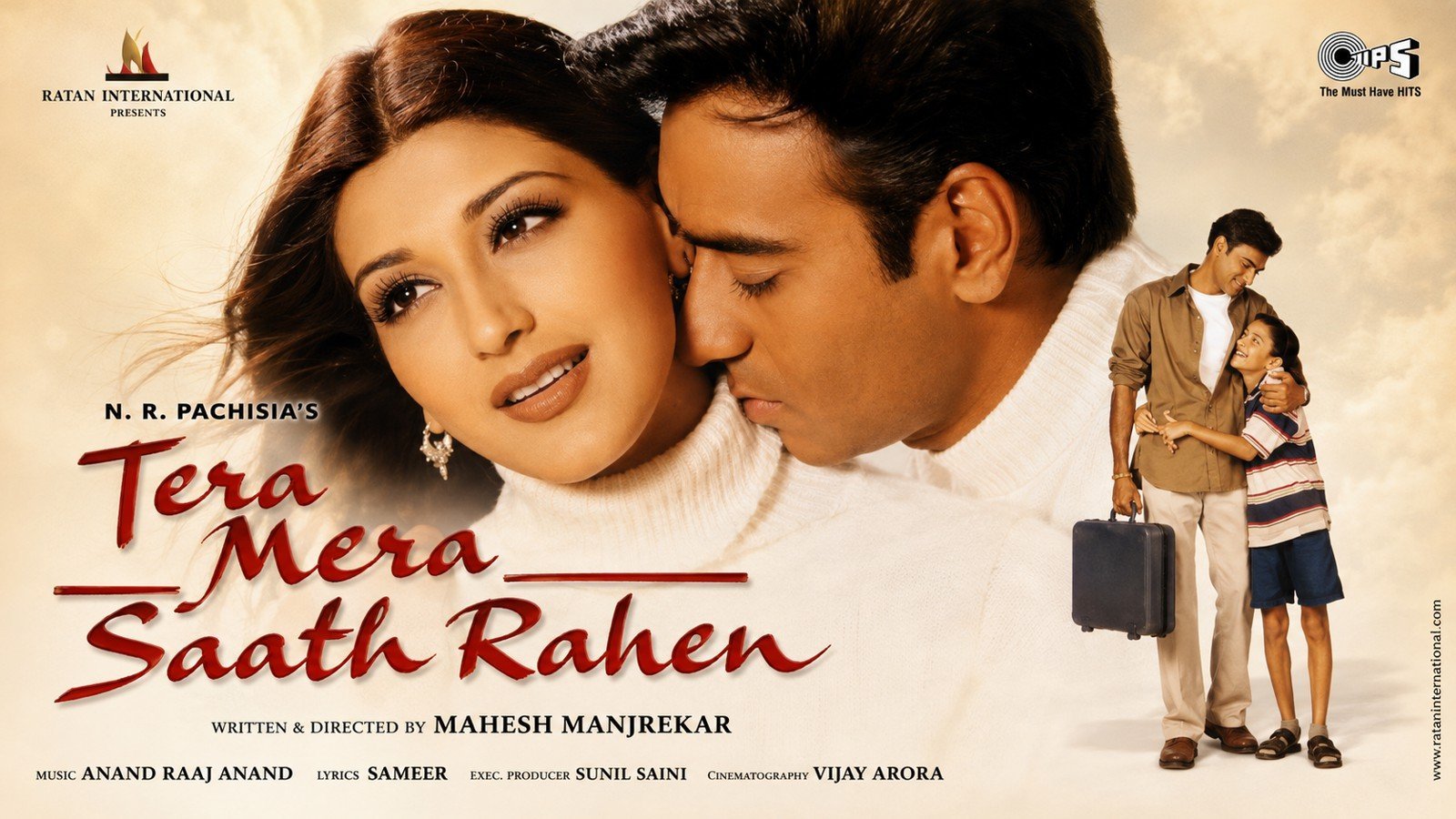
Tera Mera Saath Rahe (2001)
Starring: Ajay Devgun. Sonali Bendre, Namrata Shirodkar, Shivaji Satam
Director: Mahesh Manjrekar
Music Director: Anand Raaj Anand
Synopsis: predictable and tedious fare from the chamelionlike Mahesh Manjrekar
Reviewed by: Faiz Khan
Mahesh Manjrekar has never been a filmmaker content to repeat himself. Whether it was the underworld drama Vaastav, the quietly powerful Astitva, the police drama Kurukshetra, or the vacuous village fantasy Jis Desh Mein Ganga Rehta Hai, each film has attempted something different.
With Tera Mera Saath Rahen, Manjrekar sets out to make a mature love story built around family responsibility and personal sacrifice.
It is an admirable idea.
Unfortunately, despite the potential, it never comes to life.
Raj Dixit (Ajay Devgn) works for a shipping company and devotes his entire life to caring for his mentally disabled younger brother Rahul (Dushyant Wagh). Living next door is Suman (Namrata Shirodkar), hopelessly in love with Raj despite his complete lack of romantic interest.
From her very first appearance, you know exactly what role she has been assigned: the eternally yearning, long-suffering woman with the heart of gold who, inevitably, will finish second.
She even arrives bearing apne haath ke bane huye parathe, proving once again that the way to a man's heart is supposedly through his stomach.
Only this time it doesn't work.
We even get the obligatory fantasy song while the parathas are presumably still warm in Raj's hands, although afterwards we're never quite sure whose fantasy it actually was.
Raj is later introduced to Madhuri (Sonali Bendre), a copywriter from Delhi whose own marriage collapsed before it even began after her prospective mother-in-law died on the wedding day and she was somehow blamed for the tragedy.
Raj makes it abundantly clear that marriage has no place in his life because Rahul will always come first.
Madhuri agrees to remain "just friends."
Naturally, friendship blossoms into love.
She grows close to Rahul, becomes part of Raj's world, and eventually asks for some form of commitment. Faced with the impossible choice between his brother and the woman he loves, Raj considers placing Rahul in a rehabilitation home so that he can finally begin living a life of his own.
On paper, this is an excellent premise.
In execution, it leaves surprisingly little emotional impact.
The biggest problem is that the film remains strangely detached from its own characters. For a story built around impossible choices and personal sacrifice, it generates remarkably little feeling. The romance never develops any real warmth, Raj's inner conflict is barely explored, and the emotional consequences of his decisions never carry the weight they should.
The sluggish pacing only compounds the problem.
A slower rhythm worked beautifully in Astitva because every scene revealed something about its characters. Here, the narrative simply drifts. Commercial song sequences suddenly appear like lengthy interruptions rather than organic parts of the story, many of them filmed in picturesque foreign locations that seem to belong to an entirely different film.
The comedy, inserted to lighten proceedings, rarely raises more than a polite smile.
Only during the final twenty minutes does the film begin to show signs of genuine emotion, but by then the audience has already endured so much meandering that the impact is greatly diminished. Even the conclusion arrives exactly as expected and without much conviction.
Ajay Devgn gives an earnest performance but never quite captures the emotional depth the role demands. This is not the actor who moved audiences in Zakhm or Hum Dil De Chuke Sanam. Whether because of the screenplay or the direction, Raj remains frustratingly distant throughout.
Sonali Bendre is saddled with an inconsistent character and never appears entirely comfortable in the role.
The greatest casualty, however, is Namrata Shirodkar.
One keeps wondering why Suman exists at all.
Her entire subplot contributes almost nothing to the central relationship between Raj and Rahul, which should have been the emotional heart of the film. Instead, her scenes repeatedly distract from what is genuinely interesting. If Manjrekar intended her storyline to comment on society's treatment of unmarried women, the point is buried beneath a screenplay that never gives her enough substance.
One unintentionally amusing moment comes when Suman's father (Shivaji Satam) solemnly informs Raj that his daughter has never even stepped inside a kitchen.
Which immediately raises the obvious question.
Who made those famous apne haath ke parathe she brought Raj at the beginning?
Reema Lagoo provides a few welcome moments of warmth, while Dushyant Wagh deserves special praise. His portrayal of Rahul is refreshingly free of caricature and provides the film with its few genuinely affecting moments. Ironically, the least experienced performer often emerges as the most convincing.
Anand Raj Anand's music is entirely forgettable. None of the songs leaves any lasting impression, with the exception of the ludicrous "Jumbo Jet" number, which feels so wildly out of place that one wonders why it was included at all.
There is a thoughtful film hidden somewhere inside Tera Mera Saath Rahen. A more disciplined screenplay concentrating solely on the relationship between Raj and Rahul might have produced something genuinely moving.
Instead, Mahesh Manjrekar delivers a film that never finds its emotional centre. Slow without being reflective, sentimental without being moving, and mature only in intention, Tera Mera Saath Rahen ultimately proves to be a disappointingly lifeless affair.
At least the parathas looked appetising.

0 Comments
Leave a Comment