
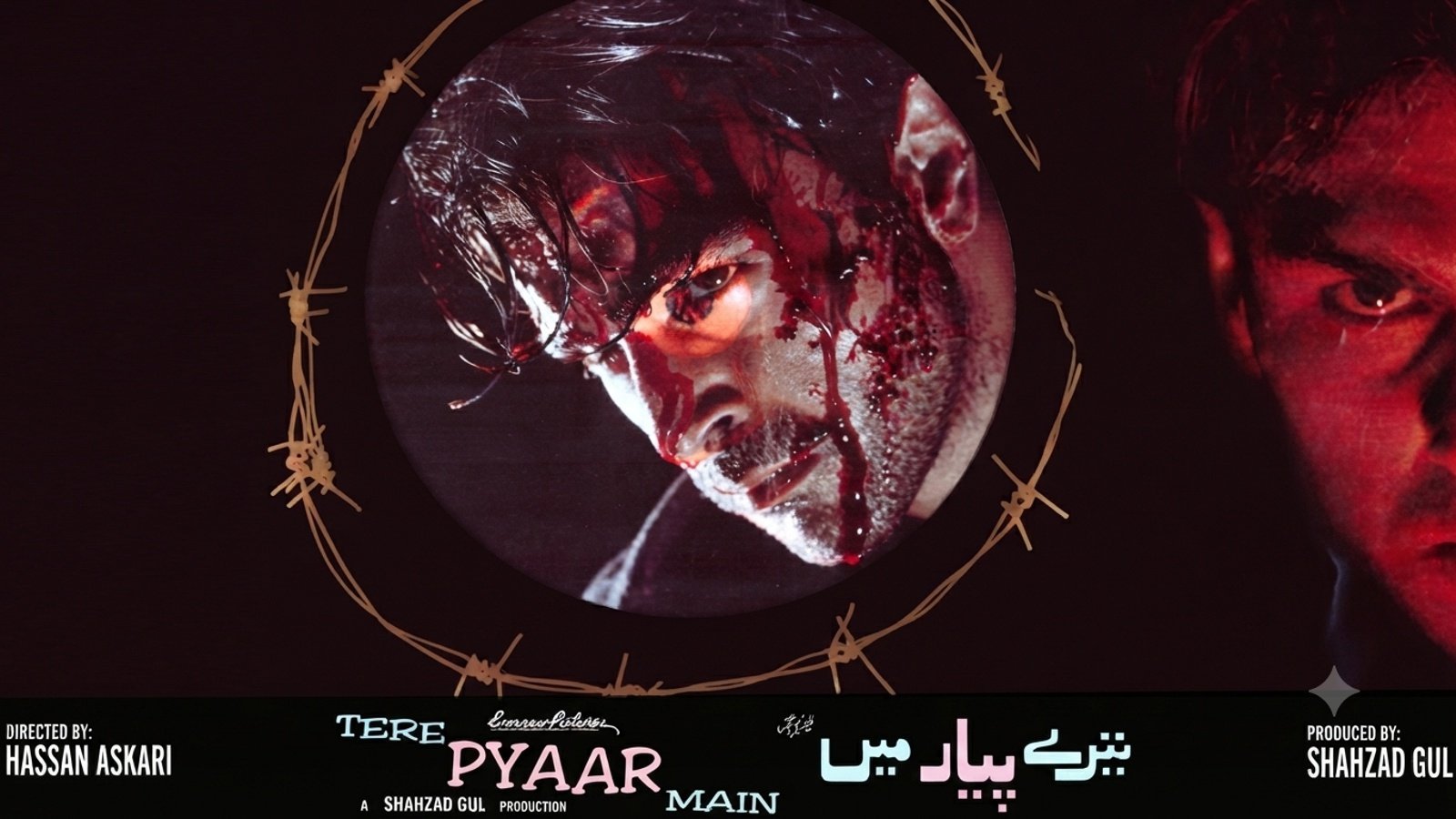
Tere Pyar Main (2000)
Cast: Zara Sheikh, Shaan, Noor, Veena Malik, Sabira Sultana, Raja Riaz, Irfan Khoosat, Khalid Butt, Badar Munir, Nawaz
Director: Hassan Askari
Synopsis: Lollywood’s smash hit response to Border, Pukar, Sarfarosh etc., stars Shaan.
Reviewed by: Omar Khan
Many regard this film as Lollywood’s stinging retort to the Spate of anti-Pakistani films streaming out of Bollywood lately. Border, Sarfarosh, Pukar, Mission Kashmir, Refugee, and now Gadar, all in relatively quick succession.
Lollywood’s minuscule industry has been straining to respond as it is going through a seemingly permanent crisis, lurching daily, with hand very much to mouth. However, two India-bashing films have been unleashed; one has threatened box office records and made a clean sweep of all the local film awards.
Tere Pyar Main has been a massive hit, while Musalman, the second of the India-bashing films, also did brisk business. Tere Pyar Main is initially set in the Indian part of Punjab. We are introduced to a stereotypical, loud-mouthed, bumbling, cheerful, and kindhearted Sikh and his pretty daughter Preeti. Though Sardar Ji is quite happy with his lot, he yearns to see the city of his childhood again and keeps saying, “Lahore, Lahore hai,” which is totally in keeping with his nonexistent intellect.
The Sardar’s wishes are accepted one day, and he is granted a visa to pilgrimage (Yatra) to the holy Sikh temples in Pakistan. His Indian (Hindu) friends are horrified that he should even consider venturing to enemy turf, but the cheerful old Sardar is adamant, and after all, he must return to Lahore. Naturally, the moment Sardar Ji and his daughter arrive in Pakistan, they find the place is a veritable land of milk and honey with no malice, tension, fear, or worry. Just wonderfully kind-hearted and welcoming, good earnest folk! After he heroically rescues her from a blaze, Preeti soon falls madly in love with the Mobilink phone salesman, Ali (Shaan). The film was “sponsored” by Mobilink!
When the two young hearts become inseparable, Sardar Ji decides it’s time to head back home to India, causing much heartbreak and calamity. Preeti is inconsolable but is forced to leave Pakistan and return to her home in India. Later, after much moping around, Shaan travels to India to meet his beloved and is horrified to discover that he is not welcomed but viewed as a despised enemy. To cut a long story short, Shaan and his beloved realize they have no future in beastly India and must battle against all odds to scrape home to safety—Pakistan.
The film is as much a piece of crude propaganda as the Bollywood films it attempts to emulate. There are pointed references to the storming of the Golden Temple in the ‘80s as an intolerable slur against the Sikh nation, in the hope that it would be as loathsome to them as the demolition of the Babri Mosque was to Muslims at large. Poor Sardar ji meets his maker, but not before spluttering something to the effect that they (the Sikhs) had befriended the wrong side. However, the film’s fascinating aspect is the filmmaker’s blatant and somewhat bewildering attempt to try to arouse the passions of the Sikhs against the Hindus.
Tere Pyar Main
Just as numerous dialogues from Pukar were puke-inducing with their gutter-level vileness and hatred-spewing venom, Tere Pyar Main follows in the same offensive vein. That the film has succeeded to the extent it has is not so much due to the anti-Indian slant but because, despite its awfulness, it is still a far more refined product than 95% of Lollywood films.
The film appears lavish; even a fraction of polish is almost unheard of in Lollywood productions till 4K cameras and drones arrived decades later. The acting is better than what is usually on display. Zara Shaikh gives a likeable performance and shows herself to be very comfortable in front of the camera despite her debut feature. Shaan tries earnestly but appears somewhat wooden rather than sensitive.
The side performers also do a reasonable job, with bumptious Sardar Ji excelling, but the music is dull and instantly forgettable. Noor (who has since found God, bless her) provides some cheap glamour in a brief guest appearance.
The production values are way above the norm for Lollywood; this is as slick as it gets. However, that aside, the film is unexceptional and speaks volumes for the decrepit state of Lollywood when a film as mediocre as this can make a virtual clean sweep of every national movie award. The movie is mildly entertaining and reasonably acted but relatively unremarkable, except for the searing propaganda tactics it employs.
Not worse than Pukar certainly, and strikingly similar in theme to the super successful Gadar, which it preceded by about eight months. Though it’s regressive, hate-inducing rubbish of the most questionable kind—someone ought to tell these propagandists (on both sides of the border) that two wrongs don’t make a right, but then at the moment, they’re too busy laughing to the nearest bank.



0 Comments
Leave a Comment