
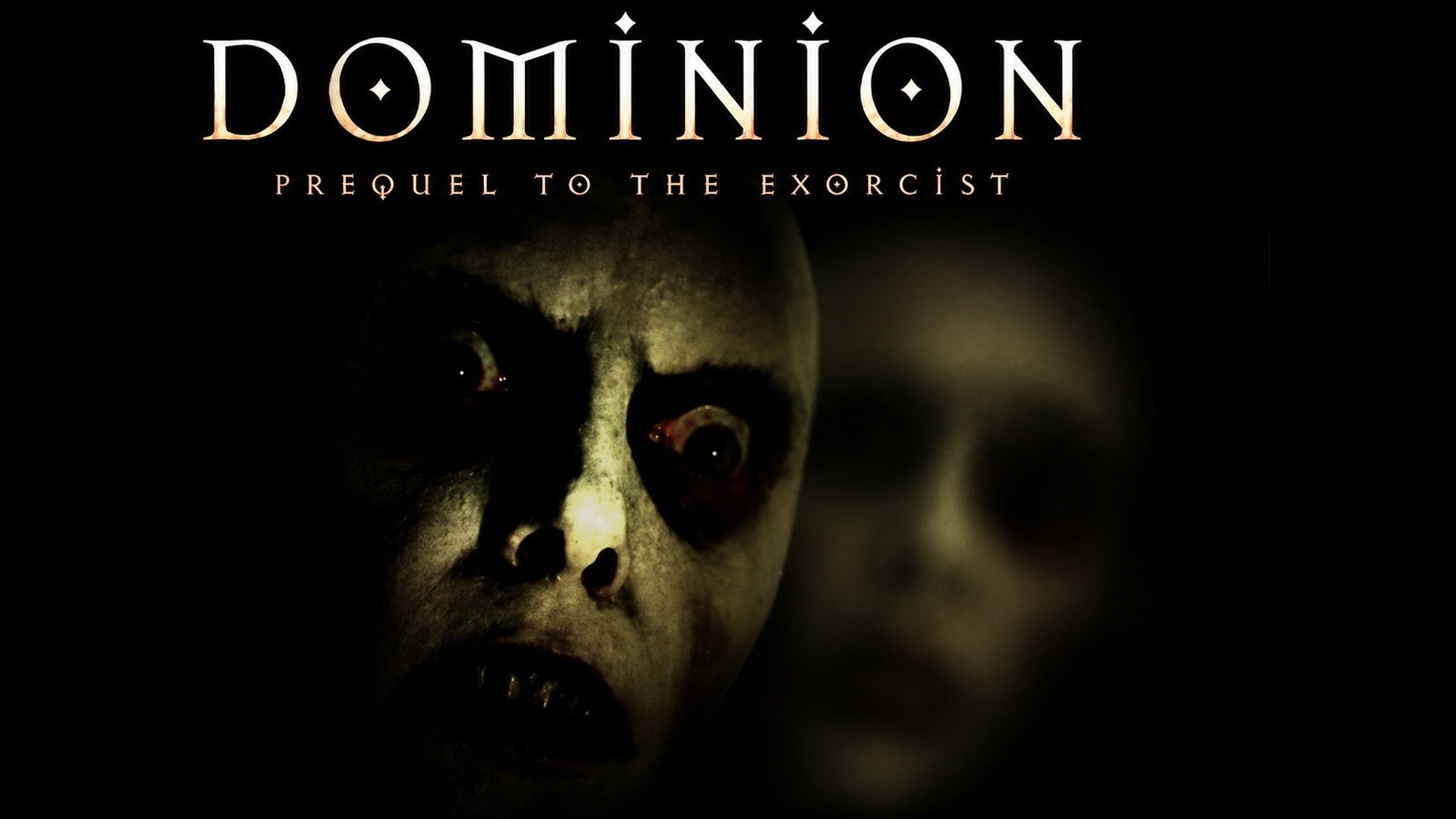
The Exorcist: Dominion (2005)
Cast: Stellan Skarsgård, Gabriel Mann, Clara Bellar, Billy Crawford, Ralph Brown
Director: Paul Schrader
Nutshell: Morgan Creek not learning from their mistakes, make a mockery of yet another Exorcist sequel/prequel.
Review by Omar Khan
Cast: Stellan Skarsgård, Gabriel Mann, Clara Bellar, Billy Crawford, Ralph Brown
Director: Paul Schrader
Nutshell: Morgan Creek, desperate for some sort of salvation after rejecting Paul Schrader's original film, finally released the discarded version. But was it worth it?
Review by Omar Khan
Morgan Creek have never seemed capable of getting things right when dealing with The Exorcist. By the late 1980s, the company had acquired the rights to continue the franchise, leading to the first of several troubled productions, Exorcist III. Ironically, it was the film that came closest to capturing the spirit of William Peter Blatty's original work and remains arguably the strongest sequel the franchise has produced since William Friedkin's monumental 1973 classic. Yet despite its considerable merits, nothing that followed has come remotely close to matching either the critical acclaim or the extraordinary financial success of the original.
Exorcist III was a brooding, intelligent slice of supernatural horror anchored by a magnificent performance from Brad Dourif. Unfortunately, its considerable strengths were severely diluted by studio interference. Executives in expensive suits decided that the film simply was not "The Exorcist" as they understood it and insisted that it required more overt horror in order to maximise its box office potential. Blatty had written and directed an adaptation of his novel Legion, a thoughtful, unsettling thriller in which psychological dread was allowed to simmer beneath the surface. Morgan Creek, horrified that audiences would not receive enough spinning heads, booming voices and exorcisms, demanded extensive reshoots. A full exorcism sequence was added, additional horror scenes were filmed and, perhaps most significantly, the title was changed from Legion to Exorcist III. Blatty's carefully constructed film was effectively pulverised and reshaped into something uneven, disjointed and tonally confused. What had been evolving into one of the decade's most intelligent horror films was crippled by corporate panic and short-term commercial thinking.
Years later, an attempt was made to reconstruct Blatty's original vision and strip away much of the studio-imposed nonsense. Admirable though the effort was, it arrived far too late. The damage had already been done. The theatrical release had underperformed at the box office, audiences had rejected its wildly inconsistent tone, and what should have been one of the great horror films of the 1990s was left floundering. By any measure, it remains one of the genre's great tragedies.
Remarkably, Morgan Creek learned absolutely nothing from the experience.
When work began on an Exorcist prequel more than a decade later, history repeated itself almost beat for beat. Once again the studio commissioned a thoughtful, restrained film—this time directed by Paul Schrader—only to panic when confronted with a slow-burning, atmospheric drama rather than the barrage of demonic spectacle they believed audiences expected. Schrader's film was rejected, Renny Harlin was brought in to reshoot much of the project from scratch and Exorcist: The Beginning emerged in 2004 bearing little resemblance to the film originally commissioned. The result was another critical and commercial disappointment, widely ridiculed and rejected by much of the original fan base.
Having spent millions replacing Schrader's version, Morgan Creek then performed an astonishing about-turn and decided to resurrect the discarded film, releasing it only months later as Exorcist: Dominion. By then the exercise resembled little more than flogging a horse that had already expired. While Dominion may have been greeted with slightly less hostility than Harlin's bombastic effort, audiences had largely lost interest. The studio had repeated precisely the same mistake it had made with Exorcist III, once again refusing to trust the filmmaker they had originally hired.
Viewed today, Exorcist: Dominion feels very much like damage control rather than a film standing confidently on its own merits. Anyone who has already endured Exorcist: The Beginning experiences an overwhelming sense of déjà vu, as scene after scene unfolds in broadly familiar fashion, only this time without Harlin's relentless barrage of explosions, CGI excess and manufactured shocks. The quieter approach is certainly less exhausting than The Beginning, but it hardly transforms the material into compelling cinema.
If anything, the film simply exposes the weaknesses inherent in the screenplay itself. The CGI effects remain decidedly poor, even if used more sparingly, while the possession sequences lack both imagination and conviction. Schrader attempts to replace spectacle with atmosphere, but the finished product never generates the overwhelming sense of dread that made Friedkin's masterpiece such an unforgettable experience. It is undoubtedly the more mature of the two prequels, yet maturity alone cannot compensate for a narrative that never truly catches fire.
For Morgan Creek, it became another failure in an increasingly depressing catalogue of failures associated with The Exorcist.
Perhaps the best piece of business the company ever conducted was not making another film at all but selling the rights for an enormous sum to Universal, who embarked upon an ambitious three-film revival under director David Gordon Green following the success of Halloween (2018). Unfortunately, Green's subsequent Halloween Kills and particularly Halloween Ends squandered much of the goodwill that first film had generated, with Halloween Ends provoking one of the fiercest backlashes horror fandom has witnessed in recent years—and deservedly so.
Universal had already committed Green to directing The Exorcist: Believer, itself an unmitigated disaster that managed to alienate both critics and longtime fans almost instantly. Plans for an entire trilogy quickly evaporated, Green quietly exited the franchise, and Universal turned instead to Mike Flanagan in the hope of restoring some credibility to one of horror cinema's most revered properties. Early indications suggest that Flanagan intends to return much closer to the spirit of Friedkin's 1973 original rather than chasing spectacle for its own sake.
Time, of course, will tell.
Sadly, the history of The Exorcist since 1973 has demonstrated one thing above all else. Studio executives continue to believe that lightning can simply be bottled a second time if enough money is thrown at the problem. They never seem to grasp that what made the original extraordinary was not spinning heads, flashing lights or booming demonic voices, but the absolute conviction with which Friedkin treated the material.
Some people never learn.
Polishing a turd rarely changes what it is.

0 Comments
Leave a Comment