
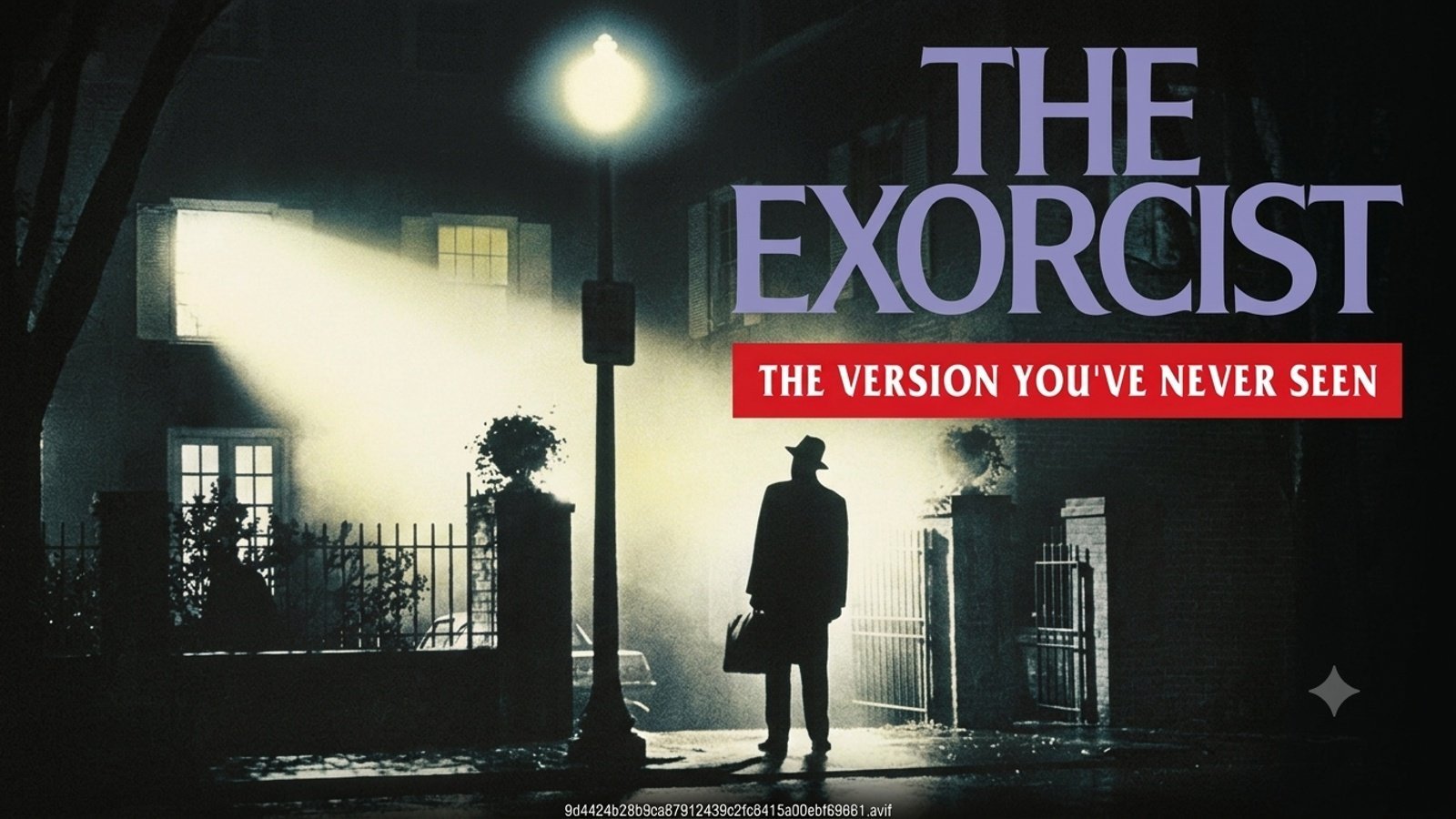
Exorcist, The - The Version You’ve Never Seen (2000)
Starring: Ellen Burstyn, Lee J. Cobb, Linda Blair, Jason Miller, Max Von Sydow
Director: William Friedkin
Synopsis: Extended by 11 minutes with a phenomenal, mind-blowing new sound mix
Reviewed by: Omar Khan
When William Friedkin and author William Peter Blatty reunited to record the commentary for the 25th Anniversary DVD of The Exorcist, it quickly became apparent that, even after all those years, they still had plenty to discuss—and plenty to argue about. One gets the distinct impression that Blatty never entirely accepted Friedkin's decision to omit certain scenes from the original release back in 1973.
So what exactly is this so-called "The Version You've Never Seen"?
The story, as we see it, is this.
In the wake of the Mary Whitehouse-inspired "Video Nasties" hysteria, The Exorcist found itself caught up in one of the most absurd episodes of British censorship. Moral crusaders began ranting about the horrors lurking on the shelves of local video shops and how their cherubic children were supposedly being traumatised by these VHS abominations. Amid the ensuing panic, the British censors began banning films left, right and centre in a desperate attempt to appease the self-appointed guardians of public morality.
Remarkably, The Exorcist—a film nominated for no fewer than ten Academy Awards—was lumped together with exploitation fare such as I Spit on Your Grave and Cannibal Holocaust and effectively disappeared from British screens for almost two decades.
Only after James Ferman's retirement was the ban finally lifted, and The Exorcist allowed to return to British cinemas before eventually making its long-awaited reappearance on home video.
The response was extraordinary.
More than twenty-five years after its original release, the film once again became one of the year's biggest box-office successes in Britain. Around the same time, Friedkin and Blatty revisited the film, restoring several scenes that had originally been removed and presenting what became known as The Version You've Never Seen.
In truth, this feels less like a traditional Director's Cut and rather more like an Author's Cut. Most of the reinstated material consists of scenes that Blatty had always favoured but which Friedkin had previously discarded. Even the more optimistic ending that Blatty originally preferred has now been grafted onto the film's familiar conclusion.
The obvious question, therefore, is whether this new version genuinely improves one of cinema's greatest horror films—or whether it is simply another opportunity to persuade audiences to pay for a film they already own.
Whatever the motivation, the commercial success was undeniable. The revised version proved another substantial box-office hit, adding millions to the film's already phenomenal worldwide earnings. Friedkin undoubtedly had the last laugh.
But does the film itself actually benefit?
In our opinion...
...not really.
Most of the deleted scenes were removed for very good reasons in the first place, and their reinstatement contributes surprisingly little to the overall narrative. The hospital sequence in which Regan behaves petulantly, for example, merely labours a point the audience has already understood perfectly well. We do not need every stage of her gradual possession explained to us in such painstaking detail.
Indeed, some of the newly inserted scenes almost suggest that modern audiences require everything to be spelt out for them in a way that viewers twenty-five years earlier evidently did not.
The legendary "spider walk" sequence is the obvious exception.
Friedkin reluctantly omitted it from the original release because the effect simply did not work convincingly with the technology available in 1973. Here it has been restored in abbreviated form and remains every bit as unsettling as horror fans had always imagined it would be. It is undoubtedly the one addition that genuinely enhances the film.
Curiously, however, Regan still does not lick Sharon's ankles with a forked tongue as she does in Blatty's novel and as seen in the documentary footage accompanying the earlier DVD edition.
Elsewhere, the additions are less convincing.
The language laboratory sequence contributes very little, while the extended dialogue between Merrin and Karras during the exorcism neither harms nor significantly enriches the drama. They simply overemphasise ideas that were already communicated perfectly well in the original cut.
There are also a couple of noticeable alterations to the soundtrack.
One occurs during the scene in which young Regan overhears her mother angrily arguing with the telephone operator. Previously played with almost no musical accompaniment, the scene has now been given a far more sinister sound design, creating a considerably more chilling atmosphere.
The second alteration comes at the very end of the film. As in the opening sequence, the chant of "Allahu Akbar" is heard once again, suggesting that Merrin's triumph over evil represents a victory for faith itself rather than one belonging exclusively to Catholicism. Whether this was intended to counter suggestions of anti-Islamic sentiment is open to debate. Personally, we have never believed The Exorcist contained such undertones in the first place—certainly nothing remotely comparable to Friedkin's rather unpleasant and overtly anti-Muslim Rules of Engagement.
If one area has been transformed beyond all expectation, however, it is the sound.
The audio restoration is nothing short of sensational.
Although the earlier 25th Anniversary DVD already featured a respectable 5.1 remix, this new presentation elevates the experience to an entirely different level. Watching The Exorcist with this remastered soundtrack is an absolute revelation. It is quite simply one of the finest audio restorations ever undertaken for an older film, ranking alongside Vertigo as one of the most impressive sound resurrections we have yet encountered.
The picture quality has also benefited enormously. The image is sharper, colours are richer, and details—particularly throughout the MacNeil household—appear clearer than ever before.
There is little doubt that The Exorcist has never looked better.
Yet it is the sound that truly steals the show.
The restoration engineers deserve enormous credit for breathing startling new life into one of cinema's greatest horror films. If you are fortunate enough to experience it through a high-quality 6.1 Surround EX system, the results are positively breathtaking.
Other than reinstating the spider-walk sequence, however, we would have left this masterpiece well alone.
Nevertheless, the new version is still well worth experiencing simply for its astonishing technical presentation. The Exorcist has never sounded better, and Mercedes McCambridge's unforgettable demonic voice remains, as ever, the film's true star.
A genuinely hair-raising experience if you possess a sound system worthy of it.
If not...
...the original version of The Exorcist will do just fine.

0 Comments
Leave a Comment