
Funhouse, The (1981)
Starring: Elizabeth Berridge, Wayne Doba, Syliva Miles
Director: Tobe Hooper
Synopsis: Another small gem of a freakshow... recommended
Reviewed by: Omar Khan
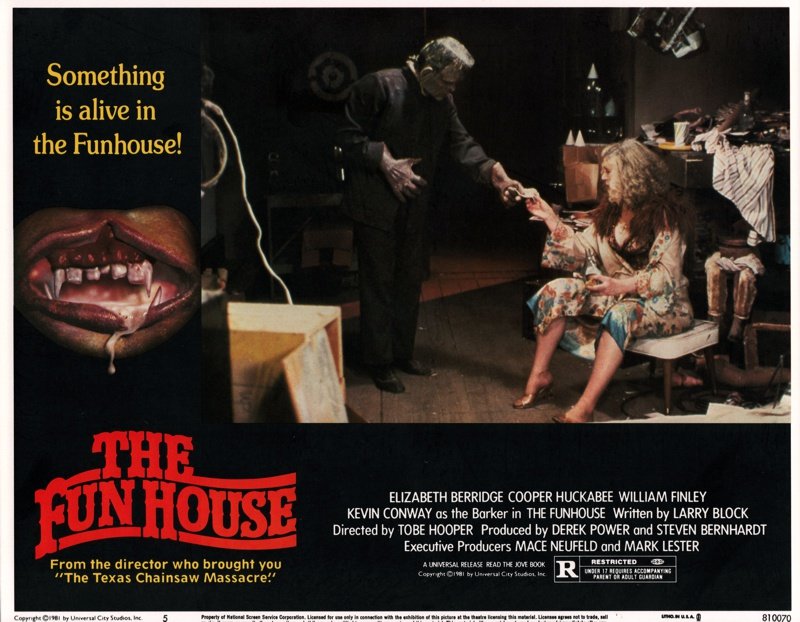
"stylish homages... a truly anarchic blend of black humour" Time Out
"pulls out all the stops" Creature Features
"atmospheric and genuinely scary" Splatter Movies
"stylish visuals help create an eerie atmosphere" Maltin's
"awfully familiar " Blockbuster Video
"a hair raising opus is there ever was one" 80's Horrors
"doesn't pan out to much in the end" Video Nasties
The Funhouse has an enormous amount going for it right from the outset. Beginning with a wonderfully creepy, atmospheric carnival title sequence, the film gets down to some heavy homage before settling into business. The most obvious nod is to John Carpenter's Halloween right at the start, which then rolls into an equally obvious wink at Psycho. Tobe Hooper knows exactly what he is doing.
The local carnival has rolled into town and our young heroine tricks her parents — shades of The Last House on the Left — and heads off to the fairground with some amorous friends. Naturally, things go catastrophically wrong.
All is not quite what it seems at the carnival and our young bunch, through their own recklessness and insensitivity, become caught up in a murderously deadly game of cat and mouse. Yet there are far more layers to The Funhouse than initially meet the eye. It is no accident that the film touches upon voyeurism, trust, the disintegration of the family unit and the darker undercurrents lurking beneath this world of cheap entertainment and tawdry spectacle.
This is clearly one of the criminally overlooked minor masterworks of horror cinema. And importantly, it isn't remotely unscary either. There are some terrific leap-out-of-your-seat shocks along the way, a screen monster as hideous as any, and John Beal's effectively creepy score maintaining a sinister aura throughout.
What The Funhouse does particularly well is capture the tackiness, charm and danger somehow inherent in travelling carnivals and freak shows. Hooper creates a neon-coloured, candy-flossed dreamworld, glowing enticingly with an aura of old-world mystique. The clunky shabbiness of the travelling country carnival is beautifully recreated and reeks simultaneously of nostalgia and menace, with more than a hint of Tod Browning's Freaks hanging over proceedings.
The enormous Laughing Lady looms over the carnival grounds like some demented Statue of Liberty, watching approvingly and mockingly as the horrors unfold beneath her. Sylvia Miles is perfectly cast as the shady fortune teller, adding another layer of carnival grime to proceedings.
But it is the Funhouse itself that becomes the great star of the film.
The ghost train is perfection, filled with grotesque, inanimate monsters that appear almost ready to spring to life, each one more lurid and ominous than the last. These figures, and the way Hooper presents them, are among the strongest aspects of the film. The entire place feels like a tacky dreamworld creaking to life — nostalgic, seedy, fascinating and deeply twisted. Alluring yet threatening, it conjures up a fairy-tale world of nightmares.
John Beal's score enhances this atmosphere of demented charm and warped dreams beautifully.
Perhaps the finest moments arrive when the carnival grinds to its nightly halt. The animated figures that had been laughing, clapping, gloating and twisting suddenly stop moving. The show is over, the lights begin to die and the mechanical laughter fades away.
Yet somehow the menace only increases.
Even in silence, the Funhouse radiates the possibility of terror. Hooper and his creative accomplices have constructed the perfect stage upon which the underlying horrors can finally be unleashed.
My memories of the film are deeply etched into the memory bank because it came out during the days when Times Square still had a life and soul entirely of its own. The Funhouse opened at the National Cinema on 44th Street and Broadway, bang in the middle of the hustle and bustle of Manhattan's theatre district. The then-notorious 42nd Street was just a stone's throw away, dominated by porn and grindhouse cinemas flickering dubious fare virtually 24 hours a day. Bruce Lee and Russ Meyer still reigned supreme alongside films featuring Marilyn Chambers and Linda Lovelace. There were coin-operated peep shows, head shops, hustlers, dealers, streetwalkers and those cruising the area looking for whatever particular vice took their fancy.
Times Square in the early 80s was the seedy, grimy underbelly of Manhattan, oozing character and shocking and delighting in equal measure. Horror movies were a staple of the area and, in the wake of the post-Halloween slasher boom, there were frequently a dozen horror films playing within half a square mile.
And so The Funhouse opened at the National and I was there with my friend from Tobago for the early show — as her birthday treat!
She never watched another horror movie with me after the experience.
I remember sitting right up front so that I could be completely engulfed by the huge screen and receive maximum jolts from those orchestrated scares that were practically a prerequisite of horror movies in those days. The cinema was eerily empty despite this being the first show of the film's theatrical run, though admittedly a 10 a.m. screening was perhaps not ideal for much of the Times Square populace, who would only just have been drowsily heading home after a night shift or partying until they were about to drop. As the late birds scurried home, sanitation workers were already preparing the area for another night of sleaze and debauchery.
I have subsequently watched The Funhouse several times and it has continued to grow on me. I currently have the 4K edition ready for yet another viewing and look forward to watching the film for perhaps the seventh or eighth time over the years, with my enjoyment seemingly increasing with every revisit.
I was also fortunate enough to shake the hand of its legendary director, Tobe Hooper, at the Sitges Film Festival in the early 2000s when he was there to screen his remake of The Toolbox Murders. Hooper never again reached the monumental heights of his all-time classic The Texas Chain Saw Massacre, but he came remarkably close to its claustrophobic excellence with The Funhouse. They are two films that rank firmly among my favourite horror movies of all time.
The Funhouse remains far less celebrated, but in my view deserves a much greater audience and far more appreciation than it has received. More than forty years after sitting almost alone in front of that enormous screen at the National in Times Square, it still works its strange magic on me.
The carnival may have packed up and left town a long time ago, but somehow The Funhouse is still there.
0 Comments
Leave a Comment