
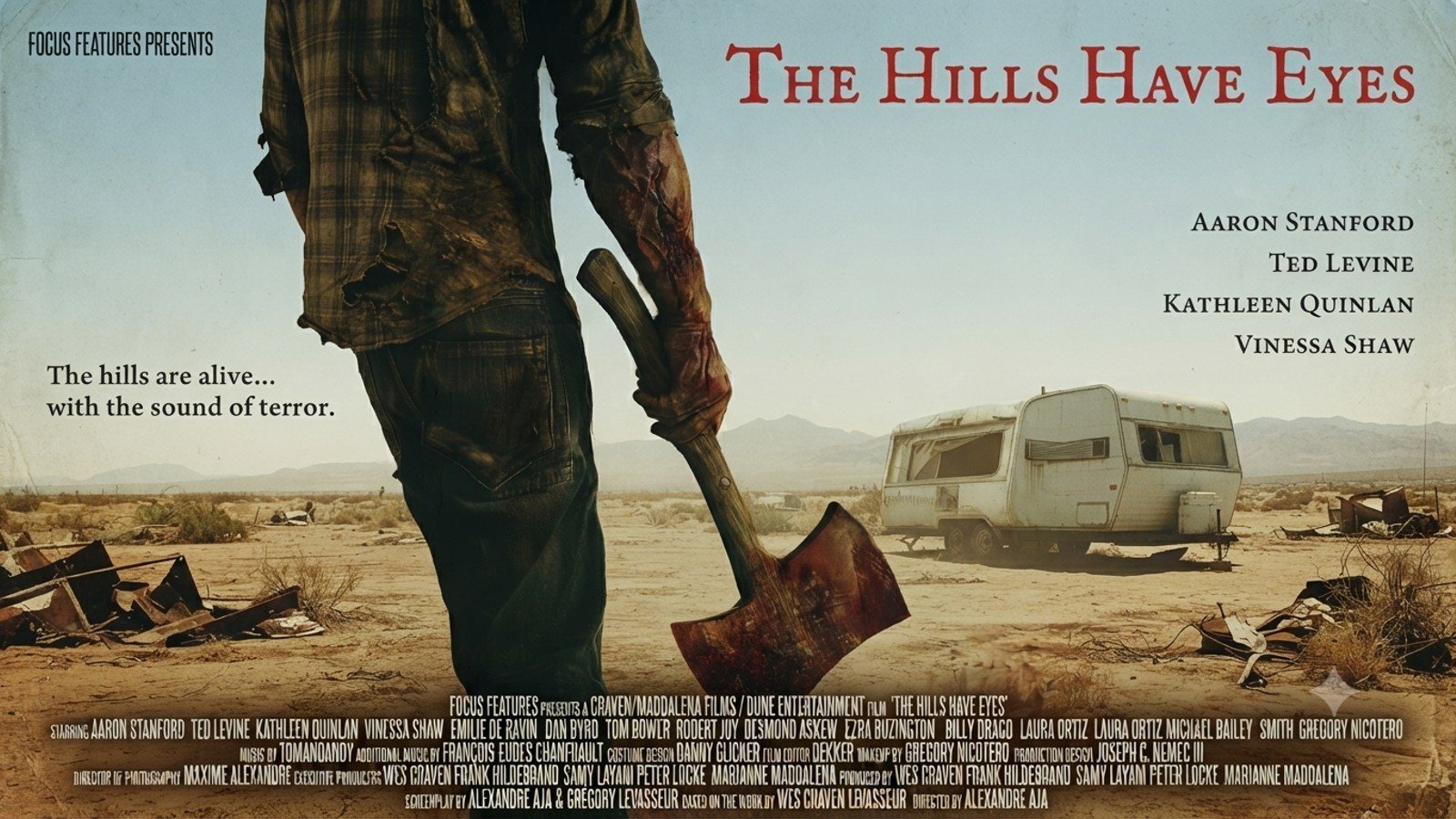
The Hills Have Eyes (2006)
Starring: Aaron Stanford, Kathleen Quinlan, Vinessa Shaw, Emilie de Ravin, Dan Byrd, Robert Joy, Ted Levine
Director: Alexandre Aja
Synopsis: One of cinema's rarities. A remake that improves on the original classic
Reviewed by: Omar Khan
There were audible groans throughout the horror community when yet another remake was announced. This time it was Wes Craven's seminal The Hills Have Eyes that was to receive the reboot treatment. Yet, unlike so many unnecessary remakes, there were reasons to be genuinely optimistic. First and foremost, it was Wes Craven himself who believed his 1977 classic was ripe for reinterpretation. More intriguingly, he had been pointed towards a young French director who had made an extraordinary impression with a little film called Haute Tension.
At this point, allow me the indulgence of taking the tiniest of bows because, although Alexandre Aja has never heard of me, I have always felt privileged to have played the smallest of roles in one of the earliest milestones of his remarkable career.
Back in October 2003, Haute Tension screened in competition at the Sitges International Fantastic Film Festival. I happened to be serving on the festival jury. Over ten exhausting but exhilarating days we watched thirty feature films, often three a day, in the magnificent surroundings of the Méliès cinema. It was heaven for any lover of genre cinema, though occasionally it felt like wonderfully rewarding hard labour.
Around halfway through the festival, two of my Spanish colleagues excitedly approached me between screenings. Knowing my affection for films such as John Carpenter's Halloween, they insisted I make time for the evening screening of a French horror film called Haute Tension (or Alta Tensión, as it was known locally). Their enthusiasm was infectious, and I settled into my seat expecting something interesting.
I was completely unprepared for what followed.
Within minutes I found myself gripped by a level of sustained tension I had not experienced since first seeing Halloween. Alexandre Aja displayed a command of suspense that was astonishing for a filmmaker still in his twenties. The tension was relentless, the pacing immaculate and the style breathtakingly confident. By the time the credits rolled, I felt as though I had survived an ordeal rather than merely watched a film.
It was exactly the kind of cinematic experience horror fans live for.
I watched the film again before the festival ended. Then came the jury deliberations.
Many members of the jury quite rightly championed Takeshi Kitano's magnificent Zatoichi, itself a superb piece of cinema and entirely deserving of major honours. But with Kevin O'Neill’s backing, I was determined that Alexandre Aja should not leave Sitges empty-handed. There was, perhaps, the faintest hint of reluctance amongst some of our Spanish hosts to bestow too many major awards upon a French production, but we held our ground. After considerable discussion, a compromise was reached. Haute Tension received the Best Director Award for Alexandre Aja while Zatoichi received the festival's highest honours.
I remember sitting in the awards ceremony watching this immensely talented young filmmaker collect his prize. Even then I had the feeling that horror cinema had discovered a major new voice. Looking back today, I still believe the recognition Alexandre Aja received at Sitges represented one of the important early milestones in what has become an outstanding career, and I remain quietly proud to have played a tiny part in that decision.
The horror community certainly took notice. Haute Tension became an international success and eventually found its way into the hands of Wes Craven. Impressed by what he saw, Craven concluded that he had found exactly the right director to remake The Hills Have Eyes.
Since then, Alexandre Aja has established himself as one of modern horror's premier directors, building an enviable body of work and proving that the promise shown in his twenties was no fluke.
So when The Hills Have Eyes was announced with Aja at the helm, for once there was genuine cause for excitement.
Did he deliver?
Emphatically.
Right from the title sequence, it is obvious that this is not simply a scene-for-scene remake. Visually, it operates on an entirely different level. The scorched desert landscape becomes a character in itself, photographed with extraordinary flair, transforming the barren wasteland into something almost monstrous.
Craven's original story remains largely intact, but Aja retells it with a confidence and cinematic sophistication that the earlier film, for all its power, never quite possessed.
A family travelling across the desert inadvertently wanders into territory inhabited by something unspeakably evil. Aja takes his time establishing both the landscape and the family dynamics before unleashing absolute mayhem. Once the violence erupts, it does so with ferocious intensity.
The film initially received an NC-17 rating before cuts secured an R certificate, although the Blu-ray restores Aja's preferred uncut version. Even today, the violence remains startlingly uncompromising. The brutality is relentless, the gore unflinching and the horror accumulates steadily towards a blood-soaked climax that never loses its momentum.
What elevates the film beyond simple shock value is Aja's complete command of tone. Every attack feels earned because he first invests us in the people under siege.
The cast, while not packed with major stars, is uniformly excellent. Aaron Stanford is particularly impressive as Doug, transforming convincingly from an initially mild-mannered outsider into one of modern horror's most memorable survivors. Kathleen Quinlan and Ted Levine give the Carter family genuine emotional weight, while Vinessa Shaw, Emilie de Ravin and Dan Byrd make the family feel entirely believable. Robert Joy's grotesque Lizard remains one of the most unsettling mutant creations modern horror has produced.
The pace never slackens. The tension rarely eases. Every frame demonstrates a filmmaker completely in control of his craft.
Some will undoubtedly consider it sacrilege to suggest that this remake surpasses Wes Craven's original.
I disagree.
Craven created a remarkable, raw and deeply disturbing film whose rough edges became part of its identity. Alexandre Aja takes that rough diamond and polishes it without ever sanding away its brutality. The visual sophistication, stronger performances and astonishing technical craftsmanship enhance rather than dilute the original's power.
Rarely does a remake improve upon a film already regarded as a classic.
The Hills Have Eyes is one of those rare exceptions.
Alexandre Aja honours Wes Craven's vision while simultaneously making the material entirely his own. The horror is every bit as savage, but the storytelling is tighter, the atmosphere richer and the filmmaking considerably more accomplished.
A masterful remake and one of the finest horror films of the modern era.
Alexandre Aja's place among horror's great directors was deservedly secured.
0 Comments
Leave a Comment