
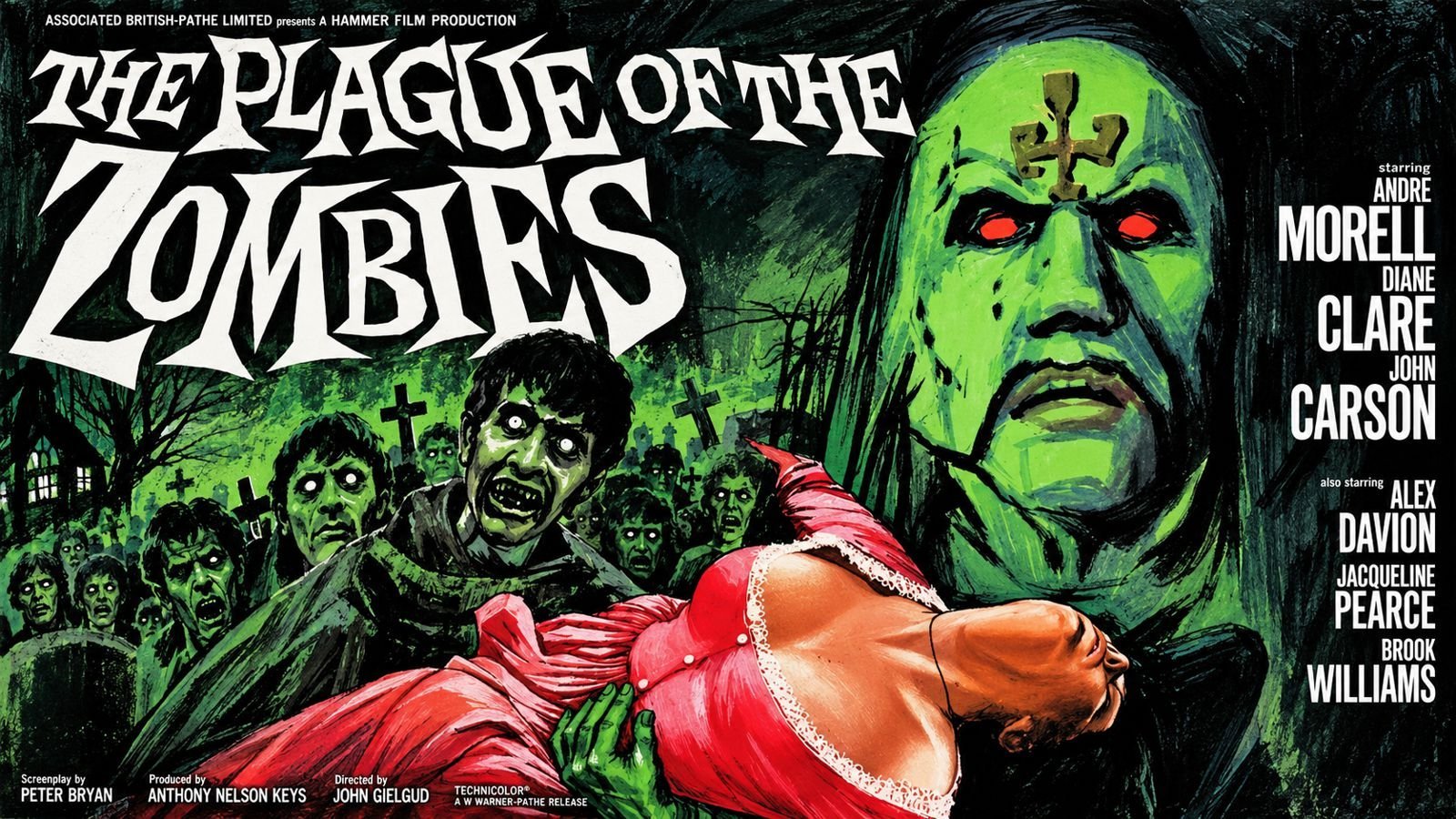
The Plague of the Zombies (1966)
Cast: Andre Morell, John Carson, Jacqueline Pearce, Diane Claire, Brook Williams
Director: John Gilling
Nutshell: A mysterious illness is killing locals at a Cornwall village with alarming regularity.
Reviewed by Omar Khan
The Plague of the Zombies, released by Hammer in 1966, finds a picturesque Cornish village under siege from a mysterious ailment that is killing members of the population with alarming regularity.
The village doctor writes to his former teacher, the renowned Sir James Forbes, explaining the predicament. Initially reluctant to leave the comfort of his London home, Sir James is persuaded by his charming daughter Sylvia (Diane Clare) to make the trip to Cornwall, especially as her old friend Alice (Jacqueline Pearce) is living there with her husband Peter, a doctor and one of Sir James's most brilliant former students.
Sir James agrees and they set off for the countryside.
Upon arriving, they find the village in a state of despair, with tension and fear on the rise and relations between the all-powerful local Squire, Clive Hamilton (John Carson), and the villagers increasingly strained. Members of the community appear to be falling prey to a deadly sickness, while the Squire lives it up on his sprawling estate with his posse of associates, enjoying the good life, going on hunts and bullying the downtrodden populace.
Sir James and Sylvia arrive in time to witness a commotion as a funeral procession is disrupted by the Squire's hunting friends. A coffin is sent crashing as the hunters chase after a fox that Sylvia has helped escape from them.
The coffin breaks open, revealing a hideous corpse within.
Later, Forbes and Sylvia arrive at their friends' home, where they are hesitantly welcomed by a strangely timid Alice. They are soon joined by Peter, the town's beleaguered doctor, who is under fire from the locals for being unable to put an end to the mounting death toll from the mysterious disease.
Peter explains that the Squire hasn't allowed autopsies to be carried out on any of the victims, and therefore it has been impossible for him to determine the cause of the sickness.
Later that evening, Sylvia is intrigued when she watches Alice slip out of the house at dusk and follows her. Alice is attacked by a man with an ashen, grey-green complexion who appears more dead than alive.
A horrified Sylvia discovers her friend's corpse moments later.
To make matters worse, Sylvia is then surrounded by the group of hunters who resent her for helping the fox escape earlier. They torment her before grabbing her and taking her away to the Squire's estate, where the ordeal continues. Just as matters are about to get seriously out of hand, Squire Hamilton arrives and puts a stop to the assault.
Sylvia, in a state of shock at her treatment at the hands of the brutes who were about to rape her, returns home furious but unharmed.
A day or so later, Sylvia is paid a visit by the Squire, who apologises profusely but contrives to have her cut her finger on a broken glass. He succeeds in drawing some of her blood and stores it in a little container he carries with him.
Clearly, the Squire is at the centre of some diabolical deeds that have gripped the town. Alice also had a cut on her wrist, and we learn that the Squire is served by men with ties to Haiti, where Hamilton had spent a large part of his earlier life.
There are dark happenings in the environs of the Squire's estate, and the canny Sir James and his associate begin to smell a rat.
Upon digging up some of the recently buried villagers, they discover that none of the dead are in their coffins!
So, where are they?
Sir James and Peter begin to unravel the mystery, but meanwhile Sylvia's life is under grave threat as Hamilton gets to work with his Voodoo effigies using her blood.
Things build to an exciting climax as the mystery unravels.
The film is directed with a deft hand by John Gilling, and the Cornish backdrop, as well as the sets, is beautifully presented in lush colours in typical Hammer Horror style. The acting is on point, with Jacqueline Pearce excelling. The film never falters as it builds towards its satisfying climax, and there is one dream sequence that is as outstanding as any in a zombie-themed film.
The background score by James Bernard, a Hammer regular, is exquisite and among his finest work.
Predating Night of the Living Dead but not nearly as successful or celebrated, The Plague of the Zombies is a strong contender in the realm of zombie films. The zombies themselves look suitably pallid and decayed, and their influence on future screen zombies is certainly visible.
The Plague of the Zombies is a wholly satisfying Hammer production and a film that does the studio's legacy proud. It was shot back-to-back with The Reptile, using the same sets and even some of the same actors for reasons of economy.
Hammer's first foray into the zombie film stands tall as one of the finest horror productions of its time. It doesn't have any of the graphic gore for which the later films of Romero or Fulci became famous, but it makes up for that in craft, style and splendid execution.
For any student of films featuring zombies, it is essential viewing.
Skilfully crafted and beautifully presented, with strong performances throughout, The Plague of the Zombies finds Hammer in excellent form.
0 Comments
Leave a Comment