
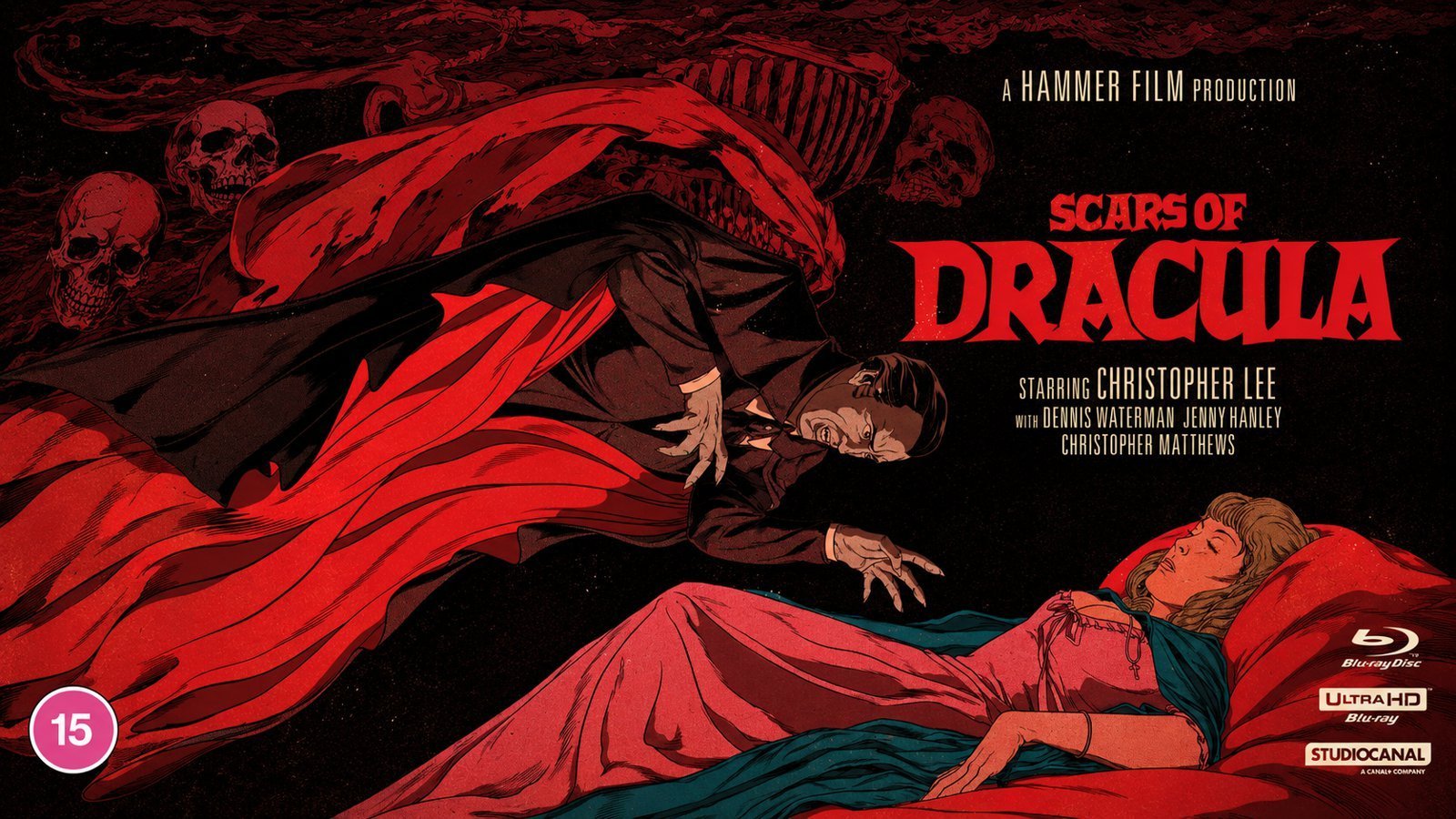
Scars of Dracula, The (1970)
Starring: Christopher Lee, Dennis Waterman, Anoushka Hempel, Jenny Hanley
Director: Roy Ward Baker
Synopsis: beyond stale and bereft of style or wit, this is Hammer on worst form
Reviewed by: Omar Khan
By the late 1960s, it was becoming painfully obvious that Hammer Films were beginning to get a little long in the tooth (no pun intended). Horror audiences were starting to crave something altogether different, something hinted at by films such as Repulsion, Rosemary's Baby and, ultimately, Night of the Living Dead. Romero's masterpiece dragged horror away from the cosy world of caped vampires and Gothic castles into something far more immediate, relentless and disturbingly real.
Against that backdrop, Scars of Dracula arrived in late 1970 already carrying plenty of baggage. The original screenplay had been rejected and rewritten before production even began, and by the time filming was nearing completion, Christopher Lee was publicly dismissing it as the weakest of Hammer's Dracula series, pointing out that it scarcely connected with any of the previous films.
Hammer's solution was to hand the project to Roy Ward Baker, one of the studio's least distinguished directors. Unfortunately, Baker merely strengthened the arguments of those who felt he could never match the artistry of Terence Fisher or even Freddie Francis.
Still...nothing quite prepares one for the opening.
Quite simply, Scars of Dracula begins with one of the most bizarre scenes in vampire movie history.
A spectacularly rubbery bat—looking distinctly irritable with its permanently furrowed eyebrows—flaps into view after what can only be described as spot-flying rather than actual flying. After bouncing up and down for a few moments, looking decidedly unwell, the poor creature suddenly vomits a stream of acidic blood onto a luxurious red satin sheet, whereupon Christopher Lee miraculously regenerates before our very eyes.
One really couldn't make it up.
Shortly afterwards, a villager arrives at the local inn carrying the body of his dead wife to prove that Dracula's curse has returned. The villagers march to Castle Dracula and burn the place to the ground, blissfully unaware that Dracula, his faithful servant Klove and, mercifully, our magnificent regurgitating rubber bat have all survived.
Dracula promptly takes his revenge by dispatching an entire squadron of rubber bats that descend upon the local church and proceed to rip the villagers' wives to pieces in what was, by Hammer standards, a surprisingly gruesome sequence.
The story then shifts to the birthday of the rather vacant Sarah, who is pining away for her boyfriend Paul. Paul, meanwhile, appears determined to seduce every woman in the district before eventually landing himself in trouble with the Burgomaster. Forced to disappear for a while, he hides inside a carriage which conveniently deposits him outside Dracula's ruined castle, where he is warmly welcomed by the beautiful Tania (Anoushka Hempel) before finally meeting a distinctly bad-tempered Count Dracula.
Paul promptly disappears.
His thoroughly insipid brother Simon (Dennis Waterman) and the even duller Sarah decide to go looking for him, leading them, inevitably, towards Castle Dracula, where the remainder of the film unfolds in depressingly predictable fashion.
Perhaps the greatest disappointment is that this may be the first Hammer Dracula film that fails to produce a single genuinely memorable set-piece. There is a fleeting glimpse of Christopher Lee scaling the walls of his castle—a lovely visual idea—but it lasts barely a second before disappearing forever.
Lee is also burdened with far too much dialogue and required to perform acts completely beneath the dignity of Hammer's greatest monster. Even worse, he spends much of the film being held at bay by what appears to be the world's smallest crucifix, reducing one of cinema's greatest vampires to a surprisingly helpless figure.
The only performer who emerges with any real credit is that remarkable rubber bat, whose opening appearance remains by far the film's most unforgettable contribution to vampire cinema.
There is certainly more gore than in previous Hammer productions, despite the censors insisting that various moments—including the sounds of human limbs being sawn off—be toned down.
Sadly, blood alone cannot rescue such a lifeless production.
Compared with Hammer's better Dracula films, Scars of Dracula is an uncommonly dull affair. None of the characters inspires the slightest sympathy. Dracula himself has been stripped of much of his hypnotic elegance, relying more upon knives and bursts of temper than charisma and fangs. His eventual downfall is disappointingly feeble and wholly unworthy of the Count's stature.
Simon is a complete prat, the local priest a slobbering old wino, Klove appears to have lost what little intelligence he once possessed, and apart from one friendly barmaid, there is scarcely a likeable soul anywhere in sight.
Only James Bernard's typically magnificent score injects the occasional spark of genuine Hammer atmosphere into proceedings.
Otherwise, this is Hammer at its most forgettable...
...with one glorious exception.
The sublime, scene-stealing, blood-spewing rubber bat.

0 Comments
Leave a Comment