
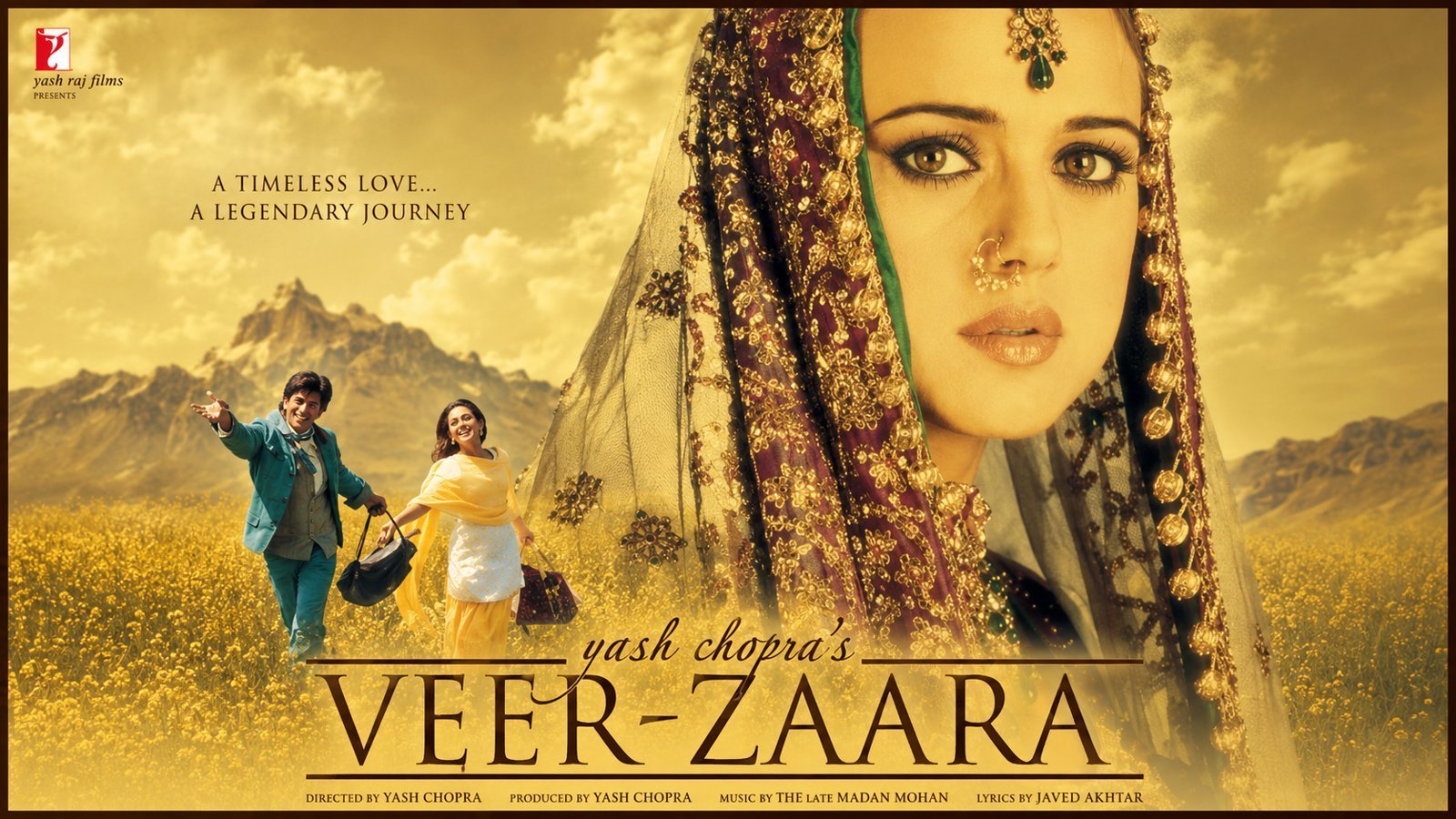
Veer - Zara (2004)
Cast: Shahrukh Khan, Rani Mukherjee, Preity Zinta, Kirron Kher, Divya Dutta
Director: Yash Chopra
Music Director: Madan Mohan (late)
Synopsis: Lush and beautifully presented yet not quite the legend it seeks to be
Reviewed by: Faiz Khan
"Dil ki waadi mein chahat ka mausam hai..."
So begins yet another Yash Chopra romance, complete with mustard fields, cascading waterfalls, fluttering dupattas and enough Swiss scenery to make the tourist board blush. One almost expects Amitabh and Rekha to emerge from behind the mist singing Yeh Kahan Aa Gaye Hum. Instead, Chopra opens on a surprisingly sombre note.
Do not be deceived.
Veer-Zaara is, predictably, yet another love story.
Yash Chopra clearly wants us to believe that Veer and Zaara belong alongside the great lovers of folklore—Laila and Majnu, Heer and Ranjha, Sohni and Mahiwal. Even the title cleverly suggests a modern-day Romeo and Juliet. Unfortunately, Veer-Zaara never quite earns such lofty company. It settles comfortably amongst Chopra's lesser romances.
That is not to say it is without merit.
Far from it.
For beneath its familiar love story lies a far more interesting and important film.
The setting alone gives Veer-Zaara an identity distinct from Chopra's earlier romances. Taking advantage of the thaw in Indo-Pak relations, Chopra places his lovers on opposite sides of the border. Veer Pratap Singh (Shah Rukh Khan) is an Indian Air Force officer, while Zaara Hayat Khan (Preity Zinta) is a young Pakistani woman.
From the outset, Chopra makes his intentions abundantly clear.
Nationality, religion and borders are almost irrelevant.
We speak the same language, share the same customs, eat the same food and mourn our dead in much the same way. Throughout the film, Chopra quietly but persistently reminds us that jaisa tera des, waisa mera des. The border may divide governments, but it has never truly divided people.
It is this sentiment that gives Veer-Zaara its greatest strength.
While visiting India to fulfil her beloved Bebe's final wish of having her ashes immersed at Kiratpur Sahib, Zaara meets Veer. Captivated by her warmth and determination, Veer agrees to help her complete her journey. What begins as a single day's companionship gradually extends into another as Veer introduces Zaara to his village and family.
Predictably, love blossoms.
Equally predictably, complications follow.
Upon discovering that Zaara is already engaged to the wealthy Raza Shirazi (Manoj Bajpayee), Veer finally confesses his feelings. Only then does Zaara fully realise her own love for him—rather conveniently perhaps, considering they have spent little more than two idyllic days together.
Determined not to lose her, Veer travels to Pakistan, only to sacrifice everything for her honour. Imprisoned under a false identity, he chooses silence over revealing the truth, believing that his suffering will allow Zaara to live a respectable and happy life.
This is where the film truly begins.
The story opens with Veer as prisoner number 786, having spent twenty-two silent years inside a Pakistani prison until his forgotten case is reopened by young lawyer Samiya Siddiqui (Rani Mukerji). Through her investigation the past slowly unfolds in flashback as we move towards discovering both Veer's sacrifice and Zaara's fate.
Yash Chopra has always been Hindi cinema's supreme romantic. His heroines remain impossibly pure, their dupattas forever flying into the hero's arms, while songs drift gently across the valleys of Switzerland accompanied, more often than not, by the voice of Lata Mangeshkar.
His cinematic signature is unmistakable.
The problem is that familiarity has begun to breed repetition.
One wishes Chopra would surprise us again with another Ittefaq instead of returning once more to his favourite territory. Sadly, Veer-Zaara often feels like the same old chocolate cake from the local bakery, elegantly repackaged as though it had come from Harrods.
The passion simply isn't what it once was.
The screenplay is overly sentimental and often asks the audience to accept emotional leaps that never quite convince. Veer's sacrifice, though noble in intention, borders on the absurd, and the romance itself never achieves the mythical stature Chopra so desperately wants it to possess.
Yet for all its shortcomings, there are moments that genuinely stir the soul.
The courtroom sequence in which Veer quietly introduces himself as "Main qaidi 786..." is one such moment. It transcends the romance and becomes something much larger—a heartfelt plea for understanding between two peoples who have far more in common than politics would ever allow them to admit.
Whatever one's political views, it is difficult not to admire the sincerity behind Chopra's message.
Some may dismiss it as calculated timing, arriving during improving relations between India and Pakistan.
I prefer to think otherwise.
If we approach one another only with cynicism, no bridge can ever be built.
Shah Rukh Khan, sporting bleached hair and a rucksack, looks less like an Air Force officer than though Raj Malhotra had wandered off the set of Dilwale Dulhania Le Jayenge and accidentally into another film. He sleepwalks through much of the role, offering little that we have not already seen several times before.
Preity Zinta, though an immensely spontaneous actress, never quite convinces as Zaara. She somehow lacks the quiet grace one associates with the classic Yash Chopra heroine, making her portrayal of a traditional Pakistani Muslim woman feel slightly forced.
Ironically, it is Rani Mukerji, with by far the smallest role, who walks away with the film. Her restrained, sincere performance gives the final act much of its emotional weight.
Technically, the production is magnificent. The cinematography is sumptuous, the interiors and locations beautifully realised—though one wishes Pakistan really possessed quite so many palatial homes. Aditya Chopra's dialogue is often thoughtful, although occasionally he insists on hammering home his message with all the subtlety of a sledgehammer. Fortunately, it is a message worth repeating.
The music, assembled from the unreleased compositions of the late Madan Mohan, is more uneven than expected. Tere Liye possesses haunting beauty, while Main Yahaan Hoon is both elegantly written and beautifully sung. Beyond those highlights, however, the soundtrack never reaches the heights one might have hoped for.
Veer-Zaara ultimately succeeds less as an immortal romance than as an appeal for compassion across one of the world's most troubled borders. The love story itself never quite convinces, but Chopra's faith that ordinary Indians and Pakistanis are far closer than politics would have us believe resonates throughout the film.
Old wine in a new bottle, perhaps not quite as beautifully packaged as before—but a bottle whose heart remains very much in the right place.

0 Comments
Leave a Comment