
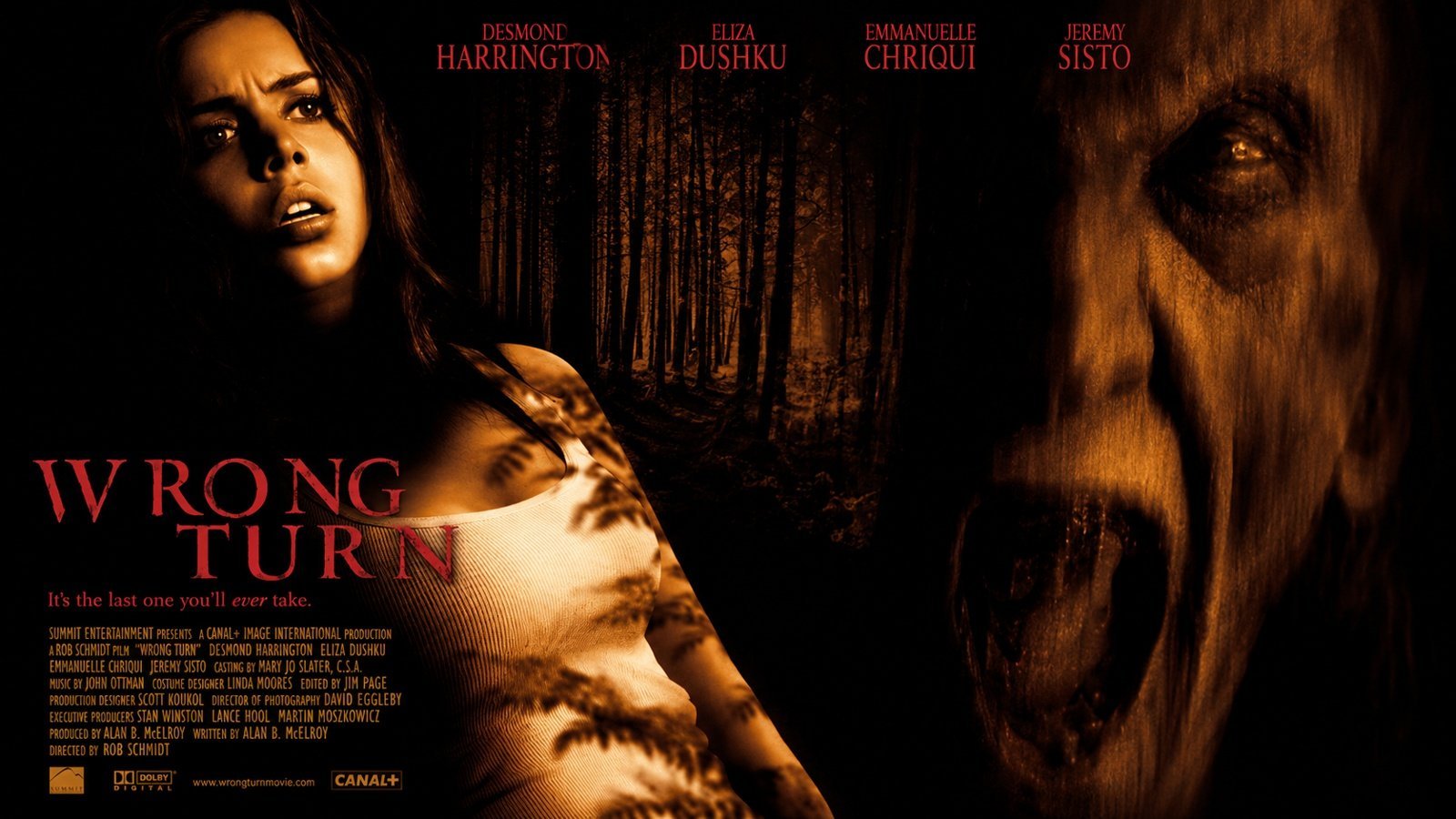
Wrong Turn (2003)
Cast: Desmond Harrington, Eliza Dushku, Jeremy Sisto, Emmanuelle Chriqui
Director: Rob Schmidt
Synopsis: Texas Chainsaw meets Hills Have Eyes in this fun if derivative shocker
Reviewed by: Omar Khan
Wrong Turn arrived during the early summer of 2003 almost out of nowhere and pleasantly surprised a number of horror fans who had grown weary of CGI extravaganzas and endless supernatural tales of the dead returning to life. What many of us were craving was some good old-fashioned, no-nonsense blood and guts in the grand tradition of The Texas Chain Saw Massacre.
Well worth checking out on DVD
Although the film was largely ignored by mainstream audiences, horror fans were already giving it a fairly enthusiastic thumbs-up. Having missed its blink-and-you'll-miss-it theatrical run, I found myself practically drooling in anticipation of the DVD release.
Did it live up to all that anticipation?
The answer is both yes and no.
Wrong Turn succeeds as an entertaining blend of The Texas Chain Saw Massacre and The Hills Have Eyes, yet it also becomes a victim of one of its greatest strengths—Stan Winston's wonderfully grotesque mutant hillbillies. Winston, of course, will always be fondly remembered by horror fans for directing Pumpkinhead.
The plot is refreshingly simple.
A group of attractive young people become lost deep in the forests of rural West Virginia and soon find themselves hunted by a family of grotesquely mutated cannibalistic hillbillies. From that point onwards, survival becomes the only objective.
The film borrows shamelessly from the classics that inspired it, particularly The Texas Chain Saw Massacre and The Hills Have Eyes. When the stranded group stumble across a ramshackle homestead littered with wrecked vehicles and rusting debris while searching for a telephone, the similarities to Hooper's masterpiece are unmistakable. Once inside the ominous house they appear to forget entirely why they came there, instead wandering from room to room until they make an appropriately grisly discovery.
Like Goldilocks trapped inside the house of three very unpleasant bears, our unfortunate protagonists suddenly find themselves prisoners as their murderous hosts return home with freshly butchered human remains in the back of their trucks.
From there the film becomes a familiar game of "Who will survive... and what will be left of them?"
To its credit, Wrong Turn generates genuine tension from its shock opening onwards. The would-be victims are also considerably less irritating than the disposable stereotypes that had become commonplace in horror films of the period.
Equally refreshing is the film's decision to play everything completely straight. There are no irritating wisecracks, no self-conscious irony and thankfully no token stoner or nerd inserted simply to provide comic relief. The violence is brutal, nasty and matter-of-fact rather than an exercise in elaborately choreographed "creative deaths."
The performances are solid throughout.
Where the film loses points is in revealing its monsters too clearly.
Once the audience has seen exactly what the mutants look like, there is little left to imagine. Far more effective are the early glimpses—a fleeting close-up of rotting teeth, a grotesquely misshapen limb, or the unforgettable image of one mutant slowly licking his protruding lips. Those moments are infinitely more unsettling than prolonged, fully lit views of the creatures.
Stan Winston's make-up effects have deservedly received considerable praise, but I cannot help feeling that showing far less would actually have made them far more frightening. Horror has always been at its most effective when it allows the audience's imagination to do some of the work. Given only fragments—a twisted silhouette, diseased skin, or those horrifying teeth—the mind creates monsters far more terrifying than anything shown explicitly on screen.
One can certainly understand why Wrong Turn found such favour among horror enthusiasts. It represents a welcome throwback to the era of lean, uncompromising horror films that relied upon atmosphere, brutality and suspense rather than spectacle.
That said, it never comes remotely close to matching the films that inspired it.
Viewed critically, it is little more than a modern reworking of two gritty 1970s classics. Even allowing for my admiration of The Hills Have Eyes, it simply cannot be mentioned in the same breath as The Texas Chain Saw Massacre. In that sense, Wrong Turn remains a rather pale imitation.
Viewed more generously, however, it works perfectly well as an affectionate homage to one of the greatest horror films ever made.
Coming from someone who virtually worships Hooper's Chainsaw, that is praise indeed.
Despite its obvious derivativeness, a few risible Tarzan-style moments during the tree-swinging climax, and its tendency to reveal too much of its monsters, Wrong Turn nevertheless emerged as one of the most enjoyable American horror films of 2003.
0 Comments
Leave a Comment