
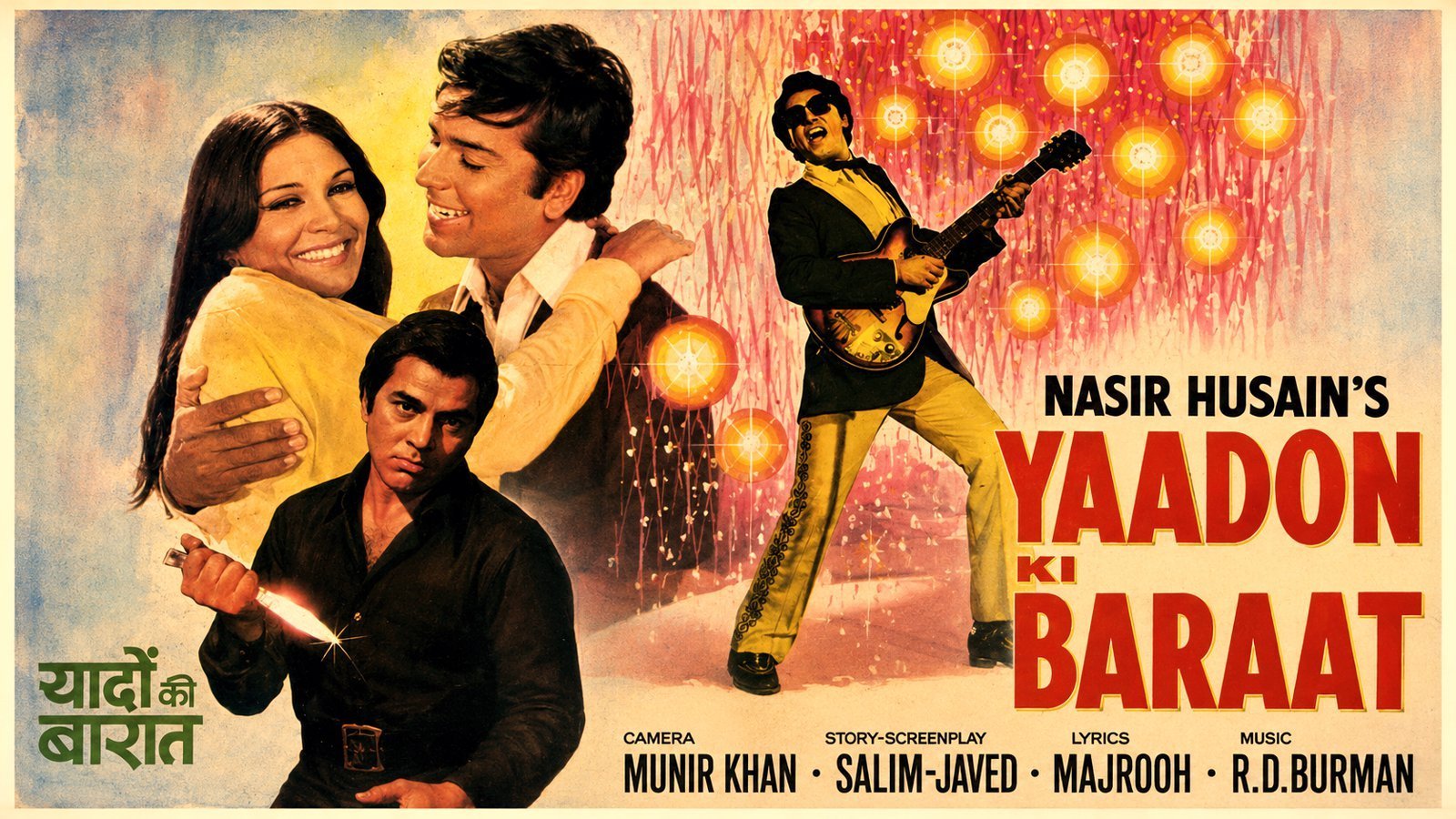
Yaadon ki Baaraat (1973)
Cast: Dharmendra, Zeenat Aman, Ajit, Vijay Arora, Tariq, Satyen Kappu
Director: Nasir Husain
Music Director: R.D. Burman
Synopsis: Typical Formula melodrama elevated by music and "chemistry"
Reviewed by: Omar Khan
Yaadon Ki Baaraat stormed the box office in 1973, further establishing its leading star, Dharmendra’s credentials as a major actor with enviable staying power. The film came from the reputed Nasir Husain Productions banner, with Husain himself directing and producing an effort that went on to become one of the company’s biggest money-spinners.
Though Yaadon Ki Baaraat offers a plot that is utterly formulaic and as stale as mildewed socks, the various ingredients somehow click together, and the resulting chemistry does far more than merely save the day. It elevates what could easily have been a humdrum, mundane masala film into one that has earned a lasting reputation and exerted a considerable influence.
The rather unimaginative plot concerns a saintly family consisting of three young boys and their parents, all living blissful lives without a care in the world. Fate intervenes cruelly when the boys’ artist father crosses paths with the heinous villain Shakal, played by Ajit. One night, the self-righteous artist sees Shakal fleeing the scene of a murder. When Shakal later spots him approaching the police, he feels compelled to act.
That night, the vicious Shakal brutally murders the artist and his wife, a grisly crime witnessed by the eldest child, Shankar. All three sons scamper for cover from the murderous Shakal, but in the ensuing frenzy, the boys are tragically separated.
Shankar, the eldest son, grows up traumatised by his memories: the brutal murder of his beloved parents and the loss of his younger brothers amid the chaos. He also remembers the song the entire family would sing together every year on 15 December.
The second son, Vijay, is fortunate enough to be adopted by an earnest middle-class man who is neither desperately poor nor remotely wealthy. The youngest boy grows up to become Monto, a fantastically talented and nattily dressed pop star who thrills trendy, swinging audiences at a fabulous local joint called the Blue Heaven Hotel.
After its dramatic opening, the middle section of the film is largely devoted to the frothy, light-hearted romance between the rather charming and dapper, if slightly greasy, Vijay and Zeenat Aman, fresh from the success of Hare Rama Hare Krishna. Never has Zeenie looked better in any film before or since. The romance is reasonably engaging, with the usual pranks, misunderstandings and quarrels eventually leading to true love.
Perhaps the most significant factor in elevating these otherwise ordinary and predictable proceedings into something extraordinary is the sublime music composed by R. D. Burman, who was given ample opportunity to indulge his passion for a more Westernised sound.
The songs he composed for the film became icons of an era. One of them, “Chura Liya Hai Tumne Jo Dil Ko,” remains virtually an anthem decades after its release and must rank among the most popular Bollywood songs of all time. Asha Bhosle has rarely sounded more sensuous, while Zeenat Aman, dressed in shimmering white and rocking gently as she strums her guitar, is utterly alluring. It remains one of the most memorable musical moments in classic 1970s Bollywood cinema.
Another number, “O Meri Soni,” crackles with energy and once again finds Asha in supreme form, singing circles around a fairly impressive Kishore Kumar. As if that were not enough, the film also offers the glorious “Aap Ke Kamre Mein Koi Rehta Hai,” another wonderfully Westernised pop number performed by Asha and company. Even the recurring family theme song is perfectly tuneful and appealing.
Dharmendra scowls and growls in a typically forceful fashion as the vengeance-obsessed Shankar, flaring his nostrils and looking suitably angry and pained in equal measure. Vijay Arora, who never quite made it into the A-list, is likeable as the frivolous and romantic middle brother.
It is, however, the amazing Tariq as Monto the pop star who steals the show with his gorgeous, smouldering looks and the sheer charm and raw animal magnetism he exudes. How Aamir Khan became a superstar while the far more handsome and immeasurably more talented Tariq was largely sidelined merely demonstrates how unjust life can be.
Among the strong supporting cast are Jalal Agha, Imtiaz Khan and Satyen Kappu in a pivotal role. Easily upstaging and outclassing almost everyone around him, however, is seasoned supervillain Ajit as the deadly Shakal.
Oozing suaveness, charm, sliminess and menace in perfect proportions, Ajit once again proves himself to belong to the master class of Bollywood villains. He was second to none, particularly when a role required a silky touch of refinement to camouflage deadly intent.
In his traditional blond wig, impeccable white suit, matching shoes and black felt gloves, while spouting lethal little couplets in English, Ajit is at his brilliant best. The only problem with his role is that there is not nearly enough of it.
R. D. Burman ultimately takes top honours, but Ajit, Zeenat Aman, Dharmendra, Vijay Arora and the magnificent geek-god — no spelling mistake — all play their parts to near perfection. The staleness of the plot proves far less of a liability than it ought to have been, as the film is rescued by its strong cast, the chemistry between the players and Burman’s unforgettable music.
Like many films of its kind and era, it is about fifteen minutes too long. One or two fights and a couple of comedy scenes could easily have been trimmed without damaging the film in the slightest.
On the whole, Yaadon Ki Baaraat may not have won many awards, but it was a tremendously popular favourite in its day, and its songs remain as beloved as ever. It is certainly not a great film by any stretch of the imagination, but it is unquestionably a memorable one and fully deserving of its status as vintage 1970s Bollywood.
0 Comments
Leave a Comment