
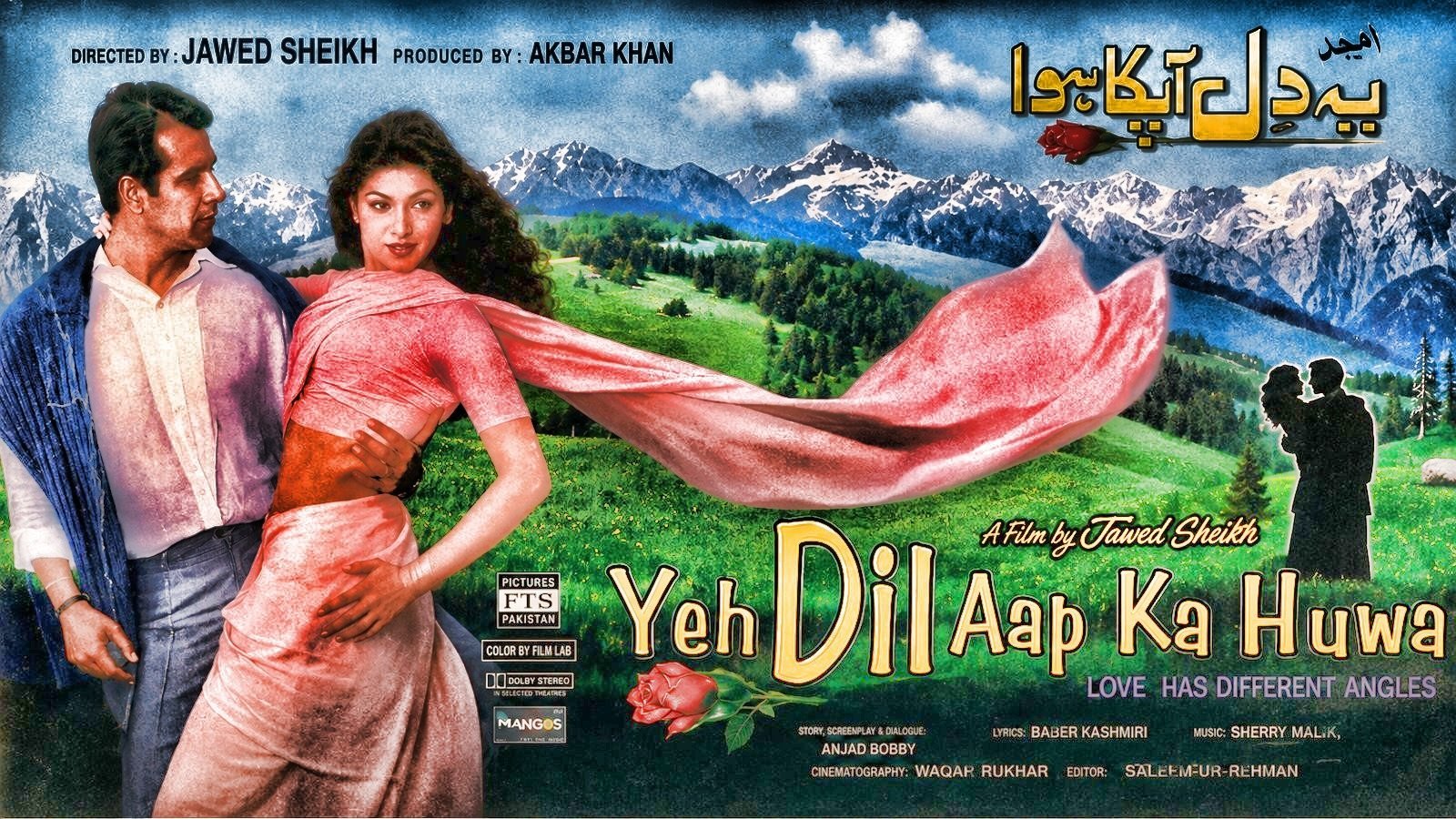
Yeh Dil Aap Ka Hua (2003)
Cast: Moammar Rana, Sana, Salim Shaikh, Javed Shaikh, Babar Ali, Shafqat Cheema
Director: Javed Shaikh
Music: Zain
Synopsis: Lush Swiss and Spanish locales lend gloss to this otherwise drab effort.
Reviewed by: Omar Khan
It speaks volumes for Pakistani cinema’s state of affairs when a film of such monumental mediocrity as Yeh Dil Aap ka Hua manages to obliterate all sorts of box office records on its victorious theatrical run. One has to feel for the poor audiences who have been fed such fodder of unadulterated garbage for the last couple of decades that they have begun to recognise a film of utter mediocrity as a work of art.
Javed Shaikh’s hugely hyped film arrived in July 2002, bombastically claiming to have simultaneous releases all over Western Europe and North America. The publicity/fake news was pure hogwash as the film was nowhere on any screen in the Western Hemisphere. Its glorious worldwide opening was confined to the dozen rat-infested local cinemas in which it finally made its much-delayed appearance. The film became a runaway success and has staked a claim as one of the biggest successes in local film history.
What is so special about this film that has elevated it from the rubbish heap and made it the movie to emulate in Lollywood? The answer requires a moment or two of reflection. First, the film’s plot is as old as the hills involving two buddies who would die for one another and end up falling in love with the same girl – ho-hum, we’ve seen that all before, countless times.
In this scenario, Falak (Moammar Rana) an ageing rich brat who hangs out with his buddy Chand (Saleem Shaikh) in the latter’s sprawling villa in sunny Marbella, Spain. The two bum around, checking out the local scenery and racing each other in their Ferraris. Two overgrown, rather imbecilic morons – 13-year-olds stuck in the bodies of 30+-year-old men! It seems Chand is a superstar bullfighter….no doubt the first Pakistani to achieve such an honour!
Falak’s elder brother Javed Shaikh is a super-powerful business tycoon. He jets in and out of international airports in his private jet and is picked up by a chauffeur-driven limo as he descends from the aircraft. He zips about the globe buying up banks and businesses at a whim. Unfortunately, he has got himself a somewhat crazed and headstrong adversary in the form of a man called Zar Gul (Babar Ali), who is bent on prizing away one of Mr. Shaikh’s banks at any cost. Zar Gul starts resorting to threats and strong-arm tactics. There is tremendous animosity between the two business adversaries even though Shaikh never resorts to the underhand tactics that Zar Gul thrives on.
While on his trip to Switzerland, Falak is in fits when he sees Sana walking down the street. Enraptured, he attempts to follow her but loses her and then an obsessive search for the woman of his dreams begins. He finds her, and a hesitant romance is set in motion. Once again, Falak loses Sitara (Sana) and finds that she has returned to Pakistan, where she lives. He jumps on the next plane to see her and reunites with his loved one after a series of painfully unfunny incidents. Alas, significant complications arise when it turns out that Sitara is the super-slimy Zar Gul’s sister. He chucks out both Falak and elder brother Javed Shaikh when they attempt to pursue Sitara for Falak. Then there is a second twist when Zar Gul quickly arranges his sisters’ marriage to Falak’s best buddy Chand – shock, horror! It
Yeh Dil Aap Ka Hua remains to be seen if Falak, Chand and Sitara will find their respective positions in the galaxy.
In the climax scenes, there are some rip-roaring dialogues about how the Moon and the stars must always go together, and the stars must never be detached from their glitter, and so on. Such dramatic and over-the-top dialogues are in keeping with the film’s highly cheesy, typically convoluted and banal plot. So, what’s the big deal that made this film such a huge success?
Firstly, the film is several cuts above what the poor public expects from local productions. Lately, Lollywood productions have fallen to such a shoddy level that the public is ready to lap up anything that looks well-presented, even if the contents within are the same old stale and formulaic hotchpotch.
This film looks good, which is probably its most significant selling point. It seems like a reasonably polished, expensive product, and part of the reason is that the film is set in plush Marbella with a few scenes in pristine Geneva. The film’s “look” is crisp and fresh, which is rare with Lollywood films, where they have mastered the art of somehow shooting and processing films so horribly that even new movies look 45 years old.
Javed Shaikh’s film has a glossiness that local films lack, and the songs are well presented in a typically ‘80s Madhuri Dixit Bollywood style. As it happens, the film’s songs stormed the local satellite TV airwaves. Because there was a ban on Indian songs on TV, these songs gained maximum exposure and captured middle- class audiences, which were essential to the film’s theatrical success.
Typically, uneducated labourers see Lollywood films in cinemas, and the movie usually caters to their perceived demands. Yeh Dil Aap Ka Hua, with its soft pastel colours and whimsical fairytale storyline, managed to bring in an audience who have given up on local films but are still willing to give something “special” a chance.
The tuneful songs supposedly composed by Nadeem Shravan have their trademark sound. Kumar Sanu or Zain, whoever is trying like mad to ape Kishore Kumar’s voice and style, is very difficult to listen to with that shaky voice making one cringe with every extended wave. But, despite the vile male vocalist, it has to be said that the songs are tuneful and well-composed and are undoubtedly a huge factor when one tries to analyse the success of this otherwise tawdry film.
The acting on display is patchy at best, with Moammar Rana proving that he has the worst voice on this side of Sachin Tendulkar and the most embarrassing histrionics. At the same time, Babar Ali hisses his dialogues with chilling pauses, stylised so that his performance ends up being vintage cheese. Sana tries hard to leave her Punjabi Patakha image behind but doesn’t convince, and her acting, even in her minimal role, is ropey at best.
Only Saleem Shaikh, despite his ridiculous Bullfighting scene, comes off ok, while everyone else overplays to the hilt. Veena Malik’s dance is ludicrous, and despite Javed Shaikh’s attempts at producing a classy product, he couldn’t help having a few bum shots to broaden his film’s appeal. If this is the best of modern Pakistani cinema – these are lamentable times. Watch this film sweep every single award at the various award ceremonies. The mind boggles!
0 Comments
Leave a Comment