
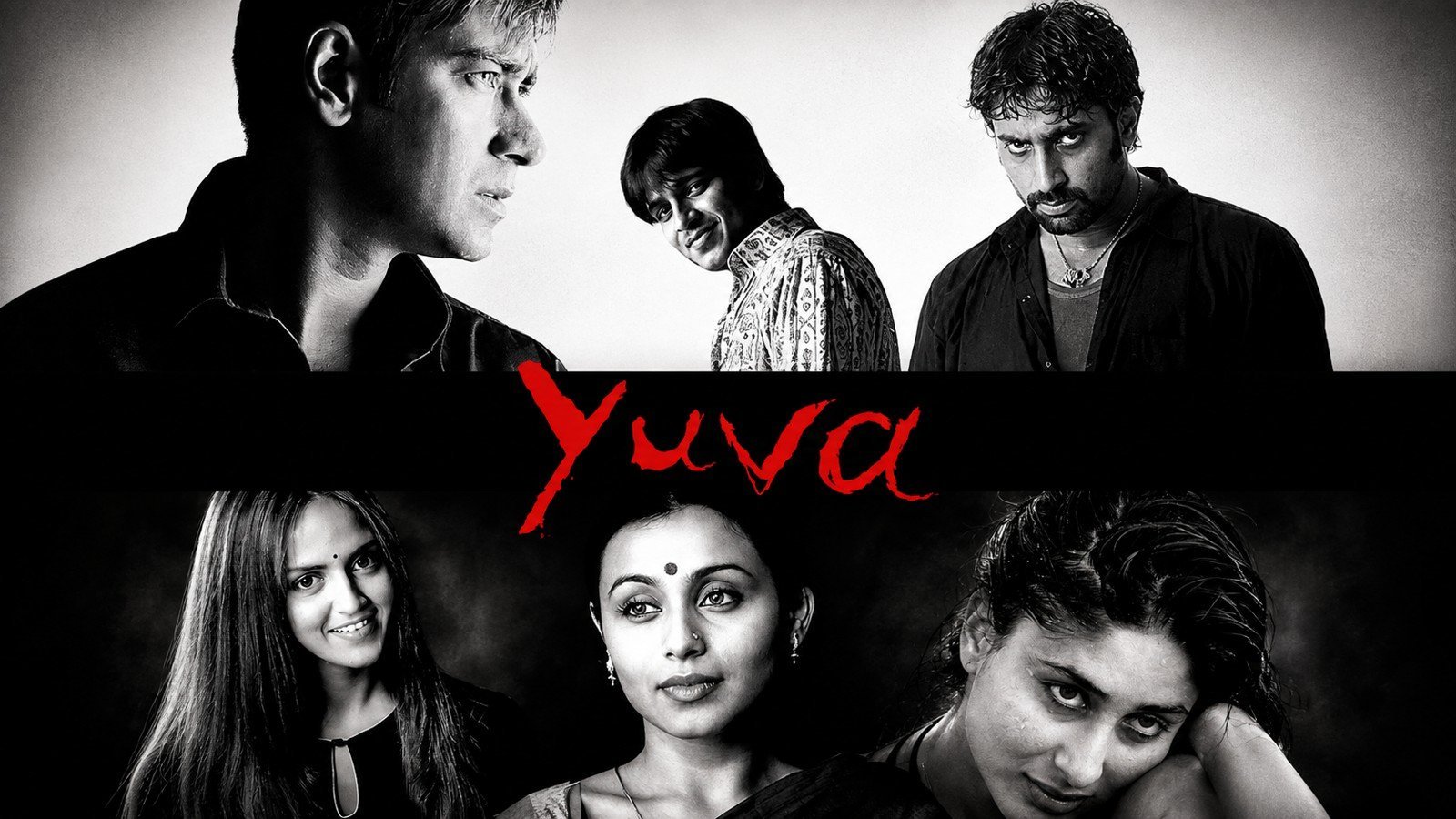
Yuva (2004)
Cast: Ajay Devgun, Rani Mukherjee, Abhishek, Vivek Oberoi, Kareena, Esha Deol
Director: Mani Ratnam
Music Director: A.R. Rahman
Synopsis: an ambitious film with a trendy non-linear style doesn't quite deliver
Reviewed by: Faiz Khan
A Mani Ratnam film is always an experience to savour, regardless of whether the experience ultimately succeeds or fails. Dil Se had many flaws, yet it also contained moments of extraordinary beauty, both visual and emotional. With Yuva, Ratnam once again reaches for something ambitious, but once again he is let down—perhaps as much by his own storytelling style as by anything else.
Most screenplays follow a familiar structure: beginning, middle and climax.
Ratnam turns that convention on its head. Much like Hitchcock's Vertigo, he begins with what is effectively the pre-climax, bringing together the three protagonists before rewinding to tell each of their individual stories. It's an intriguing opening and immediately draws the viewer in, but unfortunately the film never quite fulfils the promise of that remarkable beginning.
The story opens on Kolkata's Hooghly Bridge, where three seemingly unrelated lives collide.
We then move backwards into flashbacks, beginning with Lallan (Abhishek Bachchan).
Fresh out of prison, Lallan forcibly takes his wife Sashi (Rani Mukerji) back home despite the wishes of her family. A violent, impulsive thug, he knows little beyond the brutal world he inhabits. Sashi clings to the hope that he will one day redeem himself and, for that reason alone, endures his abuse with heartbreaking resilience.
Lallan soon becomes the trusted henchman of a ruthless politician (Om Puri), sinking ever deeper into Kolkata's criminal underworld. Only after the tragic loss of his unborn child does he begin to realise that another life might have been possible.
It is easily the darkest—and strongest—segment of the film.
In complete contrast stands Arjun (Vivek Oberoi), an idealistic middle-class student whose only ambition is to leave for the United States. Politics means nothing to him until he meets the spirited Mira (Kareena Kapoor). Despite the obvious attraction between them, he lacks the courage to stop her from entering an arranged marriage, choosing instead to pursue his own dreams abroad.
The third strand follows Michael Mukherjee (Ajay Devgn), the son of a committed political activist. Michael has devoted himself to student politics and the fight against corruption, becoming a thorn in the side of the very politician who employs Lallan. Inevitably, fate brings the two men onto a collision course.
The film then returns to the opening sequence, with all three stories finally converging.
Ironically, this is where Yuva begins to lose its grip.
Ratnam devotes so much time to establishing the individual journeys that there is comparatively little time left to unite them in a satisfying climax. Each segment is interesting enough to stand as a film in its own right—particularly Lallan's—but the overarching narrative never develops with the same conviction.
Lallan's story remains by far the most powerful. Ratnam refuses to romanticise him or offer convenient redemption. The bleakness of his existence becomes almost suffocating, precisely because there appears to be no escape.
Arjun's story provides welcome relief from that darkness and is lighter in tone, but by the time we reach Michael's section, the film begins to feel rushed. The political dimension, which many assumed would form the heart of the film, is instead compressed into the final act and never receives the development it deserves.
One ultimately comes away feeling that Yuva is less about student politics than about three very different young men whose lives briefly intersect.
That weakens the film considerably.
Arjun's sudden commitment to political activism feels abrupt and insufficiently earned, while the final confrontation lacks the emotional impact that Ratnam clearly intended.
Ratnam also misjudges the casting of Michael. Ajay Devgn is undoubtedly a gifted actor, but he never convinces as a student leader. Having already portrayed similarly brooding rebels elsewhere, he brings little freshness to the role.
Abhishek Bachchan, on the other hand, finally announces himself with a performance of remarkable control and intensity. This is the film that demonstrates just how far he had come since his uncertain early career.
He is superbly matched by Rani Mukerji, whose restrained, deeply moving performance gives Sashi extraordinary dignity despite her tragic circumstances.
Vivek Oberoi handles the comparatively lighter role of Arjun with confidence and charm. He could easily have played Lallan, but wisely avoids repeating the territory he explored in Company.
Kareena Kapoor is equally impressive, delivering one of her most understated performances. Free from unnecessary mannerisms, she brings warmth and simplicity to Mira.
Esha Deol has relatively little to do and, at this stage of her career, still lacks the ease required to make a lasting impression.
A.R. Rahman's score is interesting but oddly used. The title song feels misplaced, while several musical sequences interrupt rather than enhance the narrative. Only "Khuda Hafiz" leaves a lasting emotional impression through its superb picturisation.
Despite its shortcomings, Yuva remains well worth seeing.
It is an intelligent, ambitious and often fascinating film that dares to experiment with narrative structure, even if that very experimentation ultimately becomes its undoing. It is not easy viewing, nor is it intended to be. This is a dark, uncomfortable film whose flaws are considerable—but whose ambitions deserve genuine admiration.

0 Comments
Leave a Comment