
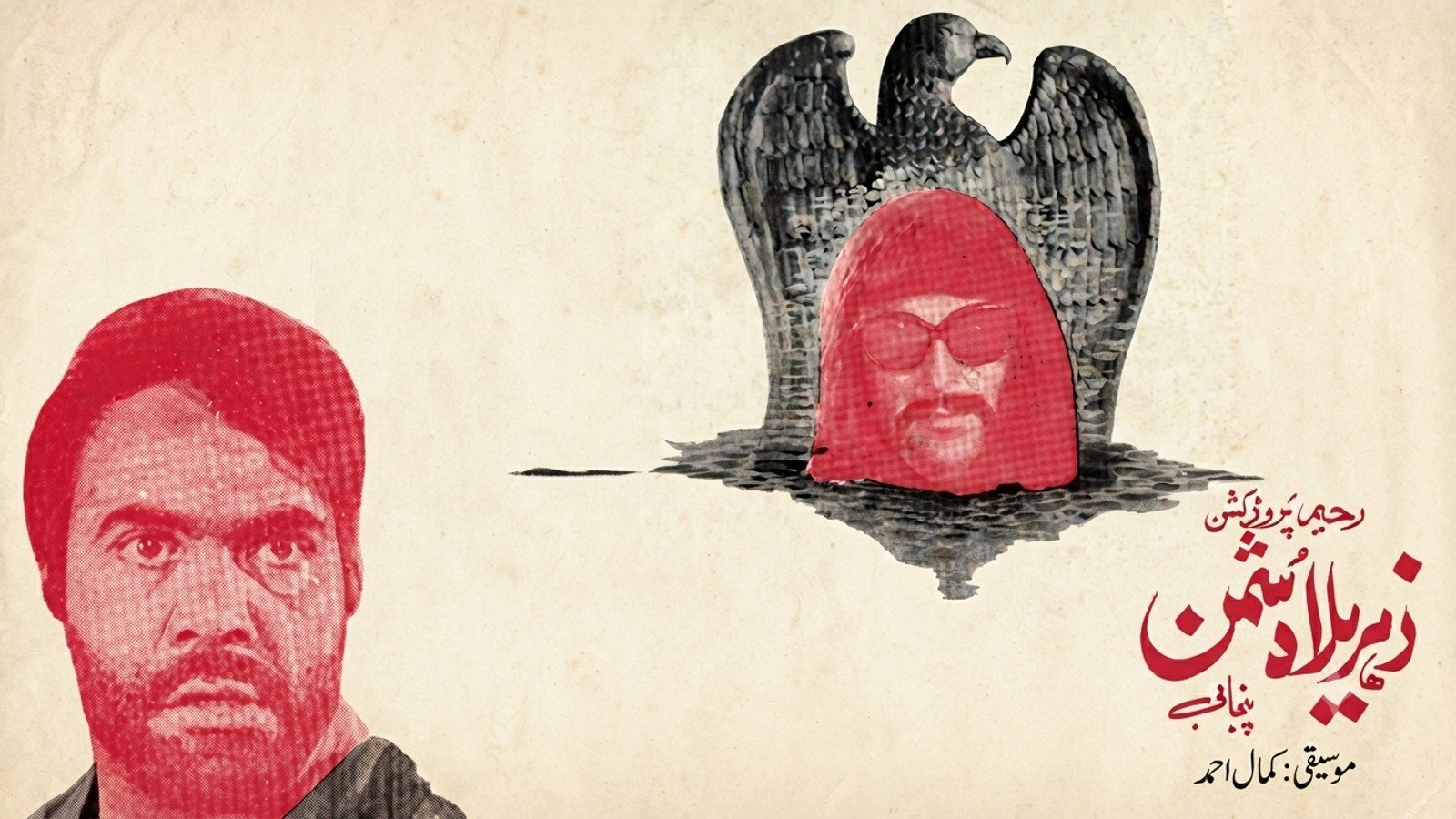
Zahreela Dushman (1993)
Cast: Sultan Rahi, Najma, Aurangzeb, Parveen Boby, Fauzia Durani, Shahnawaz, Kemal Irani, Bahar, Ilyas Kashmiri, Muneer Zareef, Jehangir Mughal.
Director: Ilyas Ahmed
Synopsis: A gritty, action-packed masala thriller with a ton of potential to emerge as a hidden classic.
Reviewed by: Omar Khan
A favourite genre of Pakistani cinema is the black-and-white, gritty, sleazy, urban-based thriller, which invariably features shady villains in wild outfits, running dens of iniquity. These films typically focus on the dubious happenings of the “Club.” It is a sordid hole where women of loose morals ply their trade, wearing fabulous weaves and equally mesmerizing dance moves. The music sizzles and the local Dons are belligerent, bellicose and very dangerful. Ajj Da Badmash, Nawabzada, Khanzada, Khatarnaak, Khaufnaak, Malik Zada, Pindi Wal, Ghairat, and Club Dancer spring to mind as delectable slices of Lollywood from a bygone and brilliant era.
Club Dancers of the highest calibre, Anita, Parveen Boby, Ishrat Chaudhary, Naureen, Nauroz, Nazli, Amrozia, Mizla, captivate audiences at these fabulous clubs, yet sadly the entire genre of the films remain hastily overlooked. The snobbish “educated class” rarely watch such movies; they would feel dirty and uncomfortable.
In the local dialect, these films, often called “Saxy Type”, were considerable money spinners in the early to mid-1970s. During its historic diamond jubilee run, Khatarnaak broke all sorts of Box Office records. But the party days and saucy nights were abruptly cut short with the arrival of a “Morally Upright” code ushered in by the latest military dictatorship. The sinful ways of the past are now replaced with a pristine new order ready to be politely thrust down people’s throats. People ary adaptable, and life went on much the same way, with minimal adjustments.
It was business as usual in many ways. Yet the atmosphere was dour and bitter, reflecting on the cinema of an era bristling with violence and rage. Compromised but inventive filmmakers learned how to give the public the masala they yearned for, especially with the clever invention of the skin coloured bodysuit and a whole lot of lycra. The Zia regime’s vice-like grip on power reflected Sultan Rahi’s hold on Pakistani cinema of the Military era.
While the General and his family enjoyed Bollywood movies on VCR at home, many “Saxy Type” films had their censor’s certificate withdrawn, while others ground to a halt and didn’t make the finish line at all.
Zehreela Dushman released in 1981, breathes the same air as the films mentioned above and contains many ingredients to elevate it to a level of the finest saucy masala epics, yet it fails to fly. The masala and sleaze factor is toned down to make way for a stunt and fight based revenge thriller, but it lacks any oomph element, and the fights,
Zahreela Dushman though initially amusing, do get more than redundant after a short viewing time.
The production values are absurdly low right from the very opening scene and continue to astound with dreadful car chases, embarrassing sets and incredibly shoddy technical skills. The story is equally threadbare, with some typical and stale formulas being thrown into the script to keep it from stalling completely. Yet, nothing works, and the film finds itself running around in circles and getting nowhere.
Noted stuntman and fight master, Jehangir Mughal, is the brains behind this production, and he also plays the role of Saleem turned into Peter then back to Saleem once again. His fighting skills are inspired by the finest b-grade kung fu movies of the early ‘70s but with a local twist, and the sound effects take matters to a surreal level of madness. It’s all quite brilliant for a while, but it gets a little laborious by the umpteenth fight scene, especially when the film has a plot devised by a buffoon.
The excellent background score and title theme music are perhaps the only things that stand out from the pretty turgid experience. Sadly none of the songs or club dances is particularly memorable.
The Background score fizzes and pops along to chase scenes and cranks out a uniquely 1970s Urban-Punjabi-Masala-Funk vibe.
Besides that, Ilyas Kashmiri’s majestic Flower Power Haight Ashbury wig and bad hombre look, are a joy to behold. He cuts quite a swagger, and his eye-popping “get up” sets the tone visually. The background score and sound effects keep the film from drowning a miserable death within minutes, but it’s just a matter of time.
By 1981, films were being watched in cinemas by an entirely all-male audience not economically able to watch films at home or labourers working far from their families. Alas, even the awfulness of this deranged mess of a movie couldn’t redeem it — no surprise that Zahreela Dushman bombed in cinemas, barely lasting a week.
Things could have worked if Mustafa Qureshi had played the main villain’s role and the whole club’s villain vibe thrown in.
Later, when reissued on the strength of Sultan Rahi’s rising star, the film sank faster than the Titanic. The lobby cards and stills promised a fabulous b-grade epic, but what materializes is utterly putrid. Endless, poorly filmed chase scenes and preposterous yet mildly amusing stunt-fight scenarios, along with some bland emotional filler and uninspired dances with tepid direction, the movie falters very severely. There is also a tedious, comic story with a man attempting a pale imitation of Munawar Zaereef but lacking his skills.
By the conclusion, the audience is uninvolved in any of the hastily manufactured threads of the storyline. Sacrifices given, families rediscovered, Peter exorcised from Saleem in a touching redemption scene. Rings and lockets tell a story, as do pictures in those lockets and hanging on the walls. All the coincidences cascade in free fall, yet they still can’t redeem the film. Perhaps director Mughal lacked a sense of courage in his ability to steer the movie clearly in his direction. Or maybe his producers felt he didn’t possess the ability to deliver results at the box office.
Zahreela Dushman Perhaps if he had taken the film over, it might have worked. Sultan Rahi looks young in some scenes but quite flabby in others, suggesting that the film had to be plastered together after butchering from the Zia ul Haq censor board. The film does have some positives, though. The fight scenes are insane, and the background score sizzles even if the songs do not.
The film has a wonderfully over-exposed, scuzzy look and feel, but it would work much better as stripped down to the trashy chase, fight, and action scenes alone. Zehreela Dushman has a tragically cheap look to the experience that almost grows on you. From the very opening scene when each of the henchmen carries empty cardboard boxes to the epic fire scene at the climax. Shockingly and delightfully and shamelessly atrocious but with a charm of its own. But other films have done this type of thing with far superior execution.

0 Comments
Leave a Comment